7 Eccles Street
Leopold Bloom's iconic address in *Ulysses* is no longer standing, yet a peculiar detail about its demolition reveals a deep connection to the novel's enduring legacy.
Full story unlocks in the tour
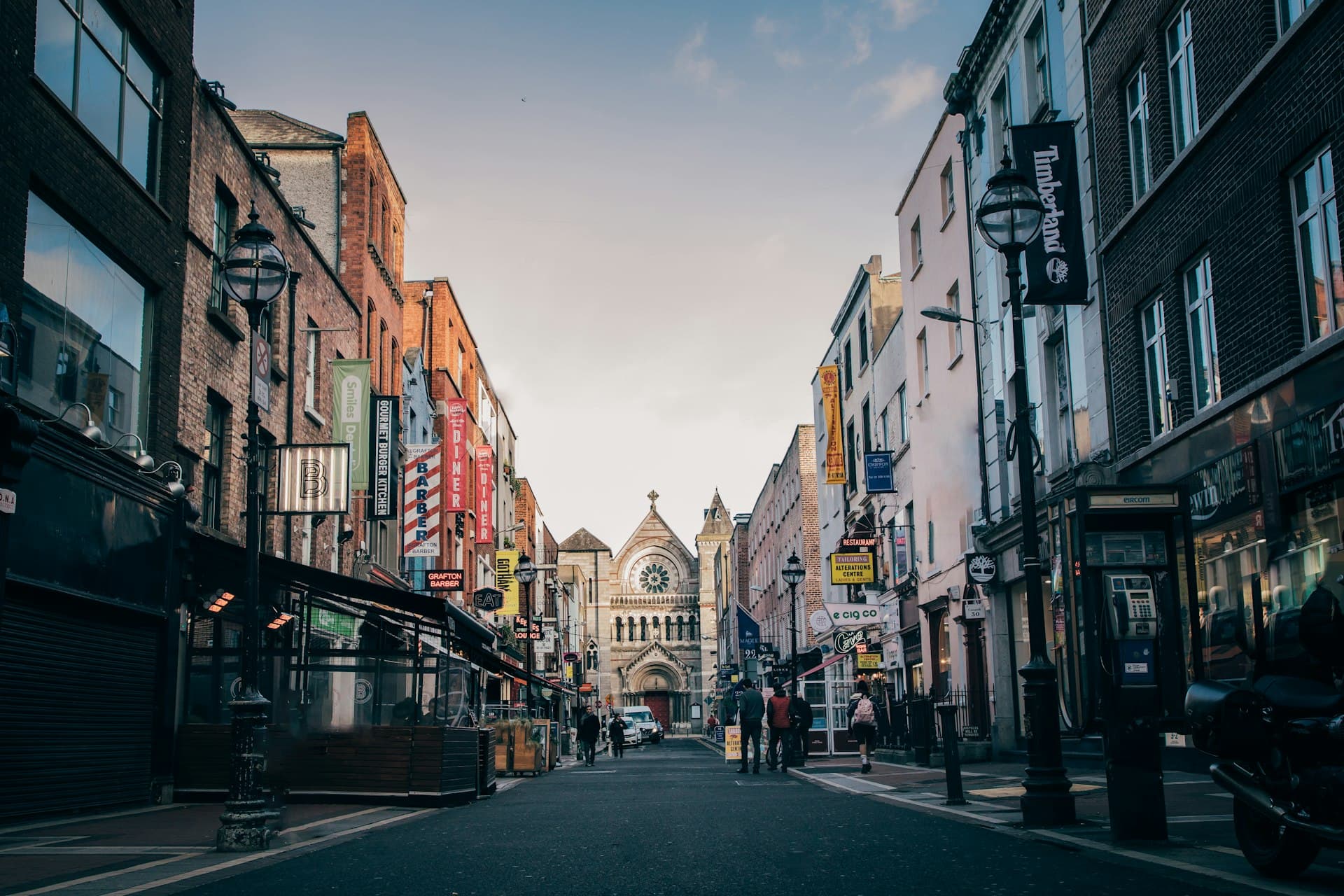 Photo: Gregory DALLEAU / Unsplash
Self-guided audio walking tour of Joyce's Ulysses in Dublin — GPS route, offline playback, story-driven narration in 32 languages.
“Walk the labyrinthine streets of Joyce's Dublin, where every corner holds a whisper of *Ulysses*.”
Not the postcards. The stories even locals don't know — whispered in your ear, right where they happened.
Leopold Bloom's iconic address in *Ulysses* is no longer standing, yet a peculiar detail about its demolition reveals a deep connection to the novel's enduring legacy.
This preserved Victorian pharmacy, immortalized by Bloom's visit, possesses a surprising connection to another literary giant, predating its Joycean fame.
Beyond its celebrated mention in *Ulysses*, this 'moral pub' holds a lesser-known, ironic connection to Joyce himself, one the author likely savored.
Discover every secret of Joyce's Ulysses in Dublin
Every address, every reveal in full — in your ear, right where it happened.
You pick your stops. You walk. The voice reveals what the others miss.
Your self-guided audio tour of Joyce's Ulysses in Dublin is ready — pick your landmarks, choose your language, and start the moment you arrive.
BuyStep into the Dublin of James Joyce, a city meticulously rendered in the pages of his monumental novel, Ulysses. This self-guided audio walk invites you to trace the footsteps of Leopold Bloom and Stephen Dedalus on June 16, 1904, a single day that unfolds across the city's streets, pubs, and public spaces. Joyce, though he spent much of his adult life in exile, carried Dublin in his imagination, recreating its essence with extraordinary detail and precision in his work.
This tour is more than a literary pilgrimage; it's an immersion into the fabric of early 20th-century Dublin, seen through the eyes of one of its most celebrated, yet complex, sons. You'll encounter the real places that inspired the fictional world of Ulysses, connecting the literary landscape with the tangible city that remains. From the bustling thoroughfares to quiet corners, each stop offers a chance to reflect on Joyce's genius and his profound connection to the city he both loved and left.
## James Joyce and His Dublin James Joyce was born in Rathgar, a Dublin suburb, on February 2, 1882, the eldest of ten children. His early life in Dublin, marked by his father's unpredictable finances, saw the family move many times. He attended Jesuit schools, including Clongowes Wood College and Belvedere College, before graduating from University College Dublin in 1902.
Though he departed Dublin in 1904 with Nora Barnacle, the woman who would become his wife and the inspiration for Molly Bloom, and never returned after 1912, Dublin remained the central setting for his literary output. He famously stated that if Dublin were destroyed, it could be rebuilt from the pages of Ulysses. However, this statement is more poetic than literal, as while Joyce was topographically accurate, he didn't provide architectural blueprints.
Ulysses, published in 1922, chronicles one day—June 16, 1904—in the lives of Leopold Bloom, Stephen Dedalus, and Molly Bloom. The novel's intricate narrative weaves through the city's streets, capturing the ordinary conversations, crowded spaces, and daily routines of Dubliners. This meticulous attention to everyday life, rather than grand historical events, is also evident in his earlier collection of short stories, Dubliners. The date of June 16th is now celebrated annually as Bloomsday, a global tribute to Joyce and his masterpiece.
This walking tour guides you through key locations in Joyce's Ulysses and his life.
Begin at the site of 7 Eccles Street, the fictional home of Leopold Bloom, now occupied by the Mater Private Hospital. While the original house was taken down in 1967, a plaque marks the spot, and the original front door is preserved at the James Joyce Centre.
Continue to Sweny's Pharmacy on Lincoln Place, a perfectly preserved Victorian chemist where Bloom purchased lemon soap. It operates today as a volunteer-run secondhand bookshop, often hosting readings of Joyce's work.
Next, visit the frontage of Davy Byrne's pub on Duke Street, where Bloom famously enjoys a gorgonzola sandwich and a glass of burgundy. The pub remains a popular spot, especially on Bloomsday.
Proceed to the National Library of Ireland on Kildare Street, a grand institution where Stephen Dedalus pontificates on Shakespeare's Hamlet in the 'Scylla and Charybdis' episode.
Head to O'Connell Street, Dublin's main thoroughfare, observing landmarks like the O'Connell Bridge, where various characters cross the Liffey.
Discover the James Joyce statue on North Earl Street, affectionately known as 'the Prick with the Stick', a prominent tribute to the author.
Observe the Trinity College railings, a significant institution in Dublin's history, even if Joyce's characters don't directly enter.
Conclude your tour with a visit to the Martello tower viewpoint in Sandycove, the setting for the opening scenes of Ulysses and now home to the James Joyce Tower and Museum.
Dublin is a year-round destination, but for a truly immersive Joycean experience, consider visiting around June 16th, Bloomsday, when the city comes alive with celebrations, readings, and events related to Ulysses. Otherwise, spring and autumn offer pleasant weather for walking, with fewer crowds than the peak summer months. The Martello Tower opens at 10 AM.
This walking tour covers a significant portion of Dublin's city center and extends to Sandycove. Wear comfortable shoes, as you'll be on your feet for several hours. Public transportation, particularly the DART train, is recommended for reaching the Martello Tower in Sandycove, which is about a 20-minute ride from the city center. Many of the stops are easily accessible by foot within the city center. Consider bringing a copy of Ulysses or a guide to the novel to enhance your experience at each location. The James Joyce Centre offers walking tours and houses the salvaged door from 7 Eccles Street, making it a good starting point for further exploration.