Tsiolkovsky State Museum of the History of Cosmonautics
The world's first museum dedicated to space exploration wasn't just a grand vision, but a personal project for the pioneers themselves.
Full story unlocks in the tour
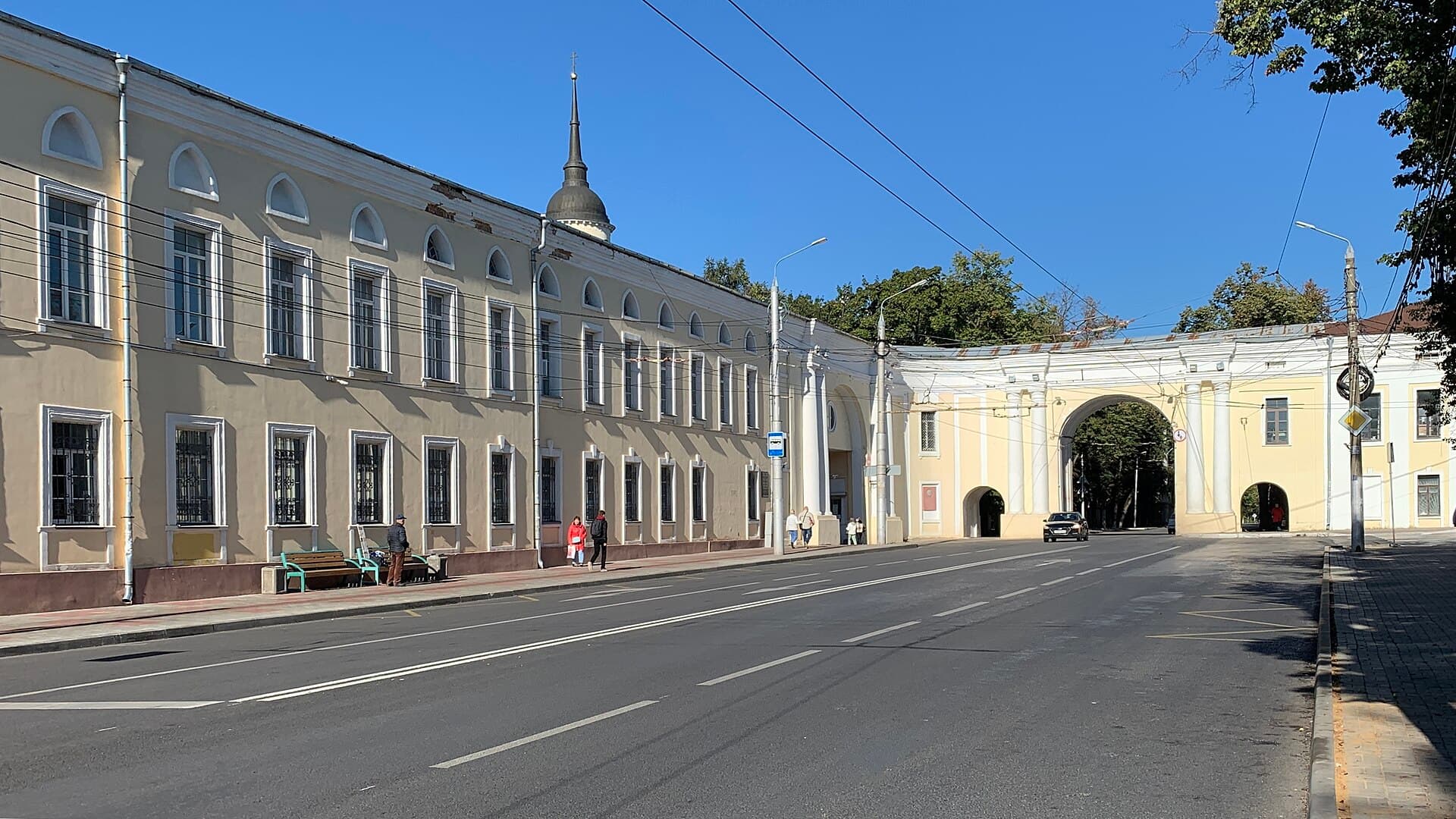 Sergey Sebelev / CC BY-SA 4.0, via Wikimedia Commons
“Where Earthly Dreams Touched the Stars”
Not the postcards. The stories even locals don't know — whispered in your ear, right where they happened.
The world's first museum dedicated to space exploration wasn't just a grand vision, but a personal project for the pioneers themselves.
Even a visionary like Konstantin Tsiolkovsky, the 'father of theoretical cosmonautics,' couldn't predict every earthly challenge.
This impressive 18th-century viaduct holds a secret that makes its construction even more remarkable.
Discover every secret of Kalouga
Every address, every reveal in full — in your ear, right where it happened.
You pick your stops. You walk. The voice reveals what the others miss.
No tours available yet. Check back soon — we're preparing them.
Kaluga, a city along the Oka River southwest of Moscow, is a destination where centuries of Russian experience converge with the pioneering spirit of space exploration. First appearing in historical records in 1371 as a border fortress, Kaluga has evolved from a strategic military outpost to a significant administrative and cultural center. Its broad streets, enduring architecture, and scenic riverside offer a glimpse into Russia's past, while its deep connection to Konstantin Tsiolkovsky, the father of theoretical cosmonautics, propels it into the future.
Often called the "Cradle of Cosmonautics," Kaluga is inextricably linked with Konstantin Tsiolkovsky, who lived and worked here from 1892 until his passing in 1935. His groundbreaking research into rocketry and space travel laid the theoretical foundations for the Soviet space program and continues to inspire generations. Beyond its cosmic claims, Kaluga offers a tranquil atmosphere, a wealth of cultural landmarks, and a provincial character that invites unhurried exploration.
## From Border Fortress to Provincial Capital Kaluga's story begins in the mid-14th century as a crucial border fortress for the Grand Duchy of Moscow. It was first documented in 1371 in a letter from Lithuanian Prince Algirdas, who complained about its capture by Grand Prince Dmitry Donskoy. Its strategic position on the Oka River, near its confluence with the Ugra, made it a vital defensive point against incursions from Lithuania and the Crimean Khanate. The city played a significant role in the Great Stand on the Ugra River in 1480, which effectively ended the Tatar-Mongol yoke over Russia.
Throughout the Middle Ages, Kaluga was a minor settlement, at one point owned by the Princes Vorotynsky. It witnessed turbulent times during the Uprising of Bolotnikov and served as a residence for False Dmitry II in 1610, who was later murdered there. In the 18th century, under Peter the Great's administrative reforms, Kaluga became part of the Moscow Governorate and was elevated to the center of the Kaluga Province in 1719. Empress Catherine the Great's visit in 1775 led to its designation as the center of the newly established Kaluga Viceroyalty in 1776, a move that significantly spurred its development. A general development plan was approved, shaping the city's historical center with its straight streets and stone mansions, many of which remain today.
## The Cradle of Cosmonautics Kaluga's most enduring legacy stems from Konstantin Tsiolkovsky, who moved to the city in 1892 and lived there until his passing in 1935. A school teacher by profession, Tsiolkovsky conducted pioneering research into cosmonautics and rocketry, developing theories that would later inspire the Soviet space program. His work earned Kaluga the moniker "The Cradle of Space Exploration," a motto even featured on the city's coat of arms. The city honors his contributions with the Tsiolkovsky State Museum of the History of Cosmonautics, the world's first museum dedicated to space exploration, which opened in 1967. The museum, along with Tsiolkovsky's preserved house-museum, stands as a testament to his visionary ideas and Kaluga's unique place in the history of space travel.
Begin your exploration at the Tsiolkovsky State Museum of the History of Cosmonautics, a world-renowned institution that showcases the history of space exploration, from Tsiolkovsky's early theories to modern spacecraft models and actual space suits. Adjacent to it is the K.E. Tsiolkovsky House-Museum, offering a personal glimpse into the life and work of the visionary scientist. Outside the museum, explore the Rocket Garden, featuring a replica of the Vostok rocket, similar to the one that carried Yuri Gagarin into space.
Stroll through Kaluga's historic center to admire the Gostiny Dvor, an impressive architectural complex from the late 18th to early 19th centuries. Take time to see the Stone Bridge, a magnificent 18th-century viaduct spanning the Berezuysky Ravine. The Holy Trinity Cathedral, with its striking 17-meter dome, is another architectural highlight. For art enthusiasts, the Kaluga Regional Art Museum houses a collection of Russian and European art. The Kaluga Regional Museum of Local Lore, housed in the historic Korobov Chambers, provides insights into the region's history. For a distinctive experience, consider a trip to the nearby Nikola-Lenivets Art Park, one of Europe's largest open-air art museums.
Kaluga experiences a temperate continental climate with distinct seasons. The most pleasant time to visit is during the late spring (May-June) and summer (June-August), when temperatures are comfortable, ranging from 20°C to 25°C (68°F to 77°F). These months offer long daylight hours, ideal for exploring outdoor attractions and enjoying the city's green spaces. While summer can have moderate rainfall, it generally provides a good balance of sunny and rainy days. Autumn (September-October) brings a gradual decrease in temperature, with pleasant days early in the season.
Kaluga is approximately 150 kilometers (93 miles) southwest of Moscow, making it an accessible destination with regular train and bus services. The local currency is the Russian Ruble (RUB). ATMs are widely available, but it's advisable to carry some cash for smaller establishments or outdoor markets. Russian is the official language, so learning a few basic phrases can be helpful.
Most museums in Kaluga are closed on Mondays, so plan your itinerary accordingly. Allow at least 2-3 hours for the Museum of Cosmonautics due to its extensive exhibits. For winter visits (November to March), pack heavy coats, thermal layers, and waterproof boots. Summers are warm but can be rainy, so a light jacket and compact umbrella are recommended. Comfortable shoes are essential for walking and exploring the city's pedestrian-friendly areas.