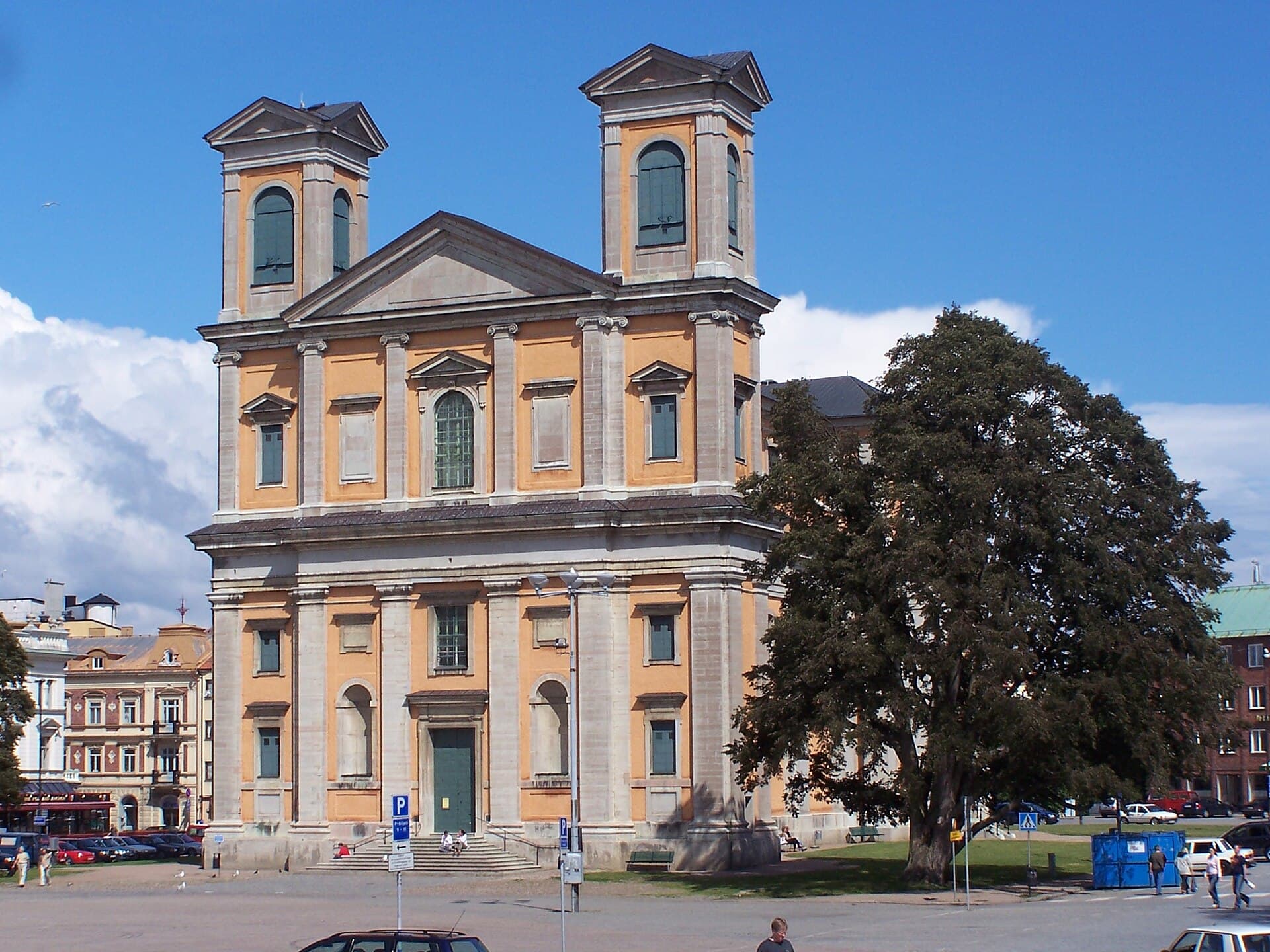
Karlskrona, SwedenSendelbach (talk) / CC BY-SA 3.0, via Wikimedia Commons
SE

Karlskrona

Where baroque grandeur meets island serenity, a city forged by the sea.

The secrets of Karlskrona

Karlskrona, as no one tells it.

Not the postcards. The stories even locals don't know — whispered in your ear, right where they happened.

3 secrets below. Many more wait inside the tour.
Stortorget (The Great Square)

Karlskrona's main square is one of the largest in Scandinavia, designed to impress as a potential capital. Yet a detail reveals a lingering vulnerability to the elements.

Full story unlocks in the tour
Admiralty Church (Amiralitetskyrkan)

Before Sweden's largest wooden church stands a weathered wooden figure with a hat that can be lifted. This is not merely a curious statue; it is a poignant reminder of a harsh winter's account.

Full story unlocks in the tour
Karlskrona Naval Base

While Karlskrona was strategically chosen for its well-protected location, its history includes an unexpected visitor that made international headlines during the Cold War.

Full story unlocks in the tour
The full tour

Discover every secret of Karlskrona

Every address, every reveal in full — in your ear, right where it happened.

Get the key to Karlskrona

You pick your stops. You walk. The voice reveals what the others miss.

Choose your time

How long do you have in Karlskrona?

No tours available yet. Check back soon — we're preparing them.

About Karlskrona

The story of Karlskrona

Karlskrona, a city spread across 33 islands in Sweden's southeastern archipelago, stands as a living testament to a grand 17th-century vision. King Karl XI founded it in 1680 as Sweden's new naval stronghold, its name, 'Karl's Crown,' reflecting its intended royal significance. Today, this meticulously planned baroque city, with its wide squares, historic fortifications, and impressive churches, is recognized as a UNESCO World Heritage Site.

The city's singular position, where urban life gracefully merges with the tranquility of the archipelago, offers a distinctive experience. The sea is an ever-present force, shaping its culture, its past, and its daily rhythm. From exploring naval history to island hopping or simply enjoying the serene coastal atmosphere, Karlskrona invites a slower pace of discovery.

Karlskrona remains an active naval base, home to the Swedish Navy's largest operations and the headquarters of the Swedish Coast Guard. This ongoing military presence ensures the preservation of many historic structures and offers a rare glimpse into a working World Heritage Site.

History

A King's Vision and a Naval Powerhouse

The story of Karlskrona commences in the late 17th century, a period when Sweden held a dominant position in Europe. King Karl XI, seeking a more strategic and ice-free naval base than Stockholm, decreed the construction of a new city and naval port in the Blekinge archipelago. The chosen site, primarily the island of Trossö, offered exceptional natural defenses with its surrounding arcs of islands.

Founded on August 10, 1680, Karlskrona was meticulously planned to embody Sweden's grandeur and serve as a formidable fortress. Erik Dahlbergh, Hans Wachtmeister, and Carl Magnus Stuart laid out the initial city plan in 1683, envisioning a pure fortress. A later plan by Erik Dahlberg in 1694 incorporated urban development, resulting in the baroque city plan still evident today, characterized by broad avenues and monumental buildings. The city grew swiftly, and by 1750, with approximately 10,000 inhabitants, Karlskrona had become one of Sweden's largest cities, even intended to become the nation's new capital.

Enduring Heritage and Modern Challenges

The naval dockyard, established almost concurrently with the city, quickly became Sweden's largest industrial employer by 1711, with 1,100 workers. It was a center of technical innovation, and structures like the Polhem dock, carved directly into the rock, are still in use today. The city's importance as a naval base drew European merchants, contributing to its early international character. Karlskrona's design even served as a model for similar naval installations across Europe.

Despite its initial rapid growth, the early 18th century brought stagnation due to wars and devastating plagues, which claimed thousands of lives. However, Karlskrona consistently maintained its role as a vital naval base. In 1998, the Naval City of Karlskrona was designated a UNESCO World Heritage Site, recognized for its exceptionally well-preserved baroque town plan, remarkable dockyard, and fortification systems. Today, Karlskrona continues to evolve, balancing its profound historical identity with modern development, particularly in marine technology.

What to see

Begin your exploration at Stortorget, Karlskrona's grand main square, one of the largest in Scandinavia. Here, you'll find the impressive Fredrikskyrkan (Fredrik Church) from 1744 and the circular Trefaldighetskyrka (Holy Trinity Church), also known as "the German church," completed in 1750. Both are notable examples of baroque architecture by Nicodemus Tessin the Younger. Nearby, the Rådhus (Town Hall), dating from 1795, stands as a neoclassical counterpoint.

Cross to the island of Stumholmen to visit the Naval Museum (Marinmuseum), a national museum dedicated to 500 years of Swedish naval history. Highlights include a collection of figureheads, ship models, and the opportunity to board a real submarine. Stumholmen itself was formerly restricted naval territory, now open to the public.

For a different perspective, wander through Björkholmen, Karlskrona's oldest district. This area, settled by shipbuilders, features narrow lanes and colorful 18th-century wooden houses, many of which remain. The streets here are often named after types of boats and admirals.

Do not miss the Admiralty Church (Amiralitetskyrkan), Sweden's largest wooden church, identifiable by its bright red exterior. In front of it stands the beloved wooden figure of Matts Rosenbom, a local icon with a poignant story.

Consider a ferry trip to Aspö Island to explore Drottningskär Citadel, a well-preserved 17th-century fortification. For a charming glimpse into local life, visit Brändaholm, an idyllic colonial cottage area often called Sweden's postcard-perfect garden village.

When to visit

The best time to visit Karlskrona for warm-weather activities and to fully experience the archipelago is from late June to late August. During these months, temperatures are comfortable, ranging between 17°C (63°F) and 21°C (69°F), and city life is lively with festivals and island tours. Spring and autumn offer milder, quieter conditions, ideal for sightseeing and photography. While winter is cold, it provides a peaceful atmosphere for exploring museums and indoor attractions.

Practical

Karlskrona is easily accessible by train from major Swedish cities like Malmö, Gothenburg, and Stockholm, and also from Copenhagen, Denmark. The nearest airport is Ronneby Airport (RNB), about a 35-minute drive away, with connecting flights from Stockholm. Ferries also connect Karlskrona with Gdynia, Poland.

The city center, located on the main island of Trossö, is compact and best explored on foot. A public bus network connects the city center with other neighborhoods and islands, and ferries are essential for exploring the wider archipelago. Cycling is also a popular way to get around, with bike paths available.

For visitor information, the Karlskrona Tourist Center, located in Amiralitetsparken, provides assistance with guided tours, sights, events, and maps.

Good to know
Why is Karlskrona a UNESCO World Heritage Site?
Karlskrona was designated a UNESCO World Heritage Site in 1998 due to its exceptionally well-preserved baroque city plan, its singular maritime history, and its remarkable naval dockyard and fortifications from the 17th century.
What is Karlskrona known for?
Karlskrona is known as Sweden's only baroque city, its largest naval base, and a UNESCO World Heritage Site. It is also recognized for its unique archipelago setting and its historical city planning.
How many islands is Karlskrona built on?
The city of Karlskrona is spread across 33 islands in the eastern part of the Blekinge archipelago.
Is Karlskrona an expensive city to visit?
While Sweden can be expensive, Karlskrona offers some budget-friendly experiences, such as the free-to-enter Blekinge Museum and the Naval Museum.
What is the local food specialty in Karlskrona?
Karlskrona's food scene is diverse, with local seafood being a highlight. For a classic Swedish experience, enjoy 'fika,' the traditional coffee break with pastries.
Can I visit the active naval base?
While Karlskrona remains an active naval base, key attractions like the Naval Museum on Stumholmen, formerly naval territory, are open to the public. Some fortifications like Drottningskär Citadel are also accessible.
Karlskrona
From€9.00
No booking · activate anytime · 12h to walk it
Get the key to Karlskrona