Kathmandu Durbar Square
The name 'Kathmandu' itself comes from a single, legendary wooden structure.
Full story unlocks in the tour
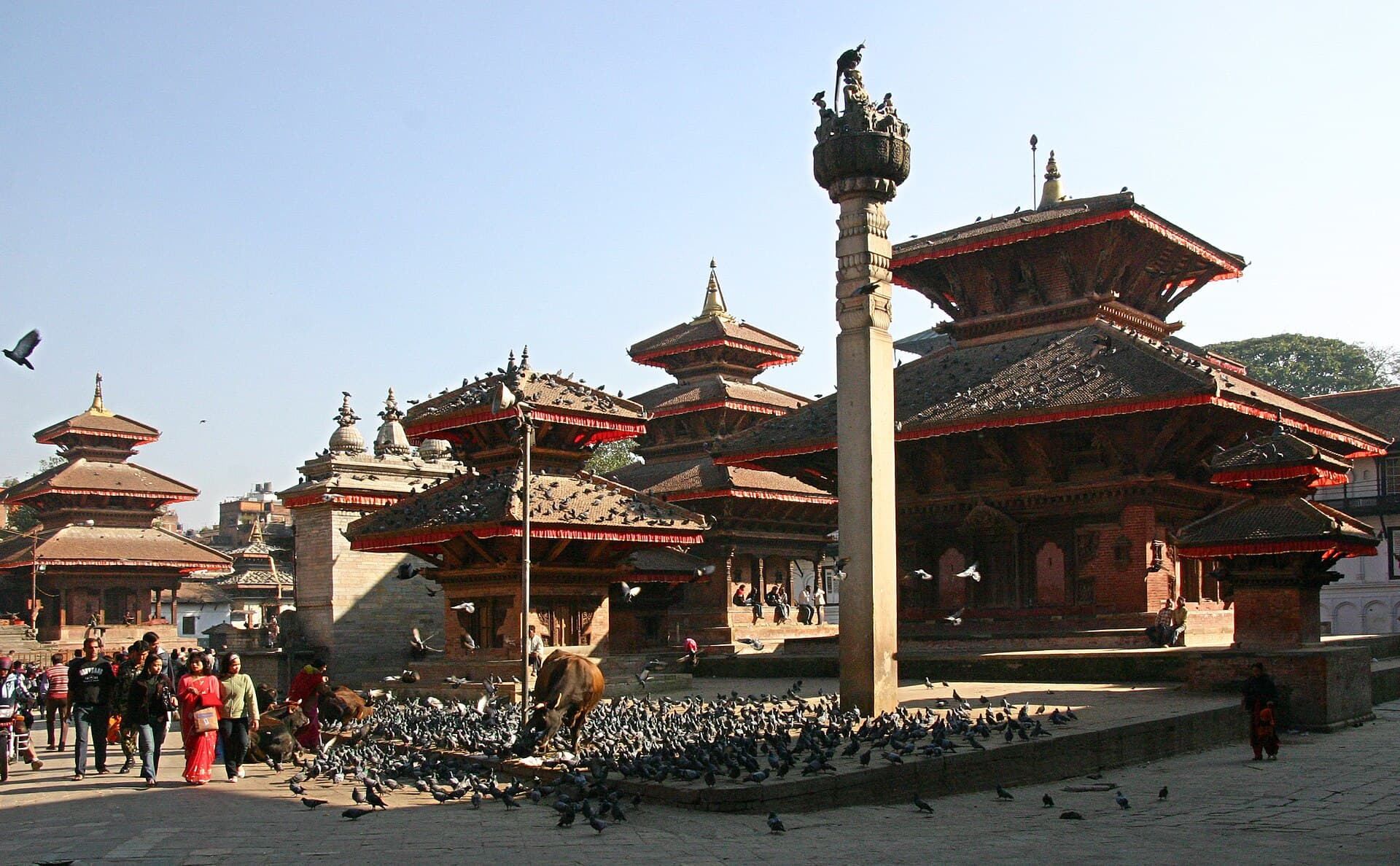 Gerd Eichmann / CC BY-SA 4.0, via Wikimedia Commons
“Where ancient traditions breathe between prayer flags and city streets.”
Not the postcards. The stories even locals don't know — whispered in your ear, right where they happened.
The name 'Kathmandu' itself comes from a single, legendary wooden structure.
The resident monkeys are not just a charming feature; their origin story is quite unusual.
This sacred site holds a profound belief about the cycle of life and death.
Discover every secret of Katmandou
Every address, every reveal in full — in your ear, right where it happened.
You pick your stops. You walk. The voice reveals what the others miss.
No tours available yet. Check back soon — we're preparing them.
Kathmandu, the capital and largest city of Nepal, presents a living narrative where time-honored customs weave into the rhythm of contemporary existence. It rests in the central part of the country, within the Kathmandu Valley, at an elevation of 1,324 meters (4,344 ft) above sea level. This city functions as Nepal's primary governmental, financial, industrial, and cultural heart. A bustling center, it is home to a multi-ethnic population, with a significant Hindu majority and a notable Vajrayana Buddhist presence, ensuring that religious and cultural festivals are an intrinsic part of daily life.
Often known as the "City of Temples," Kathmandu holds over 1,000 religious sites, reflecting its deep spiritual legacy. The Kathmandu Valley, recognized as a UNESCO World Heritage site, safeguards this inheritance through its historic structures and sacred grounds. While the city can feel a whirlwind with its narrow passageways, energetic markets, and constant sounds, its welcoming spirit and deep-rooted past offer a singular and captivating encounter.
The story of Kathmandu stretches back to the 2nd century AD, establishing it as one of the world's oldest continuously inhabited places. According to ancient mythology and geological evidence, the Kathmandu Valley was once a vast expanse of water known as Nagdaha, where serpents made their home. Legend recounts that the Buddhist saint Manjushri, arriving from China, drained this lake by carving a gorge in the hills at Chobhar, revealing fertile land. The city's early designation was Manju-Patan, founded by Manjushri, and later, Raja Gunakamadeva established a city called Kantipur in 723 AD.
Kathmandu gained prominence under the Licchavi dynasty (4th to 8th centuries CE), becoming an important city along the trade routes connecting India and Tibet. This period fostered significant cultural exchange, and the indigenous Newar people became celebrated for their artistry and architectural skill. The Malla dynasty, governing from the 12th to the mid-18th century, ushered in a golden era of artistic and cultural advancement, frequently termed the "Renaissance" period of Nepal's classical culture. During this time, Kathmandu Durbar Square, the royal palace complex, underwent extensive development, showcasing intricate Newari architecture, palaces, temples, and courtyards.
In 1768, the Gorkha Kingdom, under the leadership of Prithvi Narayan Shah, conquered the Kathmandu Valley, bringing an end to the Malla confederation and designating Kathmandu as the capital of the unified Kingdom of Nepal. The Shah dynasty continued to reside in Hanuman Dhoka Palace within Durbar Square until 1886. The Rana regime, from the mid-19th to mid-20th century, introduced Western European architectural styles, visible in structures like Singha Durbar and the Garden of Dreams. Today, Kathmandu remains the core of Nepal's history, art, culture, and economy.
Kathmandu offers a profusion of historical and spiritual sites. Begin your exploration at Kathmandu Durbar Square, a UNESCO World Heritage Site and the city's historic core. It features ancient temples, courtyards, and palaces that once served as the royal residence. Be sure to visit the Kumari Ghar, where Kathmandu's Living Goddess resides.
Ascend to Swayambhunath Stupa, also known as the "Monkey Temple," for sweeping views of the Kathmandu Valley. This ancient Buddhist stupa, dating back to the 5th century, is a significant pilgrimage destination. Another essential Buddhist location is Boudhanath Stupa, one of the largest stupas in the world and a central point for Tibetan Buddhism, where pilgrims walk around the immense dome.
For a profound Hindu encounter, visit Pashupatinath Temple, the most sacred Hindu temple in Nepal, dedicated to Lord Shiva. Situated on the banks of the Bagmati River, it forms a complex of temples, shrines, and cremation sites. While the main temple is generally open only to Hindus, the surrounding complex offers a singular understanding of religious practices. Beyond these major sites, explore the narrow lanes of Thamel for shops and eateries, or wander through the Asan Bazaar for a glimpse into local daily existence.
The most favorable times to visit Kathmandu are during spring (March to May) and autumn (September to November). In these months, the weather is generally mild and agreeable, with temperatures ranging from 10 to 30 degrees Celsius. Clear skies afford excellent views of the Himalayan peaks and are ideal for outdoor pursuits and walks in the surrounding hills. Autumn, in particular, also aligns with significant Hindu festivals like Dashain and Tihar, offering a lively cultural immersion.
Most nationalities can secure a visa upon arrival at Kathmandu's Tribhuvan International Airport. The local currency is the Nepalese Rupee (NPR). While ATMs are accessible, it is wise to carry some cash, as airport ATMs can be unreliable, and some smaller establishments may not accept cards or might apply a surcharge. Kathmandu can experience significant air pollution, so bringing a face mask is advisable. Taxis are readily available and equipped with fare meters, but cycle-rickshaws provide a distinctive way to navigate the narrow lanes. Public buses offer an inexpensive method of local travel, but be prepared for crowded conditions. Bargaining is a common practice in markets and when negotiating tour prices. Consider engaging a local guide to navigate the city and gain deeper cultural understanding.