Before it became a park for visitors, this valley nurtured a different kind of community.
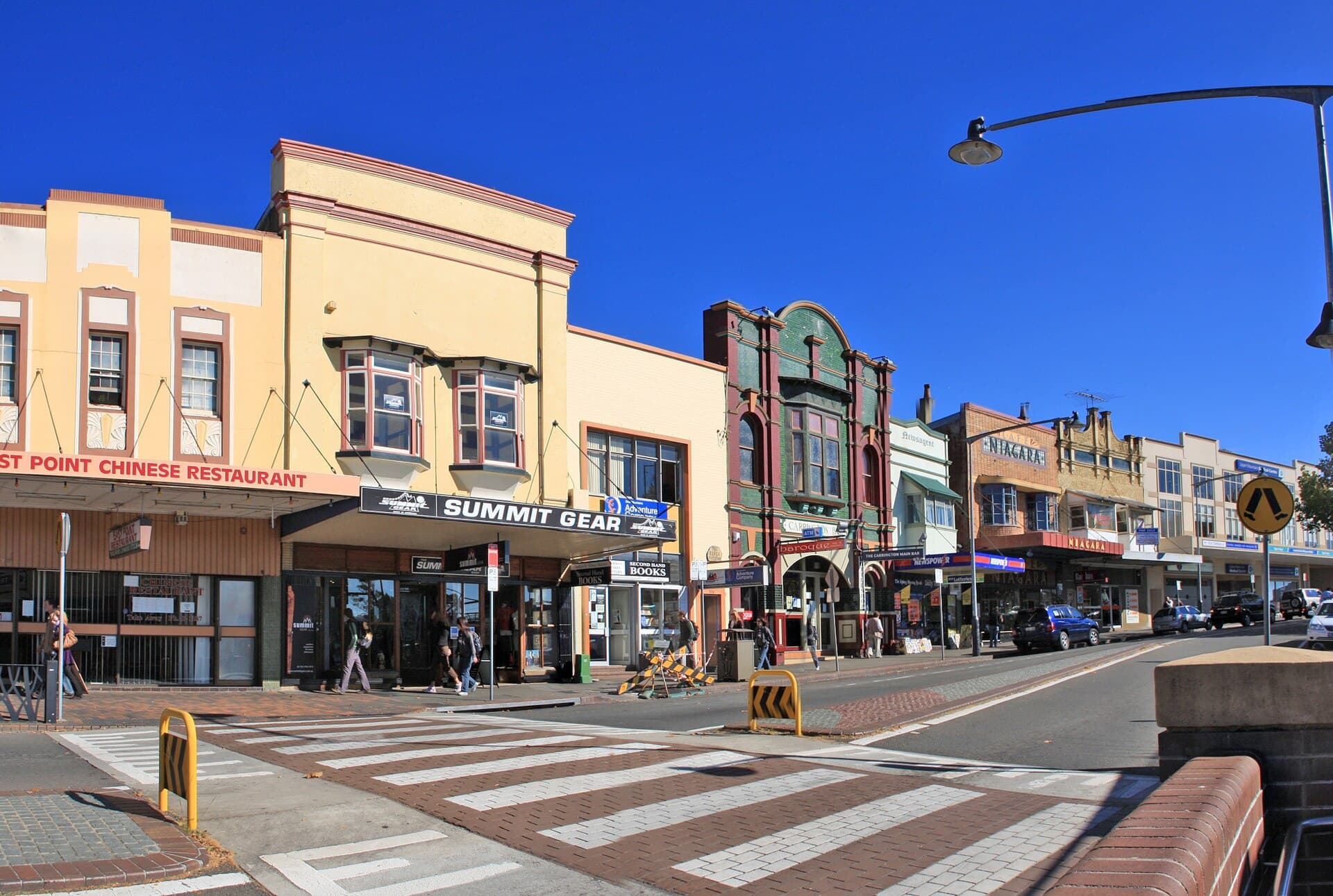
Adam.J.W.C. / CC BY-SA 2.5, via Wikimedia CommonsKatoomba
“Where ancient echoes meet Art Deco elegance.”
Katoomba, as no one tells it.
Not the postcards. The stories even locals don't know — whispered in your ear, right where they happened.
Observe the older buildings closely, and you might uncover a concealed narrative beneath your feet.
The world's steepest passenger railway once served a purpose far removed from scenic excursions.
Discover every secret of Katoomba
Every address, every reveal in full — in your ear, right where it happened.
You pick your stops. You walk. The voice reveals what the others miss.
How long do you have in Katoomba?
No tours available yet. Check back soon — we're preparing them.
The story of Katoomba
Katoomba, the core of the UNESCO World Heritage-listed Blue Mountains, is a town where dramatic natural splendor converges with a rich, layered past. Situated roughly 100 kilometers west of Sydney, at an elevation of 1030 meters, Katoomba offers a cooler climate and a distinct ambiance compared to the bustling city. Its name, derived from the Aboriginal word "Kedumba" or "Katta-toon-bah," translates to "shining falling water" or "water tumbling over a hill," a fitting description for a region defined by its cascades and deep valleys.
This town acts as the primary entrance to the Blue Mountains National Park, drawing millions of visitors each year. From its clifftop perspectives, observers can gaze upon the expansive Jamison Valley and the celebrated Three Sisters rock formation. Beyond the sweeping panoramas, Katoomba itself presents a blend of historic architecture, local galleries, and a thriving cafe culture, inviting exploration both outdoors and along its engaging streets.
From "The Crushers" to a Mountain Retreat
The history of the area now known as Katoomba extends back thousands of years, with the Gundungurra and Darug Aboriginal peoples as its original custodians, utilizing the abundant resources of the Blue Mountains. European settlement began to take shape in the latter half of the 19th century. Initially, the location was referred to as "The Crushers," a practical name derived from a nearby quarry where stone was processed for railway ballast. The railway line, laid through the region in 1867, was a crucial development, connecting the coast with the western plains and enhancing accessibility.
The name Katoomba was officially adopted for the railway station in 1877, and the town achieved municipal status in 1889. The late 19th century saw the rise of coal and oil shale mining in the surrounding valleys. J.B. North, a pivotal figure in the town's economic development, opened the Katoomba Coal Mine in 1878 and constructed infrastructure, including cable inclines, to transport coal. The freight tramway he created to haul coal up the escarpment would later be repurposed, becoming the acclaimed Scenic Railway in 1925, transporting sightseers instead of minerals.
By the 1880s, Katoomba was already evolving into a resort town. The opening of the Great Western Hotel (later renamed The Carrington) in 1882 marked the beginning of its tourism era, attracting affluent Sydney residents seeking solace in the mountain air. This period shaped the town's architectural core, blending its industrial past with Victorian refinement. The interwar period of the 1920s and 1930s experienced a construction surge, imbuing Katoomba with its distinctive Art Deco character, and it was even known as 'the Honeymoon Capital of Australia'. The Greater Blue Mountains Area, with Katoomba at its core, was inscribed on the UNESCO World Heritage List in 2000, acknowledging its unique natural and cultural importance.
Katoomba offers a wide array of attractions, from celebrated natural formations to distinctive cultural experiences. The Three Sisters rock formation at Echo Point Lookout is perhaps the most recognized, providing expansive views of the Jamison Valley. Arriving at sunrise or sunset can offer exceptional photographic opportunities as the light transforms across the sandstone. Adjacent to this, Scenic World presents a unique way to experience the valley with its four attractions: the Scenic Railway, the world's steepest passenger railway; the Scenic Skyway, a cable car with a glass-bottom floor traversing the Jamison Valley; the Scenic Cableway, descending into the rainforest; and the Scenic Walkway, an elevated boardwalk through ancient forest.
Beyond these primary sites, explore the Prince Henry Cliff Walk, a 7-kilometer trail offering cliff-top views and access to various lookouts and waterfalls, including Katoomba Falls. For a more demanding trek, consider sections of the historic Six Foot Track that links Katoomba to Jenolan Caves. In town, the Blue Mountains Cultural Centre displays local art and history, often with expansive views. For a taste of local history and delightful treats, visit The Paragon Café, a heritage-listed Art Deco masterwork. Other notable viewpoints include Cahill's Lookout and Eaglehawk Lookout, offering different perspectives of the surrounding valleys.
Katoomba welcomes visitors throughout the year, with each season presenting a distinct experience. Spring (September to November) brings mild temperatures, blooming wildflowers, and flowing waterfalls, making it ideal for walking and sightseeing. Autumn (March to May) also provides comfortable temperatures and clear skies, perfect for photography and bushwalking, with the added beauty of changing foliage. While summer (December to February) is warm, with daytime temperatures around 20-30°C, it can also bring rain. Winter (June to August) is crisp and serene, with fewer crowds and exceptionally clear air, enhancing views. Temperatures can drop to near freezing, and occasional snowfalls create a unique, inviting atmosphere, especially for fireside dining.
Katoomba is approximately 100-110 km west of Sydney. The most convenient way to reach Katoomba from Sydney without a car is by train via the Blue Mountains Line from Sydney Central Station, with express services taking around 90 minutes. Once in Katoomba, the town center is quite walkable, and local buses or hop-on hop-off tourist services connect to major attractions like Scenic World and Echo Point. If driving, parking is available in town, with timed parking on the street. Parking fees are charged at Echo Point, but Scenic World offers a large car park, and you can walk to Echo Point from there.
Temperatures in Katoomba can be up to 10°C cooler than in Sydney due to its elevation. Dressing in layers is recommended year-round, with warm clothing, scarves, and a coat essential for cool mornings and evenings in autumn and winter. Lightweight, breathable clothing, sunscreen, and a hat are suitable for spring and summer, along with comfortable walking shoes for exploring the many trails. A light waterproof jacket is always a good idea.
- How long should I spend in Katoomba?
- A minimum of two full days is recommended to experience Katoomba's primary attractions, including Scenic World, the Three Sisters, and several walking trails. Extended stays of 3-4 days allow for deeper exploration of the Blue Mountains National Park.
- Are there free activities in Katoomba?
- Yes, many experiences are free. Visiting Echo Point to view the Three Sisters costs nothing, and the Prince Henry Cliff Walk offers 7 kilometers of cliff-top walking without entry fees. Numerous Blue Mountains National Park walking trails are also free to access.
- Is Katoomba accessible for visitors with mobility limitations?
- Many premier attractions offer accessible experiences. Echo Point features wheelchair-accessible viewing platforms and boardwalks, and Scenic World's Walkway provides 2.4 kilometers of elevated boardwalk suitable for wheelchairs and mobility scooters.
- What is the weather like in Katoomba?
- Katoomba has an oceanic climate with mild summers and cool to cold winters. Summer daytime temperatures are usually around 20°C, rarely exceeding 30°C. Winter highs are typically around 10°C, with lows often near 0°C on clear nights. Misty days are common, and the town usually experiences a few snowfalls each year.
- Can I swim in Katoomba?
- While some waterfalls, like Minnehaha Falls, offer pools suitable for swimming, it's important to note that the outdoor pools at Katoomba Sports and Aquatic Centre were undergoing upgrades in late 2021 and were expected to reopen for the 2022/23 summer season.
- What local events or festivals take place in Katoomba?
- Katoomba hosts several notable events, including the Six Foot Track Marathon in March and the Winter Magic Festival in June. Other festivals include Yulefest, the Spring Gardens Festivals, and the Blue Mountains Music Festival.