Konark Sun Temple wheels
The intricately carved wheels of the Konark Sun Temple are more than mere decoration. They hold a secret, revealing the ingenuity of ancient Indian builders.
Full story unlocks in the tour
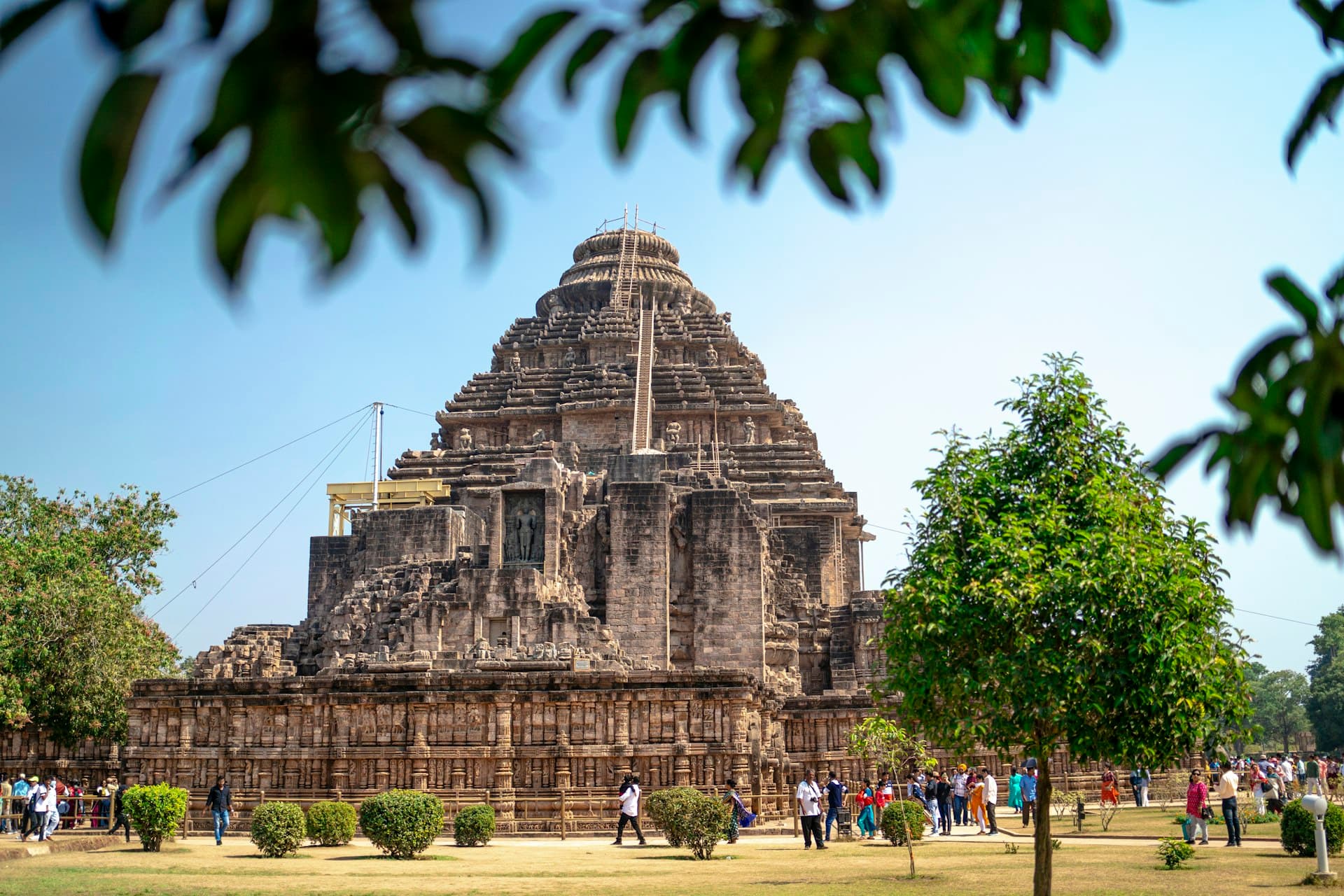 Photo: anik das / Unsplash
Self-guided audio walking tour of Konark — GPS route, offline playback, story-driven narration in 32 languages.
“Where stone tells time, and the sun's journey is etched in rock.”
Not the postcards. The stories even locals don't know — whispered in your ear, right where they happened.
The intricately carved wheels of the Konark Sun Temple are more than mere decoration. They hold a secret, revealing the ingenuity of ancient Indian builders.
The central deity of the Konark Sun Temple, the idol of the Sun God Surya, is conspicuously absent from the temple's sanctum today. Its disappearance remains a profound mystery.
For centuries, European sailors navigating the Bay of Bengal had a distinctive, albeit ominous, name for the Konark Sun Temple.
Discover every secret of Konark
Every address, every reveal in full — in your ear, right where it happened.
You pick your stops. You walk. The voice reveals what the others miss.


Your self-guided audio tour of Konark is ready — pick your landmarks, choose your language, and start the moment you arrive.
BuyLume has a built-in augmented-reality guide. Hold your phone up and its camera shows the street ahead of you, with a glowing arrow laid over the real view that always points to your next stop — no map to puzzle over, no wrong turns. Like everything in Lume, it works fully offline.
Konark, a town on the coastline of Odisha, India, holds the majestic 13th-century Sun Temple, a UNESCO World Heritage Site. Dedicated to the Hindu Sun God, Surya, the temple stands as an extraordinary example of Kalingan architecture, conceived as a colossal chariot for the sun deity. Its grandeur unfolds through 24 elaborately carved stone wheels, each approximately 3.7 meters (12 feet) in diameter, and seven stone horses that appear to pull the chariot across the sky.
The name 'Konark' itself derives from the Sanskrit words 'Kona' (corner or angle) and 'Arka' (sun), signifying the temple's dedication to the Sun God. The temple's design is not merely artistic; it embodies profound symbolism, with the seven horses representing the days of the week and the visible spectrum of light, and the 12 pairs of wheels symbolizing the 12 months of the Hindu calendar or the 24 fortnights in a year. This architectural marvel stands as a testament to ancient Indian engineering and artistic excellence, drawing visitors from across the globe to witness its intricate carvings and historical weight.
The Konark Sun Temple was commissioned around 1250 CE by King Narasimhadeva I of the Eastern Ganga dynasty and took approximately 12 years to complete, with the efforts of 1,200 workers. It is believed that the temple was built to commemorate King Narasimhadeva I's military victory over Muslim forces in Bengal, serving both as a shrine and a victory memorial. The temple was constructed primarily from three types of stone: chlorite, laterite, and khondalite, some of which were imported. Its design as Surya's chariot reflects Hindu Vedic iconography, where the Sun God is depicted traversing the sky in a chariot drawn by seven horses.
The main temple, or deul, once reached an impressive height, possibly exceeding 60 meters (200 feet), but its spire collapsed by the 19th century. The exact cause of this collapse remains a subject of speculation, with theories ranging from ransacking, cyclones, the removal of a central magnet, or structural weaknesses due to its immense weight. Worship at the temple ceased by the 15th century, contributing to its decline. During the 15th to 17th centuries, the temple endured multiple attacks by Muslim armies, causing significant damage. European sailors, who used the temple as a landmark, referred to it as the 'Black Pagoda' due to its dark appearance and the navigational issues its alleged magnetic properties caused for their compasses.
In the 19th century, British authorities initiated conservation efforts to restore and preserve the temple. The entrance hall, or jagamohana, was filled with stone and sand in the early 20th century to prevent its collapse. The Konark Sun Temple was designated a UNESCO World Heritage Site in 1984, recognizing its outstanding universal value.
The Konark Sun Temple complex offers a wealth of architectural and sculptural details to explore. The most striking feature is the temple itself, designed as a colossal chariot with 24 intricately carved wheels and seven stone horses. Each of the large wheels functions as a sundial, allowing visitors to tell the time with remarkable accuracy by observing the shadow cast by the spokes.
Beyond the main chariot, examine the detailed sculptures that adorn the temple walls. These carvings depict a wide array of subjects, including deities, celestial dancers and musicians, scenes from daily life, royal hunts, military events, and various flora and fauna. Look for the famous erotic sculptures, which symbolize fertility, life, and the celebration of love.
The complex also includes the Natya Mandapa (Dancing Hall), supported by beautifully carved pillars showcasing dancers and musicians. Nearby, you can find the ruins of subsidiary shrines, such as the Mayadevi Temple, which dates to the late 11th century and was discovered during early 20th-century excavations. The Archaeological Museum, located near the temple, houses a collection of sculptures and artifacts recovered from the site, offering further insight into the region's art and past.
The best time to visit Konark is during the winter months, from October to March. During this period, the weather is pleasant, with temperatures ranging from 15°C to 30°C (59°F to 86°F), making it ideal for exploring the temple complex and nearby beaches. The humidity is also relatively low, enhancing comfort. Avoiding the intense heat of the summer months (April to June), when temperatures can exceed 40°C (104°F), is advisable. The monsoon season (July to September) brings heavy rainfall, which can hinder outdoor activities. Consider planning your visit during the Konark Dance Festival in December for a cultural experience.
Konark is approximately 35 kilometers (22 miles) northeast of Puri and 65 kilometers (40 miles) from Bhubaneswar. The nearest airport is Biju Patnaik International Airport in Bhubaneswar. From there, you can hire a taxi or take a pre-booked car to Konark. The nearest railway station is Puri.
The Konark Sun Temple is open from sunrise to sunset. Entry fees are INR 40 for Indian citizens and INR 600 for foreign citizens, with free entry for children under 15. It is recommended to visit early in the morning to avoid crowds and experience the magical lighting. Wear comfortable shoes, as the stone floors can get hot. Modest dress, covering shoulders and knees, is advised, and footwear must be removed before entering the temple premises. Hiring a government-approved guide can enrich your understanding of the temple's intricate details and past.
Konark in Korean, in Chinese or in Hebrew — and 29 more languages, every stop narrated by a native voice. The widest language range of any self-guided audio tour.
Available in: