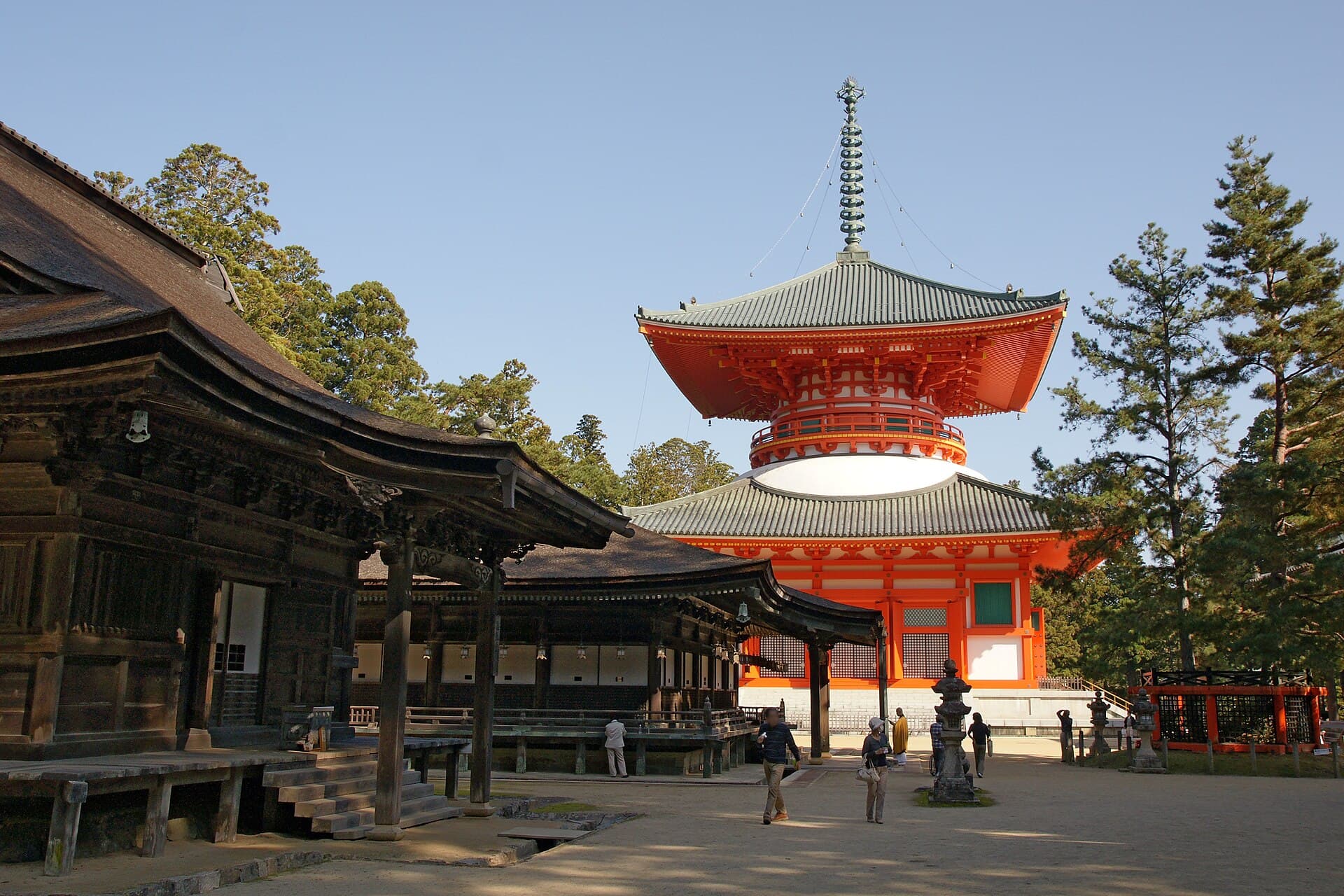
Kōyasan, Japan663highland / CC BY 2.5, via Wikimedia Commons
JP

Kōyasan

Where ancient cedars guard eternal meditation.

The secrets of Kōyasan

Kōyasan, as no one tells it.

Not the postcards. The stories even locals don't know — whispered in your ear, right where they happened.

3 secrets below. Many more wait inside the tour.
Okunoin Cemetery

Among the thousands of gravestones, one memorial stands out for its surprising dedication.

Full story unlocks in the tour
Danjo Garan

The layout of this sacred complex isn't just architectural; it's a cosmic blueprint.

Full story unlocks in the tour
Torodo Hall (Lantern Hall)

Inside this hall, a flame has burned continuously for over a thousand years, tended by monks.

Full story unlocks in the tour
The full tour

Discover every secret of Kōyasan

Every address, every reveal in full — in your ear, right where it happened.

Get the key to Kōyasan

You pick your stops. You walk. The voice reveals what the others miss.

Choose your time

How long do you have in Kōyasan?

No tours available yet. Check back soon — we're preparing them.

About Kōyasan

The story of Kōyasan

Kōyasan, also known as Mount Kōya, is a secluded monastic complex in the forested mountains of Wakayama Prefecture, south of Osaka. This sacred site serves as the headquarters of Shingon Buddhism, an important esoteric Buddhist sect introduced to Japan in 805 by Kobo Daishi (Kukai), one of Japan's most significant religious figures. The entire area, a plateau surrounded by eight peaks resembling a lotus flower, is considered the grounds of Kōyasan, making it a living religious town with over 100 temples and monasteries.

Designated a UNESCO World Heritage site in 2004 as part of the "Sacred Sites and Pilgrimage Routes in the Kii Mountain Range," Kōyasan offers a profound spiritual retreat. Visitors can immerse themselves in centuries-old traditions, from staying in temple lodgings (shukubo) and partaking in vegetarian Buddhist cuisine (shojin ryori) to participating in morning prayers and meditation. It's a destination that invites contemplation, offering a stark contrast to the bustle of modern Japan.

History

The Founding by Kobo Daishi

Kōyasan's history begins in 816 AD when the monk Kūkai, posthumously known as Kobo Daishi, founded the monastery complex. After studying Esoteric Buddhism in Tang Dynasty China for two years, Kobo Daishi returned to Japan with the aim of propagating Shingon Buddhism. He sought a remote and tranquil location for a monastic center that would embody Shingon teachings, which emphasize meditation, rituals, and the pursuit of enlightenment. Emperor Saga granted him permission to establish this complex, and Kobo Daishi chose the Kōya-Ryujin Quasi-National Park, a basin surrounded by eight peaks, which he believed resembled a lotus flower—a sacred symbol in Buddhism.

Growth and Flourishing as a Sacred Center

Kobo Daishi began the construction of the original Danjo Garan temple complex in 826. Even though he did not live to see its full completion, he guided his followers, giving the site immense importance for Shingon Buddhism. Kobo Daishi entered eternal meditation in 835 at the age of 62, believing he would await Miroku Nyorai (Maitreya), the Buddha of the Future, and continue to provide salvation. Since his time, Kōyasan has flourished as an active monastic center for over 1,200 years, becoming one of Japan's most sacred sites. At its peak during the Edo era (1603-1868), the area had over 2,000 temples; today, 117 intricately crafted buildings remain.

Enduring Legacy and World Heritage Status

Kōyasan's spiritual significance attracted emperors, feudal lords, aristocrats, and ordinary citizens throughout its history. The deep faith of the Tokugawa family, who founded the shogunate in Edo, contributed to Kōyasan's renewed prosperity after periods of decline due to conflict. In 2004, Kōyasan, along with Kumano Sanzan and Yoshino and Omine, and their connecting pilgrimage routes, were collectively designated a UNESCO World Heritage site as the "Sacred Sites and Pilgrimage Routes in the Kii Mountain Range." This recognition highlights Kōyasan's unique universal value as a cultural landscape shaped over centuries by ascetic spiritual practices intertwined with nature.

What to see

Begin your exploration at Okunoin Cemetery, Japan's largest cemetery, where a 2-kilometer path winds through ancient cedar trees and over 200,000 tombstones, leading to Kobo Daishi's mausoleum. This serene space is considered one of Japan's most sacred sites. Within Okunoin, the Torodo Hall (Lantern Hall) is a main worship hall housing over 10,000 lanterns, many of which have been continuously lit for centuries. Monks still bring meals to Kobo Daishi's mausoleum twice daily, believing he remains in eternal meditation.

Next, visit Kongobu-ji Temple, the head temple of Shingon Buddhism. Originally built in 1593 by Toyotomi Hideyoshi for his mother, it features exquisite gilded sliding doors and Japan's largest rock garden, the Banryutei Rock Garden, which depicts two dragons emerging from a sea of clouds. Just a short walk from Kongobu-ji is Danjo Garan, a central temple complex with around twenty structures, including the impressive 45-meter-tall Konpon Daito Pagoda and Kondo Hall, where important ceremonies are performed. The Konpon Daito is a three-dimensional mandala, representing the esoteric Buddhist cosmos.

When to visit

Kōyasan offers beauty in every season. Late spring (April–May) and autumn (October–November) are popular for comfortable temperatures and captivating scenery, especially the autumn leaves. Temperatures in mid-October range from 10-15 degrees Celsius, while mid-November can see temperatures drop to around 0 degrees, sometimes with early snowfall. Summer provides comparatively cooler temperatures than other parts of Japan due to its mountainous location. Winter can be quiet and atmospheric, with snow transforming the landscape into a mysterious scene, though it can be quite cold.

Practical

Kōyasan is accessible by train from Osaka, typically taking 1.5 to 2.5 hours. The Nankai-Koya Line leads to Gokurakubashi Station, where a cable car then transports visitors to the mountaintop. Local buses connect the main sights within Kōyasan, though many attractions are within walking distance. Consider purchasing the Koyasan World Heritage Ticket, which includes round-trip train fare, unlimited bus rides within Kōyasan, and discounted admission to select attractions for up to two consecutive days. For a truly immersive experience, an overnight stay at a shukubo (temple lodging) is highly recommended. These temples offer traditional rooms, vegetarian shojin ryori meals, and the opportunity to participate in morning prayers and meditation. Booking in advance is advisable, especially during peak seasons.

Good to know
What is Kōyasan?
Kōyasan is a mountain plateau town in Wakayama Prefecture, Japan, known for its concentration of Buddhist temples and memorial sites. It serves as the headquarters of Shingon Buddhism and is both a living religious community and a popular destination for travelers.
How do I get to Kōyasan?
The most common way to reach Kōyasan is by train from Osaka to Gokurakubashi Station, followed by a cable car ride to the mountaintop. Local buses operate within Kōyasan to connect the main attractions.
Can I visit Kōyasan as a day trip?
While a day trip is possible, it can feel rushed due to travel time and the number of sites to see. An overnight stay is recommended for a richer experience, allowing time to explore and participate in temple activities.
What is a shukubo?
A shukubo is a temple lodging where visitors can stay overnight. It offers traditional rooms, vegetarian meals (shojin ryori), and often includes the opportunity to attend morning prayers and other Buddhist practices.
Is Kōyasan a UNESCO World Heritage Site?
Yes, Kōyasan was designated a UNESCO World Heritage site in 2004 as part of the "Sacred Sites and Pilgrimage Routes in the Kii Mountain Range."
What kind of food is served at the temples?
Temple lodgings serve *shojin ryori*, a traditional vegetarian Buddhist cuisine made entirely of vegetables and edible wild plants. It excludes meat, fish, eggs, and dairy products.
Kōyasan
From€9.00
No booking · activate anytime · 12h to walk it
Get the key to Kōyasan