Krasnoyarsk Railway Bridge
This enduring bridge, once a marvel of engineering, held a secret admirer with a very famous name.
Full story unlocks in the tour
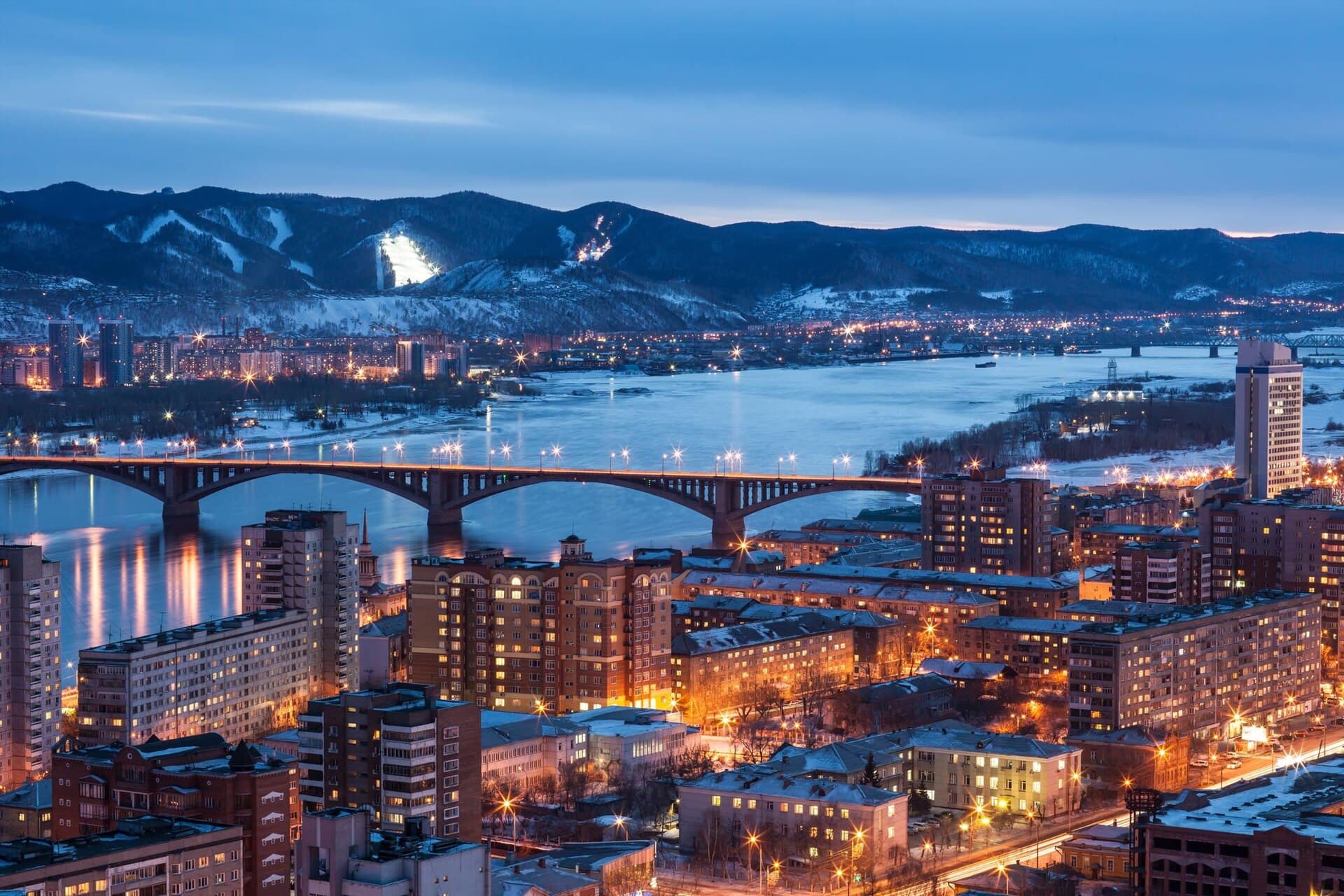 University2019 / CC BY-SA 4.0, via Wikimedia Commons
“Siberia's Red River City: Where Nature's Drama Meets Industrial Might”
Not the postcards. The stories even locals don't know — whispered in your ear, right where they happened.
This enduring bridge, once a marvel of engineering, held a secret admirer with a very famous name.
Before its transformation into a beloved recreational spot, this island in the Yenisei River played a surprising role in sustaining the city.
In a city defined by its extreme winters, residents once relied on an ingenious, low-tech solution for food preservation that extended far beyond a simple root cellar.
Discover every secret of Krasnoïarsk
Every address, every reveal in full — in your ear, right where it happened.
You pick your stops. You walk. The voice reveals what the others miss.
No tours available yet. Check back soon — we're preparing them.
Krasnoyarsk, the administrative heart of Krasnoyarsk Krai, stands as Siberia's second-largest city, home to over 1.1 million people. Along the powerful Yenisei River, one of the world's longest waterways, the city unfolds as a striking fusion of urban development and dramatic natural grandeur. Author Anton Chekhov once proclaimed Krasnoyarsk to be the most beautiful city in Siberia.
Serving as a crucial nexus on the Trans-Siberian Railway, Krasnoyarsk functions as a significant industrial center, notably a leading producer of aluminum in Russia. Beyond its industrial prowess, the city is a major educational hub, hosting the Siberian Federal University, and proudly hosted the 2019 Winter Universiade. Its continental climate delivers sharply defined seasons, from frigid, snowy winters to comfortable, partly cloudy summers.
The city's singular geography, with the Yenisei River carving its path through the landscape and forested mountains embracing its edges, offers a compelling stage for exploration. The Yenisei, remarkably, never freezes within the city limits due to the Krasnoyarsk hydroelectric dam upstream. From its distinctive rock formations to its bustling city center, Krasnoyarsk invites visitors to uncover the many layers of its Siberian character.
Krasnoyarsk's origins trace back to August 19, 1628, when a detachment of Cossacks under Andrey Dubenskiy established a Russian border fort. The fort, initially named "Krasny Yar" (meaning "Beautiful bank" or "Red Steep Bank" owing to the color of the marl on the river's left bank), was strategically constructed at the confluence of the Kacha and Yenisei Rivers to guard the frontier against indigenous peoples. The settlement officially attained city status in 1690, coinciding with Siberia's full incorporation into Russia.
The 18th century witnessed Krasnoyarsk's evolution from a military outpost into a more typical Siberian city. A significant impetus to its development arrived between 1735 and 1741 with the completion of the Siberian Route, a vital road connecting Krasnoyarsk to other towns and the broader Russian Empire. In 1822, Krasnoyarsk was designated the administrative center of the newly formed Yeniseysk Governorate, prompting a notable increase in its urban population and solidifying its position as the region's primary economic hub by the mid-19th century.
The city experienced further expansion with the discovery of gold and, more profoundly, with the arrival of the Trans-Siberian Railway in 1895. This railway transformed Krasnoyarsk into a major Siberian transport hub, stimulating rapid industrial growth. The construction of the Krasnoyarsk Railway Bridge over the Yenisei, completed in 1899, represented a monumental engineering achievement, further cementing the city's role in linking European Russia with Siberia and the Far East.
During the Stalinist era, Krasnoyarsk became a significant center within the gulag system. However, the centralized planning of the Five-Year Plans also led to the construction of numerous large industrial facilities, including a hydroelectric power station and a paper factory. World War II further amplified its industrial capacity as many factories were relocated to the city from the European part of the country. In the post-war period, the development of hydropower resources on the Angara and Yenisei rivers marked a new chapter in the city's history. More recently, the establishment of the Krasnoyarsk Scientific Centre in the 1970s affirmed its status as an important scientific and educational hub in Siberia. The city also underwent significant modernization in preparation for hosting the XXIX Winter Universiade in 2019.
Begin your exploration at the Chapel of Paraskeva Pyatnitsa, resting atop Karaulnaya Hill. This chapel serves as both an important pilgrimage site and a symbol of the city, even gracing the 10-rouble note. From this elevated position, you will gain expansive views of Krasnoyarsk and the Yenisei River.
Descend to Mira Avenue, the city's main thoroughfare, recognized for its blend of grand pastel facades and Soviet-era architecture. Here, you will find the Intercession Cathedral, a stone edifice dating back to 1785, displaying Siberian Baroque style. Continue to Peace Square (Mira Square), the oldest square in Krasnoyarsk, offering views of the Yenisei River and featuring the Arch of Triumph.
No visit to Krasnoyarsk is complete without experiencing the Stolby Nature Sanctuary. Just 10 kilometers south of the city, this reserve is celebrated for its towering, ochre-stained rock pillars, or 'stolby,' which punctuate the forested mountains. The area offers a network of trails for hiking and opportunities for rock climbing.
For a different perspective, embark on a boat tour on the Yenisei River. The Krasnoyarsk Hydroelectric Power Station, one of the world's largest, is located upstream and creates the impressive 'Krasnoyarsk Sea' reservoir, a favored recreational spot. Discover the city's many fountains; Krasnoyarsk offers over 140, with the musical fountains in Theater Square proving particularly captivating.
Krasnoyarsk experiences a distinct continental climate, with significant temperature variations throughout the year. The ideal time for warm-weather activities and exploring the region's natural beauty is during the summer months, from late June to mid-August. During this period, daytime temperatures are comfortable, typically ranging from 20°C to 25°C (68°F to 77°F). July is generally the warmest month, with an average high of 77°F (25°C) and clearer skies. This season is perfect for hiking in Stolby Nature Reserve and enjoying the city's outdoor festivals. If you wish to experience a true Siberian winter, with snow-laden landscapes and winter sports opportunities, plan your visit between November and February, though temperatures can drop significantly below freezing.
Krasnoyarsk operates on Krasnoyarsk Time (KRAT), which is UTC+7 and does not observe Daylight Saving Time. The local currency is the Russian Ruble (RUB). While Russian is the primary language, carrying a translation app or knowing some basic Russian phrases can be helpful, as not all locals may speak English.
Travel to Krasnoyarsk is most commonly undertaken via the Trans-Siberian Railway, with the city serving as a major stop. Krasnoyarsk International Airport (KJA) also offers regular flights connecting to Moscow and other major Russian cities. For navigating within the city, public transportation is available. While generally secure, especially in downtown areas, it is advisable to exercise common sense precautions, particularly when walking alone in suburban areas after dark. Petty theft can occur in crowded places. Consider allocating 5-7 days to fully experience Krasnoyarsk and its surrounding natural attractions.