Le marégraphe de Kronstadt
Toutes les profondeurs et altitudes pour la Russie, et même la hauteur des engins spatiaux, sont mesurées à partir d'un seul point discret à Kronstadt.
L'histoire complète se débloque dans le tour
 Florstein (Telegram:WikiPhoto.Space) / CC BY-SA 4.0, via Wikimedia Commons
Visite audio autoguidée de Kronstadt — parcours GPS à pied, lecture hors ligne, narration en 32 langues.
“Là où les ambitions impériales ont rencontré la ferveur révolutionnaire.”
Pas les cartes postales. Les histoires que même les habitants ignorent — soufflées à l'oreille, là où elles se sont passées.
Toutes les profondeurs et altitudes pour la Russie, et même la hauteur des engins spatiaux, sont mesurées à partir d'un seul point discret à Kronstadt.
Un seul mémorial sur la Place de l'Ancre commémore non pas une, mais trois insurrections distinctes qui ont façonné l'histoire russe.
Sous vos pieds, sur la place principale de Kronstadt, se trouve un matériau étonnamment rare et historiquement significatif.
Découvrez tous les secrets de Kronstadt
Chaque adresse, chaque révélation en entier — dans ton oreille, là où elle s'est passée.
Tu choisis tes lieux. Tu marches. La voix te révèle ce que les autres ignorent.


Votre visite audioguidée de Kronstadt vous attend — choisissez vos lieux, votre langue, et lancez-vous dès votre arrivée.
AcheterLume intègre un guide en réalité augmentée. Levez votre téléphone : sa caméra montre la rue devant vous, avec une flèche lumineuse posée sur l'image réelle qui pointe toujours vers votre prochain arrêt — aucune carte à déchiffrer, aucun mauvais virage. Comme tout dans Lume, ça fonctionne entièrement hors-ligne.
Kronstadt, ville portuaire historique située sur l'île de Kotlin dans le golfe de Finlande, s'étend à environ 30 kilomètres à l'ouest de Saint-Pétersbourg. Pierre le Grand a fondé la ville en 1704, et sa position stratégique à l'entrée du golfe en a fait le principal poste de défense maritime pour l'ancienne capitale russe et la base principale de la flotte baltique russe.
Plus qu'une simple forteresse militaire, le centre historique de Kronstadt et ses vastes fortifications sont reconnus comme un site du patrimoine mondial de l'UNESCO, faisant partie du plus grand ensemble « Saint-Pétersbourg et groupes de monuments connexes ». La ville est reliée au continent par le barrage de Saint-Pétersbourg, une combinaison de digue-chaussée-écluse qui sert à la fois de défense contre les inondations pour Saint-Pétersbourg et de lien routier vital. Aujourd'hui, Kronstadt offre un mélange d'histoire militaire, de patrimoine maritime et une atmosphère de ville plus calme et plus européenne par rapport à sa grande voisine.
Bien que son importance militaire ait diminué depuis l'ère soviétique, Kronstadt continue d'abriter une base navale russe, et son passé de ville fermée à l'époque soviétique souligne son importance stratégique. Les visiteurs peuvent explorer ses impressionnantes fortifications, son emblématique Cathédrale Navale et ses parcs tranquilles, obtenant une perspective unique sur la puissance navale et les événements historiques de la Russie.
## Fondation et signification impériale L'histoire de Kronstadt commence en 1703, lorsque les forces impériales russes de Pierre le Grand s'emparèrent de l'île de Kotlin aux Suédois pendant la Grande Guerre du Nord. Pierre le Grand supervisa personnellement la construction des premières fortifications, connues sous le nom de Kronshlot, qui furent inaugurées le 18 mai 1704. La construction fut un exploit d'ingénierie, les ouvriers déplaçant des milliers de cadres en bois remplis de pierres à travers le golfe de Finlande gelé pour créer les fondations. Le nom « Kronstadt » lui-même, signifiant « Ville de la Couronne » en allemand, fut choisi par Pierre le Grand.
La ville se développa rapidement en une base navale cruciale pour la marine russe, gardant les approches de Saint-Pétersbourg, alors capitale de la Russie. Son importance stratégique s'accrut tout au long des XVIIIe et XIXe siècles, conduisant à d'importantes refortifications. Le port de Kronstadt fut autrefois considéré comme le plus fortifié du monde, contenant 22 forts sur des îles artificielles et à l'intérieur de la ville elle-même.
## Échos révolutionnaires Kronstadt joua un rôle pivot, bien que complexe, dans l'histoire révolutionnaire de la Russie. Les marins de Kronstadt étaient connus pour leur ferveur révolutionnaire, participant aux soulèvements contre le Tsar en 1905 et 1917. Ils furent de fidèles alliés des Bolcheviks après la Révolution de Février, allant même jusqu'à déclarer une « République de Kronstadt » et à soutenir la Révolution d'Octobre.
Cependant, en mars 1921, la désillusion face à l'autoritarisme du gouvernement bolchevique et aux dures conditions du « communisme de guerre » conduisit à la rébellion de Kronstadt. Marins, soldats et civils se soulevèrent, exigeant la liberté d'expression, la fin des déportations vers les camps de travail et la libération des conseils ouvriers du contrôle du parti. Les Bolcheviks, choqués par la rébellion de leurs anciens alliés, réprimèrent brutalement le soulèvement. Si de nombreux rebelles s'échappèrent en Finlande, d'autres furent exécutés ou envoyés dans des camps de prisonniers. La rébellion, bien qu'écrasée, est largement considérée comme ayant incité Lénine à introduire la Nouvelle Politique Économique, qui répondait à certaines des revendications économiques des rebelles.
## Guerres mondiales et époque moderne Pendant la Seconde Guerre mondiale, Kronstadt servit à nouveau de point de défense vital, fournissant un soutien d'artillerie pour la tête de pont d'Oranienbaum et résistant aux bombardements de la Luftwaffe. Après la chute de l'Union soviétique, Kronstadt, qui avait été une ville fermée, fut ouverte aux touristes. Aujourd'hui, avec une population estimée à environ 44 795 habitants en 2026, Kronstadt conserve son héritage naval tout en offrant aux visiteurs un aperçu de son passé riche et complexe.
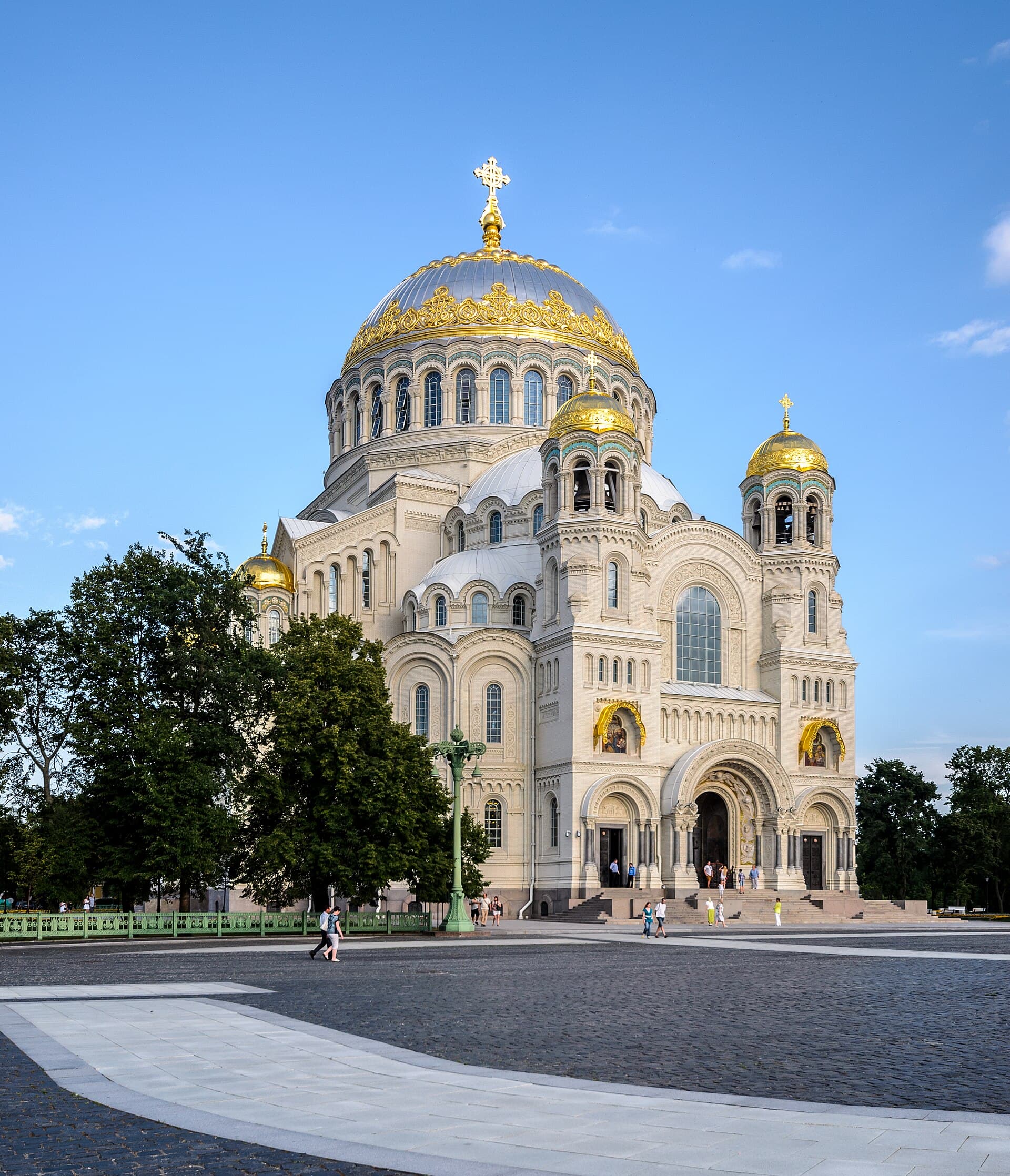
Kronstadt offre un éventail de sites, dont beaucoup sont liés à son passé naval et défensif. La Cathédrale Navale Saint-Nicolas (Morskoy Nikolo-Bogoyavlenskiy Sobor), un chef-d'œuvre néo-byzantin saisissant construit entre 1908 et 1913, est l'église principale de la marine russe et est dédiée à tous les marins tombés au combat. Sa grande échelle et son intérieur orné, avec des mosaïques et des sols en marbre, sont un point fort.
Explorez la Forteresse de Kronstadt et ses forts environnants, qui en faisaient autrefois le port le plus fortifié du monde. Bien que certains forts aient été démolis lors de la construction du barrage de Saint-Pétersbourg, beaucoup subsistent sur de petites îles artificielles et peuvent être vus depuis le barrage. Le Fort Kronshlot, construit en 1704, fut l'un des premiers et joua un rôle crucial dans la sécurisation de l'accès de la Russie à la mer Baltique.
La Place de l'Ancre (Yakornaya Square) sert de point central, abritant des mémoriaux militaires et le Monument à l'Amiral Stepan Makarov, un héros naval russe renommé. À proximité, le Musée d'Histoire de Kronstadt offre un aperçu approfondi des 300 ans d'histoire de la ville, y compris son rôle dans divers conflits et la rébellion de Kronstadt. Pour une expérience plus tranquille, le Parc Petrovsky offre un espace vert avec des vues sur le golfe de Finlande et des monuments navals. Ne manquez pas le marégraphe de Kronstadt près du Pont Bleu, un marqueur apparemment simple qui revêt une immense signification nautique pour la Russie.
La période la plus agréable pour visiter Kronstadt et profiter des activités par temps chaud s'étend de fin juin à mi-août. Pendant ces mois d'été, les températures sont confortables, avoisinant les 20 à 25 degrés Celsius (68-77°F), et les journées sont longues et partiellement nuageuses. Le célèbre phénomène des « Nuits Blanches » à Saint-Pétersbourg, avec son crépuscule prolongé, peut également être vécu pendant cette période. Bien que les hivers soient longs, glacials, neigeux et nuageux, de décembre à avril, le port est pris par les glaces pendant 140 à 160 jours.
Kronstadt est située sur l'île de Kotlin, à environ 30 kilomètres à l'ouest de Saint-Pétersbourg. Elle est facilement accessible depuis Saint-Pétersbourg via le barrage de Saint-Pétersbourg, qui sert également de route.
Comment s'y rendre : En bus : La ligne de bus publique 101 relie Kronstadt à la station de métro Staraya Derevnya à Saint-Pétersbourg. Une autre option est le minibus (marshrootka) #405 depuis Chyornaya Rechka ou #407 depuis Prospekt Prosvesheniya. En hydroptère : Pendant la haute saison (mai à octobre), des hydroptères rapides (Meteors) offrent un itinéraire pittoresque de Saint-Pétersbourg à Kronstadt, prenant environ 60 à 90 minutes. Ils partent de divers quais du centre de Saint-Pétersbourg. * En voiture/covoiturage/taxi : Le trajet en voiture depuis Saint-Pétersbourg prend environ 38 minutes, et des services de covoiturage sont également disponibles.
Se déplacer : Kronstadt est une ville relativement compacte, ce qui la rend propice à la marche. Des bus locaux et des taxis sont également disponibles.
Monnaie : La monnaie locale est le rouble russe (RUB ₽).
Langue : Le russe est la langue officielle, et un peu d'anglais peut être parlé dans les zones touristiques.
Hébergement : Bien que limité, il y a au moins un hôtel, l'Hôtel Viktoria, et quelques appartements et maisons d'hôtes sur l'île de Kotlin. De nombreux visiteurs choisissent de séjourner à Saint-Pétersbourg et de visiter Kronstadt en excursion d'une journée.
Kronstadt en coréen, en chinois ou en hébreu — et dans 29 autres langues, chaque étape narrée par une voix native. La plus large gamme de langues de tous les audioguides autoguidés.
Disponible en :