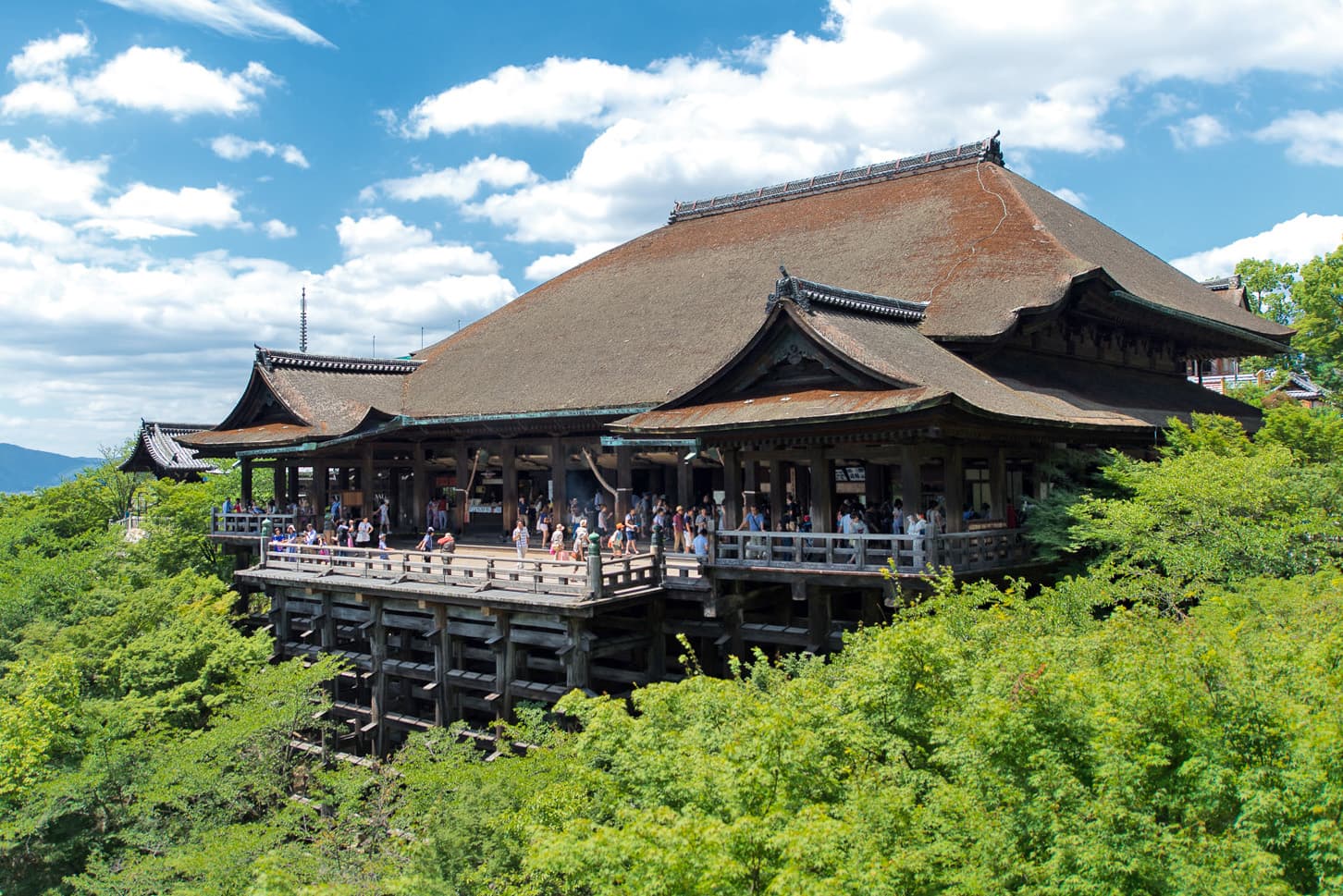
Edo-era temple ledgers logged 234 people who deliberately leapt off this very stage to make a wish come true, and the survival rate will surprise you.
Jordy Meow / CC BY-SA 3.0, via Wikimedia CommonsKyoto
Self-guided audio walking tour of Kyoto — GPS route, offline playback, story-driven narration in 32 languages.
“Silence between temples; time bends gently here.”
Kyoto, as no one tells it.
Not the postcards. The stories even locals don't know — whispered in your ear, right where they happened.
Run your eyes along the old wood at the building's edge and you'll find the scars of an all-night contest where samurai loosed thousands of arrows down this corridor.
A tea master put a statue of himself in his sandals atop this gate, and the most powerful man in Japan made him pay for it with his life.
Discover every secret of Kyoto
Every address, every reveal in full — in your ear, right where it happened.
You pick your stops. You walk. The voice reveals what the others miss.


How long do you have in Kyoto?
Your self-guided audio tour of Kyoto is ready — pick your landmarks, choose your language, and start the moment you arrive.
BuyThe story of Kyoto
On the night of July 2, 1950, a 22-year-old novice monk set fire to the Golden Pavilion and reduced six centuries of gilded timber to ash. Kyoto rebuilt it by 1955, brighter than before. That instinct tells you most of what you need to know about this city: it has been burning down and rising again since Emperor Kanmu named it Heian-kyo, the "capital of peace," in 794. For more than a thousand years it was the seat of the imperial court. Today it holds seventeen UNESCO-listed monuments, a working geisha quarter, and 30,000 vermilion gates climbing a mountain. Come for the temples. Stay for the stubbornness.
A capital built on a Chinese grid
In 794, Emperor Kanmu moved his court from Nagaoka-kyo and founded a new capital he called Heian-kyo, "the capital of peace and tranquility." He laid it out on a grid modeled on Chang'an, the Tang dynasty capital in China, a tidy rectangle roughly 4.5 kilometers east to west and 5.2 north to south. The name stuck to an era: the Heian period, Japan's long aristocratic golden age, when court poetry and The Tale of Genji set the tone for centuries of Japanese taste.
Heian-kyo remained the official imperial capital from 794 until 1869, even as real power slipped to the samurai through three successive shogunates. The emperor stayed in Kyoto. The warlords ruled from elsewhere. That gap between symbolic and actual power runs through the whole story.
The war that gutted the city
The great rupture was the Onin War (1467-1477). What began as a succession dispute between two officials, Hosokawa Katsumoto and Yamana Sozen, metastasized into a nationwide civil war. By 1477 much of Kyoto lay in ruins, picked over by mobs. The conflict shattered the authority of the Ashikaga shoguns and lit the fuse on the Sengoku period, Japan's century of warring states. Kyoto, the cultural center, had become a battlefield.
Spared, then preserved
The city kept rebuilding, temple by temple. Its closest brush with annihilation came in 1945. Kyoto sat near the top of the atomic bomb target list, but US Secretary of War Henry Stimson pressed President Truman to remove it, arguing it was the ancient capital and a shrine of Japanese art and culture. Stimson went further and ordered it spared even from conventional air raids. Kyoto became the one great Japanese city to escape serious wartime bombing, which is why so much of it still stands.
In 1994, UNESCO inscribed the "Historic Monuments of Ancient Kyoto" as World Heritage: seventeen sites across Kyoto, Uji, and Otsu, thirteen Buddhist temples, three Shinto shrines, and one castle, charting more than a millennium of wooden architecture and garden design.
Kyoto rewards the visitor who picks a few places and goes slowly. The headline sights earn their reputations, but they reward early arrivals and punish the crowds who turn up at noon.
Fushimi Inari Taisha is the one people picture: thousands of vermilion torii gates forming tunnels up Mount Inari. Founded in 711, it is the head shrine of more than 30,000 Inari shrines across Japan, dedicated to the Shinto deity of rice and prosperity. Look for the fox statues, Inari's messengers. The full mountain loop takes a couple of hours, and the upper reaches thin out beautifully.
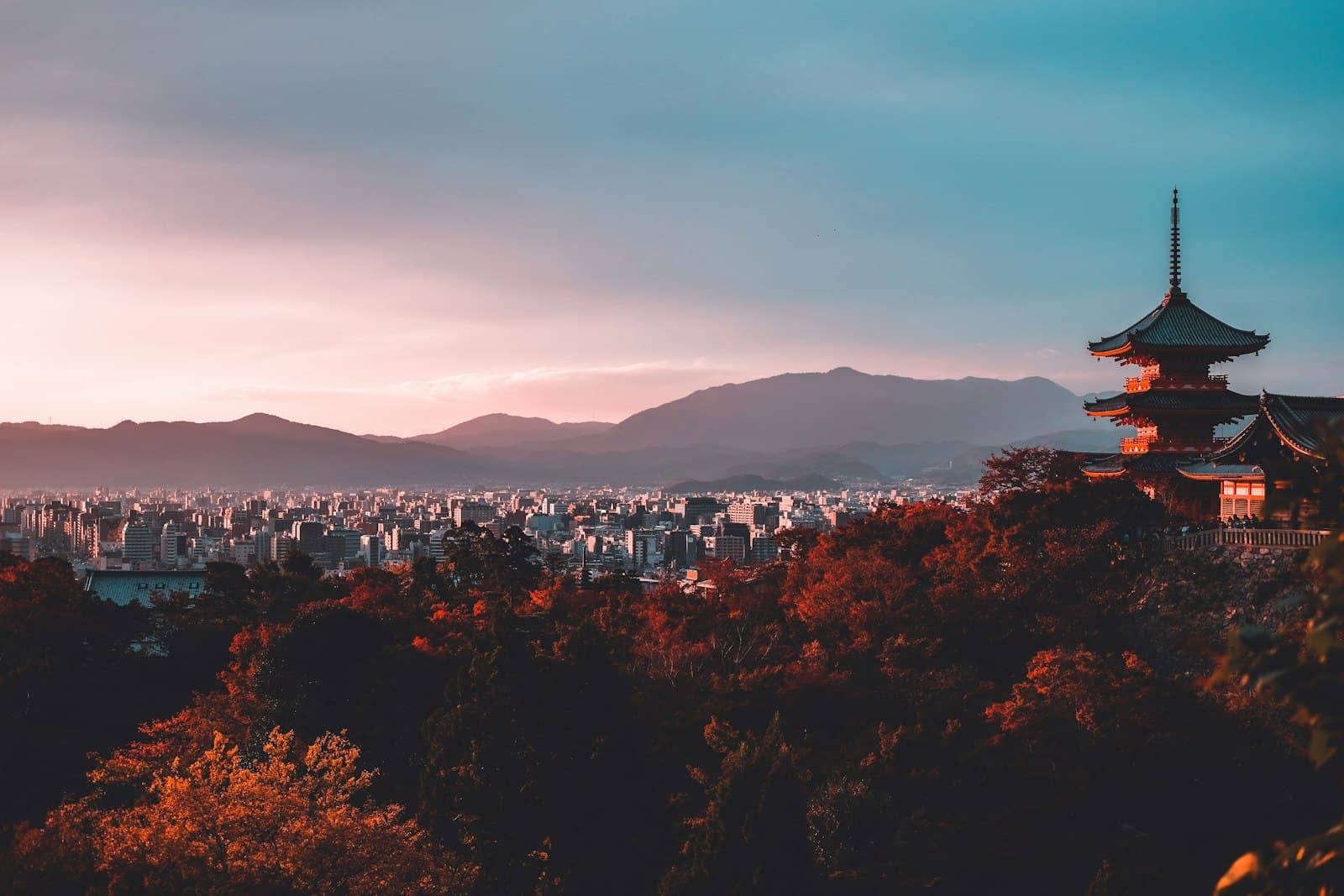
Kiyomizu-dera ("Pure Water Temple"), founded in 778, is built on a vast wooden stage propped over the eastern hillside by hundreds of pillars, assembled without nails. Below the main hall, the Otowa waterfall splits into three streams; pick one for longevity, love, or success in study. Just don't drink from all three. That's considered greedy.
Kinkaku-ji, the Golden Pavilion, began in 1397 as the retirement villa of shogun Ashikaga Yoshimitsu. The structure you see is a 1955 reconstruction, rebuilt in wood after a monk burned the original in 1950, the event Yukio Mishima fictionalized in his 1956 novel.
A few others worth your hours:
- Gion, the geisha district along Shijo Avenue, where geiko and maiko still work the teahouses
- Arashiyama, west of the city, for its bamboo grove and the Katsura River
- The eastern temple belt, walkable from Kiyomizu-dera north through old stone lanes
Resist the urge to collect all seventeen UNESCO sites in one trip. Three temples done well beat ten done at a jog.
Spring and autumn are the obvious answers, and the crowds know it. Cherry blossoms peak from late March into the first two weeks of April; autumn foliage starts in late October and peaks in November. Both are gorgeous and both bring super-peak crowds and prices. A quieter trick: the stretch between late November and Christmas still catches good color with thinner crowds. Avoid summer if you can. June through August is hot and humid, and Kyoto's bowl-shaped basin traps heat, so July and August highs sometimes top 37C, hotter than Tokyo or Osaka. June carries the rainy season. For scenery without the crush, aim for May, early June, or September.
Getting around. Kyoto runs on buses, with two subway lines filling gaps. A rechargeable IC card (ICOCA is the local Kansai card, but Suica, PASMO, and others work nationwide) saves fumbling for change. City buses have a flat fare of 230 yen for adults within the central zone; tap on and off only on non-flat routes. Buses get jammed near major temples, so build in time.
Money. Japan remains cash-friendly, and yen is accepted everywhere; carry some, especially for smaller shrines and shops, though IC cards and cards are increasingly fine.
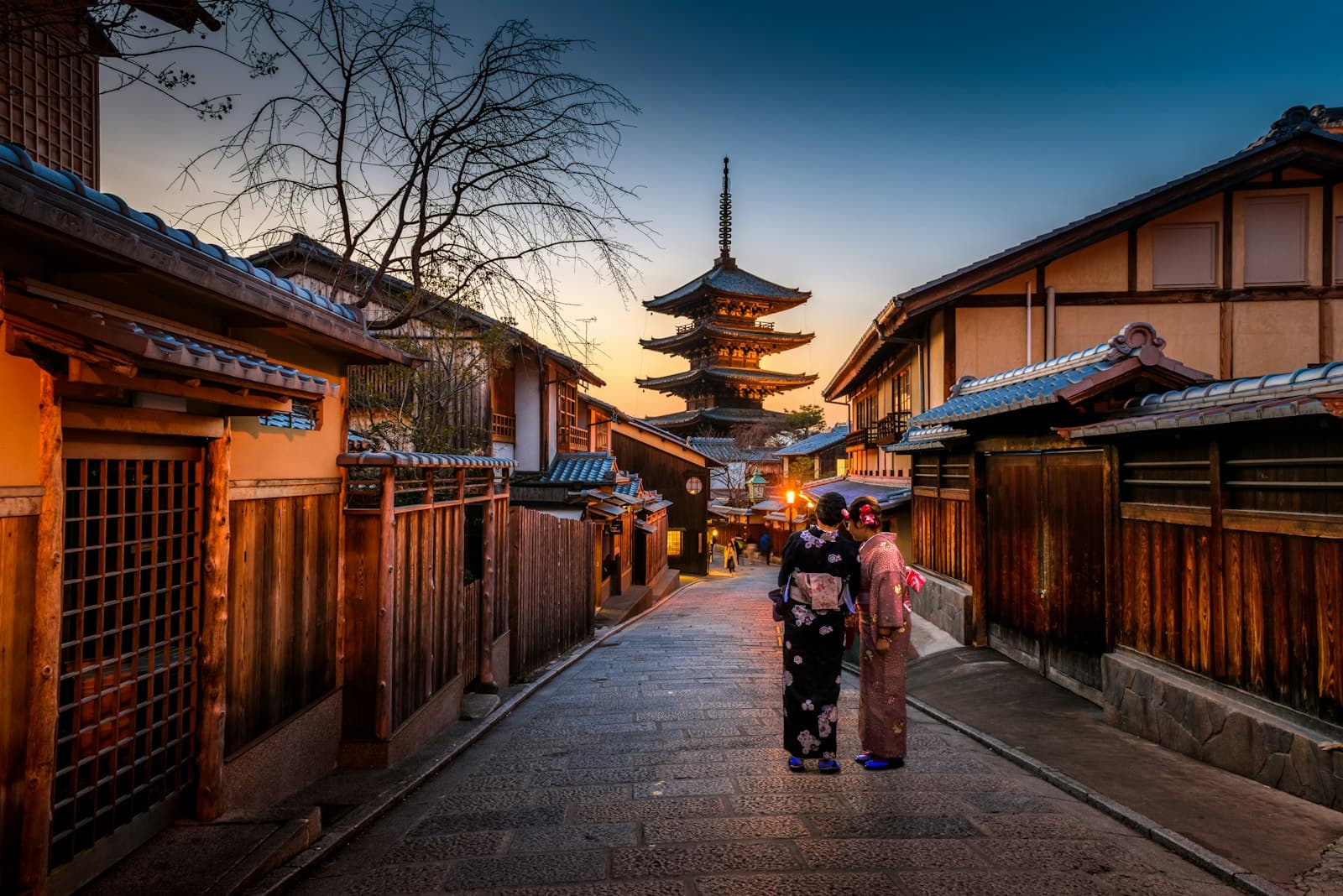
Etiquette. This matters in Kyoto more than most places. In Gion, do not photograph geiko or maiko without permission. Since April 2024, several private alleys in southern Gion are closed to tourists entirely, with a 10,000 yen penalty for trespassing on private roads; an earlier 10,000 yen fine for unauthorized photography dates to 2019. Stick to Hanamikoji and the public streets. Many of those quiet lanes are people's homes.
- How many days do I need in Kyoto?
- Three full days lets you cover the major eastern temples, Fushimi Inari, Kinkaku-ji, and Arashiyama without rushing. With only one or two days, pick a single district per day rather than crisscrossing the city, since buses near the big sights are slow and crowded.
- Can I actually see a geisha in Kyoto?
- Geiko (the Kyoto term) and maiko apprentices still work the teahouses of Gion, and you may glimpse one heading to an appointment around dusk. Do not chase or photograph them without permission. Since April 2024, several private Gion alleys are off-limits to tourists with a 10,000 yen penalty. For a guaranteed, respectful encounter, book a teahouse experience or performance.
- Is the Golden Pavilion the original building?
- No. The original dated to 1397, but a novice monk burned it down on July 2, 1950. The pavilion you see today is a faithful wooden reconstruction completed in 1955. Yukio Mishima based his 1956 novel "The Temple of the Golden Pavilion" on the arson.
- When is the best time to visit Kyoto?
- Cherry blossoms peak from late March to mid-April and autumn foliage peaks in November, both stunning and both extremely crowded. For fewer people, try May, September, or the weeks between late November and Christmas. Avoid July and August, when the city's basin traps heat and highs can exceed 37C.
- Do I need cash, or are cards enough?
- Cards and IC cards (ICOCA, Suica, PASMO) work for transport and many shops, but Japan is still very cash-friendly and some smaller temples, shrines, and shops prefer yen. Carry some cash as a backup, especially away from the main tourist areas.
- How do I get around the city?
- Buses are the workhorse of Kyoto, supplemented by two subway lines. Get a rechargeable IC card to avoid counting coins. The central city bus fare is a flat 230 yen for adults. Expect buses near Kiyomizu-dera and Kinkaku-ji to be packed at peak times, so allow extra time or walk between nearby sights.
Kyoto in your own language — all 32· 32
Kyoto in Korean, in Chinese or in Hebrew — and 29 more languages, every stop narrated by a native voice. The widest language range of any self-guided audio tour.
Available in:
- English
- FrenchFrançais
- SpanishEspañol
- GermanDeutsch
- ItalianItaliano
- PortuguesePortuguês
- DutchNederlands
- PolishPolski
- SwedishSvenska
- DanishDansk
- NorwegianNorsk
- FinnishSuomi
- RussianРусский
- UkrainianУкраїнська
- TurkishTürkçe
- CzechČeština
- HungarianMagyar
- RomanianRomână
- BulgarianБългарски
- GreekΕλληνικά
- Japanese日本語
- Korean한국어
- Chinese中文
- Arabicالعربية
- Hebrewעברית
- Hindiहिन्दी
- Thaiไทย
- VietnameseTiếng Việt
- IndonesianBahasa Indonesia
- MalayBahasa Melayu
- CatalanCatalà
- BasqueEuskara