Fontana delle 99 Cannelle (Fountain of 99 Spouts)
This iconic fountain, with its 99 unique stone faces, holds a secret about its very origin that even its architect couldn't take to his grave.
Full story unlocks in the tour
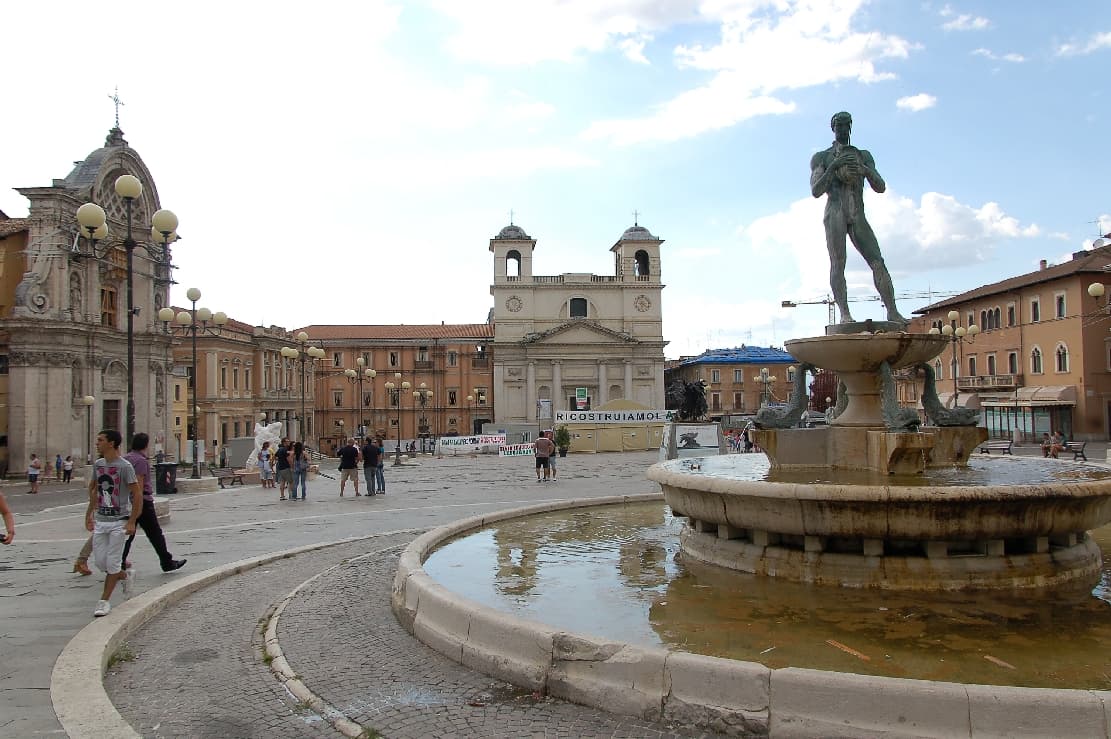 © Ra Boe / Wikipedia Create the proper attribution for your usage by clicking on this button! This file is licensed under the Creative Commons Attribution-Share Alike 3.0 Germany license.Attribution: Ra Boe / Wikipedia You are free: to share – to copy, distribute and transmit the work to remix – to adapt the work Under the following conditions: attribution – You must give appropriate credit, provide a link to the license, and indicate if changes were made. You may do so in any reasonable manner, but not in any way that suggests the licensor endorses you or your use. share alike – If you remix, transform, or build upon the material, you must distribute your contributions under the same or compatible license as the original.https://creativecommons.org/licenses/by-sa/3.0/de/deed.enCC BY-SA 3.0 deCreative Commons Attribution-Share Alike 3.0 detruetrue Internet: Titel Foto: Ra Boe / Wikipedia, Original; Lizenz: CC by-sa 3.0 Print: Titel Foto: Ra Boe / Wikipedia, Lizenz: CC by-sa 3.0 I have published this image as author Ra Boe under the "CC-BY-SA-3.0" in Wikipedia. This means that free, commercial usage outside of Wikipedia is permitted under the following licence terms: Online media: The author " RaBoe/Wikipedia " is named A weblink to the original image is provided: //commons.wikimedia.org/wiki/File:L%27Aquila_2011_by-RaBoe-197.jpg A copy of, or the Uniform Resource Identifier (https://creativecommons.org/licenses/by-sa/3.0/de/legalcode) for, this License with every copy Print media: The author " RaBoe/Wikipedia" is named A copy of, or the Uniform Resource Identifier (https://creativecommons.org/licenses/by-sa/3.0/de/legalcode) for, this License with every copy Please send me a specimen copy or the URL of the website where the image is used. Please write an email to raboe001-at-web.de, if you need the image in a higher resolution need my postal address for sending a specimen copy have further questions about the terms of the licence PS: In case of refusal of the above terms the author reserves the right to take legal action. This license and the rights granted hereunder will terminate automatically upon any breach by you of the terms of this license. In this case the author reserves to demand declaration to cease and desist, and compensation (according to the MFM fee references currently in force). Any of the above conditions can be waived if you get permission from the copyright holder. Foto selbst aufgenommen mit Nikon-D50: Objektiv Tamron 18 - 250 mmvon Wikipedia-User: Ra Boe This photo was taken with an Nikon-D50:, Objective Tamron 18 - 250 mm by Wikipedia user: Ra Boe / CC BY-SA 3.0 de, via Wikimedia Commons
Self-guided audio walking tour of L'Aquila — GPS route, offline playback, story-driven narration in 32 languages.
“L'Aquila: A city of enduring spirit, rebuilding its story in stone and light.”
Not the postcards. The stories even locals don't know — whispered in your ear, right where they happened.
This iconic fountain, with its 99 unique stone faces, holds a secret about its very origin that even its architect couldn't take to his grave.
This grand basilica is not just a masterpiece of Abruzzese architecture; it's home to a unique annual event that predates the Catholic Church's own Jubilee.
Despite its long history, L'Aquila's identity is deeply intertwined with a number that isn't quite what it seems.
Discover every secret of L'Aquila
Every address, every reveal in full — in your ear, right where it happened.
You pick your stops. You walk. The voice reveals what the others miss.


Your self-guided audio tour of L'Aquila is ready — pick your landmarks, choose your language, and start the moment you arrive.
BuyLume has a built-in augmented-reality guide. Hold your phone up and its camera shows the street ahead of you, with a glowing arrow laid over the real view that always points to your next stop — no map to puzzle over, no wrong turns. Like everything in Lume, it works fully offline.
L'Aquila, the capital of Italy's Abruzzo region, is a city with a compelling narrative of resilience and rebirth. Situated on a hill in the wide Aterno River valley, it is framed by the dramatic peaks of the Apennine Mountains, including the Gran Sasso d'Italia. The city's name, meaning 'The Eagle,' hints at its elevated position and enduring spirit. L'Aquila's historic center, one of Italy's largest, showcases a blend of medieval, Renaissance, and Baroque architecture, much of it meticulously restored after the devastating 2009 earthquake.
Designated as the Italian Capital of Culture for 2026, L'Aquila is a testament to the power of cultural restoration as a tool for recovery and community building. Its story is not one of a quick comeback, but a deliberate and complex rebuilding process, integrating modern seismic reinforcement with the preservation of its historical character. Visitors today will find a city that is both deeply rooted in its past and looking towards its future, offering a unique glimpse into Italy's lesser-known, yet profoundly significant, cultural landscape.
L'Aquila's origins trace back to the 13th century, founded around 1240 by the Holy Roman Emperor Frederick II. Tradition holds that the city was formed from the union of ninety-nine castles, a founding myth that continues to shape its identity. This unique origin is famously embodied by the Fontana delle 99 Cannelle, the Fountain of the 99 Spouts, where each spout is said to represent one of the original settlements.
Throughout the Middle Ages, L'Aquila flourished, becoming an important center in the Kingdom of Naples. Its strategic location in central Italy contributed to its wealth, driven by trade and the establishment of significant religious and academic institutions. The city's medieval walls, completed in 1316, still stand as a testament to its historical importance.
However, L'Aquila's history is also marked by a recurring challenge: earthquakes. The city is partly built on an ancient lakebed, which amplifies seismic activity. Major seismic events in 1315, 1349, 1461, and particularly the devastating earthquake of 1703, have repeatedly reshaped its urban fabric. Each time, the city has undergone significant rebuilding, with the 1703 quake leading to an almost complete reconstruction. The most recent major earthquake in April 2009 caused extensive damage, claiming over 300 lives and displacing tens of thousands. The subsequent reconstruction has been a slow, complex, and deliberate process, focusing on seismic reinforcement while preserving the city's historic character.
Begin your exploration at the Fontana delle 99 Cannelle (Fountain of 99 Spouts), a 13th-century monument with 99 unique sculpted faces, each spouting water into three pools. Its alternating red and white stone creates a striking visual effect.
Next, visit the Basilica di Santa Maria di Collemaggio, a Romanesque-Gothic masterpiece known for its distinctive white and pink checkerboard facade and the Holy Door. This basilica is the resting place of Pope Celestine V and the site of the annual Celestinian Forgiveness.
Dominating the historic center is the Forte Spagnolo (Spanish Fort), an imposing 16th-century fortress that now houses the National Museum of Abruzzo (MuNDA). Walk through Piazza del Duomo, the city's historic meeting place, where you can see the L'Aquila Cathedral and the Church of the Holy Souls.
Other notable sites include the Basilica of San Bernardino, with its Renaissance facade and Baroque interior, housing the tomb of Saint Bernardino of Siena. Beyond the city, consider a trip to Rocca Calascio, a medieval fortress, or explore the natural beauty of the Gran Sasso e Monti della Laga National Park.
The best time to visit L'Aquila for warm-weather activities is from mid-June to early September. During these months, the weather is generally warm to hot and sunny, with low humidity, though evenings can be cool. Spring (March, April, May) and early autumn (September, October) also offer pleasant weather for sightseeing and outdoor activities. Winters are typically cold, with temperatures dropping below freezing, and November tends to be the cloudiest and wettest month.
L'Aquila is approximately 100-120 kilometers (60-75 miles) from Rome, making it accessible for a day trip or longer stay. The most straightforward way to reach L'Aquila is by car, a journey of about 90 minutes from Rome, offering scenic mountain views. Regular long-distance buses also connect Rome to L'Aquila. The city itself is compact and walkable, but local buses are available, especially for reaching areas like the Fountain of 99 Spouts, which is downhill from the main city center. The local currency is the Euro (EUR). L'Aquila is a university town, contributing to a lively atmosphere and a reasonable cost of living.
L'Aquila in Korean, in Chinese or in Hebrew — and 29 more languages, every stop narrated by a native voice. The widest language range of any self-guided audio tour.
Available in: