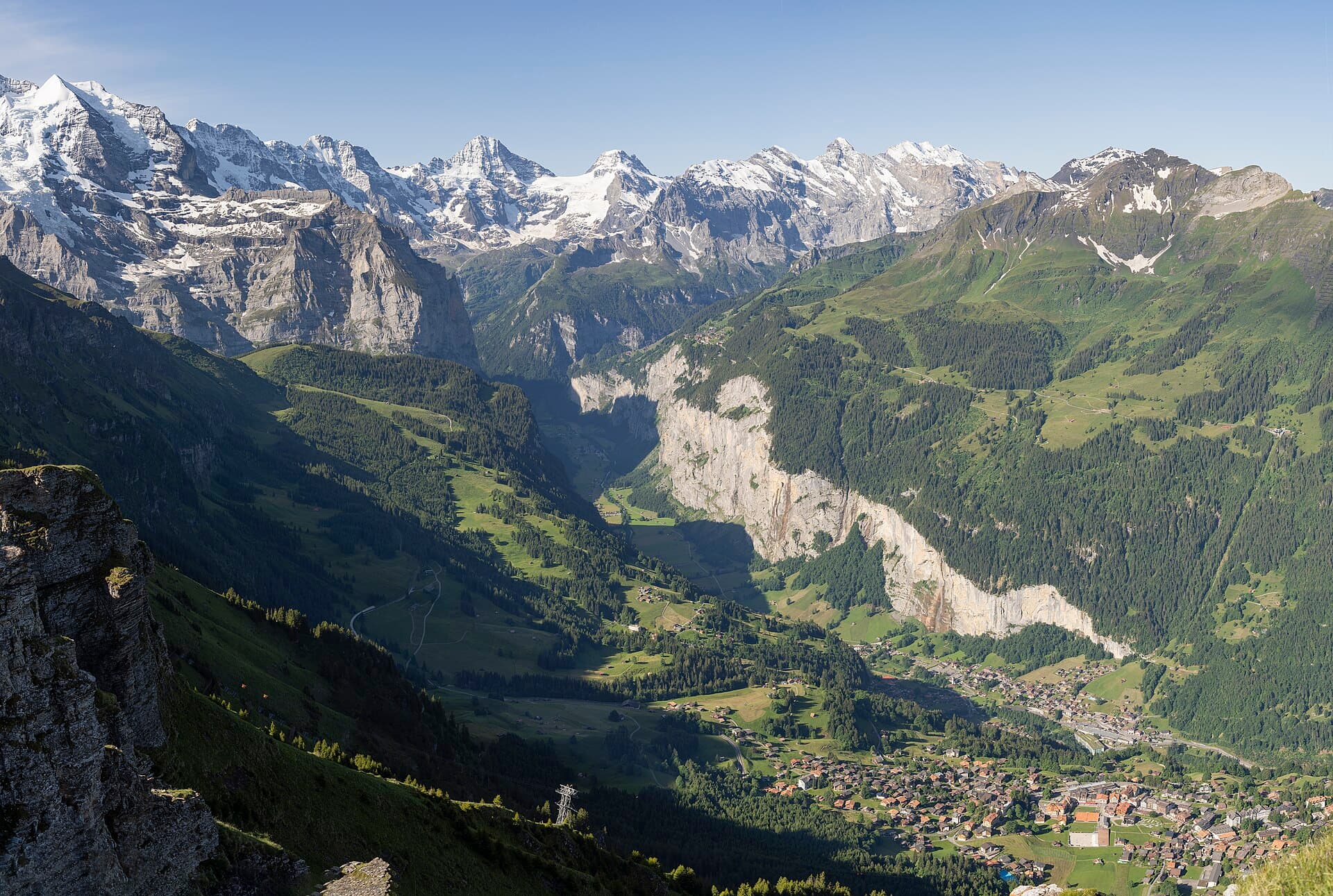
The dramatic landscape of Lauterbrunnen, with its towering cliffs and cascading waterfalls, might feel strangely familiar to fans of a certain fantasy epic.
Chensiyuan / CC BY-SA 4.0, via Wikimedia CommonsLauterbrunnen
“Where colossal cliffs weep 72 waterfalls into a verdant valley.”
Lauterbrunnen, as no one tells it.
Not the postcards. The stories even locals don't know — whispered in your ear, right where they happened.
While Lauterbrunnen is known for its visible waterfalls, one of its most powerful natural spectacles roars from within the mountain itself.
One of Lauterbrunnen's iconic waterfalls, the Staubbach Falls, has a name that perfectly captures its ethereal descent.
Discover every secret of Lauterbrunnen
Every address, every reveal in full — in your ear, right where it happened.
You pick your stops. You walk. The voice reveals what the others miss.
How long do you have in Lauterbrunnen?
No tours available yet. Check back soon — we're preparing them.
The story of Lauterbrunnen
Lauterbrunnen, a village in the Bernese Oberland of Switzerland, unfolds within a dramatic U-shaped valley. This striking landscape is characterized by sheer rock faces that rise hundreds of meters, forming a natural amphitheater. The valley is celebrated for its abundant waterfalls, with 72 cascades plunging from the high cliffs, giving the region its name, which roughly translates to 'many fountains' or 'loud springs'.
At an elevation of 795 meters, Lauterbrunnen serves as a gateway to some of the most iconic peaks in the Swiss Alps, including the Eiger, Mönch, and Jungfrau mountains. The village itself radiates a timeless charm, with traditional chalet-style buildings and the constant sound of rushing water. It offers a tranquil escape, deeply connected to the powerful forces of nature that shaped it.
From Glacial Carving to Alpine Attraction
The Lauterbrunnen Valley's dramatic U-shape stands as a testament to the immense power of glaciers during the last Ice Age. Approximately 25,000 years ago, a massive glacier, flowing downwards from the Jungfrau, carved this deep trough, transforming what were once V-shaped river valleys into the sheer-sided, flat-floored valley seen today. The immense weight of the ice, sometimes over 1000 meters thick, acted like an oversized milling machine, scraping away rock and leaving behind the vertical rock walls and terraced plateaus.
The earliest known trace of human settlement in the area is a Roman coin found in the Blumental. Lauterbrunnen first appeared in historical records in 1240, referred to as 'in claro fonte,' meaning 'by the clear spring(s)'. By the 14th century, Walser people from the Lötschen Valley settled in the highlands of the Lauterbrunnen Valley, seeking high terraces and valley floors.
Tourism began to take root in the mid-18th century as the Alps captivated European visitors. Early travelers, including the composer Felix Mendelssohn-Bartholdy and the poet Johann Wolfgang von Goethe, were drawn to the valley's natural beauty, with Goethe even finding inspiration for his poem 'Song of the Spirits over the Waters' from Staubbach Falls. The completion of a road from Interlaken in 1834 and the Bernese Oberland Railway in 1890 further opened the valley to visitors, leading to the development of hotels and other tourist infrastructure. The early 20th century saw the construction of cable cars to Mürren (1891) and Wengen (1893), and most notably, the Jungfrau Railway in 1912, which ascends to the highest railway station in Europe at Jungfraujoch. While tourism faced setbacks during the World Wars and the Great Depression, it rebounded after WWII, leading to the construction of vacation homes, ski lifts, and a heliport, solidifying Lauterbrunnen's status as a year-round alpine destination.
The village of Lauterbrunnen itself offers a charming starting point, with its traditional architecture and views of Staubbach Falls. A short walk from the village leads directly to the base of Staubbach Falls, one of Europe's highest free-falling waterfalls, where visitors can experience its impressive height and refreshing spray. During summer, a specially designed viewing gallery allows access behind the waterfall.
A few kilometers from Lauterbrunnen, the Trümmelbach Falls offer a unique experience. These ten glacier waterfalls are contained within the mountain, accessible via a tunnel lift, galleries, and stairways. They drain the meltwater from the Eiger, Mönch, and Jungfrau, with up to 20,000 liters of water per second thundering through the rock. Other notable waterfalls include the Mürrenbach Waterfall, Switzerland's highest, plunging 417 meters in five cascades near Stechelberg.
Lauterbrunnen also serves as a base for exploring the car-free mountain villages of Mürren and Wengen, accessible by cable car and cogwheel railway, respectively. These villages offer sweeping views of the Lauterbrunnen Valley and surrounding peaks, as well as access to extensive hiking trails and ski slopes.
The ideal time to visit Lauterbrunnen depends on desired activities. For hiking and experiencing the waterfalls at their fullest, late spring to early fall (May to October) is excellent, with June to September offering the most favorable weather and lush landscapes. July and August bring the warmest temperatures, though it is also peak tourist season. For winter sports, December to March is suitable, with access to nearby ski resorts like Mürren and Wengen. Some attractions and hiking trails may be closed due to snow during winter.
Lauterbrunnen is easily accessible by train from Interlaken. Public transportation within the region, including trains, buses, and cable cars to surrounding villages and attractions, is excellent. Consider purchasing a Swiss Travel Pass, Jungfrau Travel Pass, or Bernese Oberland Pass for cost-effective travel on public transport and mountain railways. Dress in layers, as mountain weather can change quickly, and bring sturdy shoes for walking and hiking. While German is the primary language, English is widely spoken. The local currency is the Swiss Franc (CHF), and credit cards are generally accepted. It is advisable to make reservations for popular restaurants, especially during high season.
- How many waterfalls are in the Lauterbrunnen Valley?
- The Lauterbrunnen Valley is known for its 72 waterfalls.
- What is the most famous waterfall in Lauterbrunnen?
- Staubbach Falls is the most famous and iconic waterfall in Lauterbrunnen, plunging nearly 300 meters from a sheer cliff face.
- Can you go inside a waterfall in Lauterbrunnen?
- Yes, at Trümmelbach Falls, you can go inside the mountain via tunnels, lifts, and walkways to view ten glacier waterfalls.
- Is Lauterbrunnen car-free?
- The village of Lauterbrunnen itself is not car-free, but nearby mountain villages like Mürren and Wengen are.
- What inspired J.R.R. Tolkien in Lauterbrunnen?
- J.R.R. Tolkien's visit to the Lauterbrunnen Valley in 1911 provided inspiration for the fictional valley of Rivendell in 'The Lord of the Rings'.
- What are the main outdoor activities in Lauterbrunnen?
- Lauterbrunnen is excellent for hiking, mountain biking, and exploring waterfalls in summer, and skiing in nearby resorts during winter.