Lavenham Guildhall
Le grand Guildhall, symbole de la prospérité médiévale de Lavenham, a autrefois servi un but étonnamment rude.
L'histoire complète se débloque dans le tour
 Oxyman / CC BY 2.5, via Wikimedia Commons
Visite audio autoguidée de Lavenham — parcours GPS à pied, lecture hors ligne, narration en 32 langues.
“Là où les charpentes tordues racontent des histoires de richesse médiévale et de métiers oubliés.”
Pas les cartes postales. Les histoires que même les habitants ignorent — soufflées à l'oreille, là où elles se sont passées.
Le grand Guildhall, symbole de la prospérité médiévale de Lavenham, a autrefois servi un but étonnamment rude.
Le bar des aviateurs de l'hôtel The Swan abrite une collection unique et poignante.
Cette remarquable maison à colombages, connue pour son apparence distinctive, a un lien surprenant avec un géant de la littérature.
Découvrez tous les secrets de Lavenham
Chaque adresse, chaque révélation en entier — dans ton oreille, là où elle s'est passée.
Tu choisis tes lieux. Tu marches. La voix te révèle ce que les autres ignorent.
Votre visite audioguidée de Lavenham vous attend — choisissez vos lieux, votre langue, et lancez-vous dès votre arrivée.
AcheterLume intègre un guide en réalité augmentée. Levez votre téléphone : sa caméra montre la rue devant vous, avec une flèche lumineuse posée sur l'image réelle qui pointe toujours vers votre prochain arrêt — aucune carte à déchiffrer, aucun mauvais virage. Comme tout dans Lume, ça fonctionne entièrement hors-ligne.
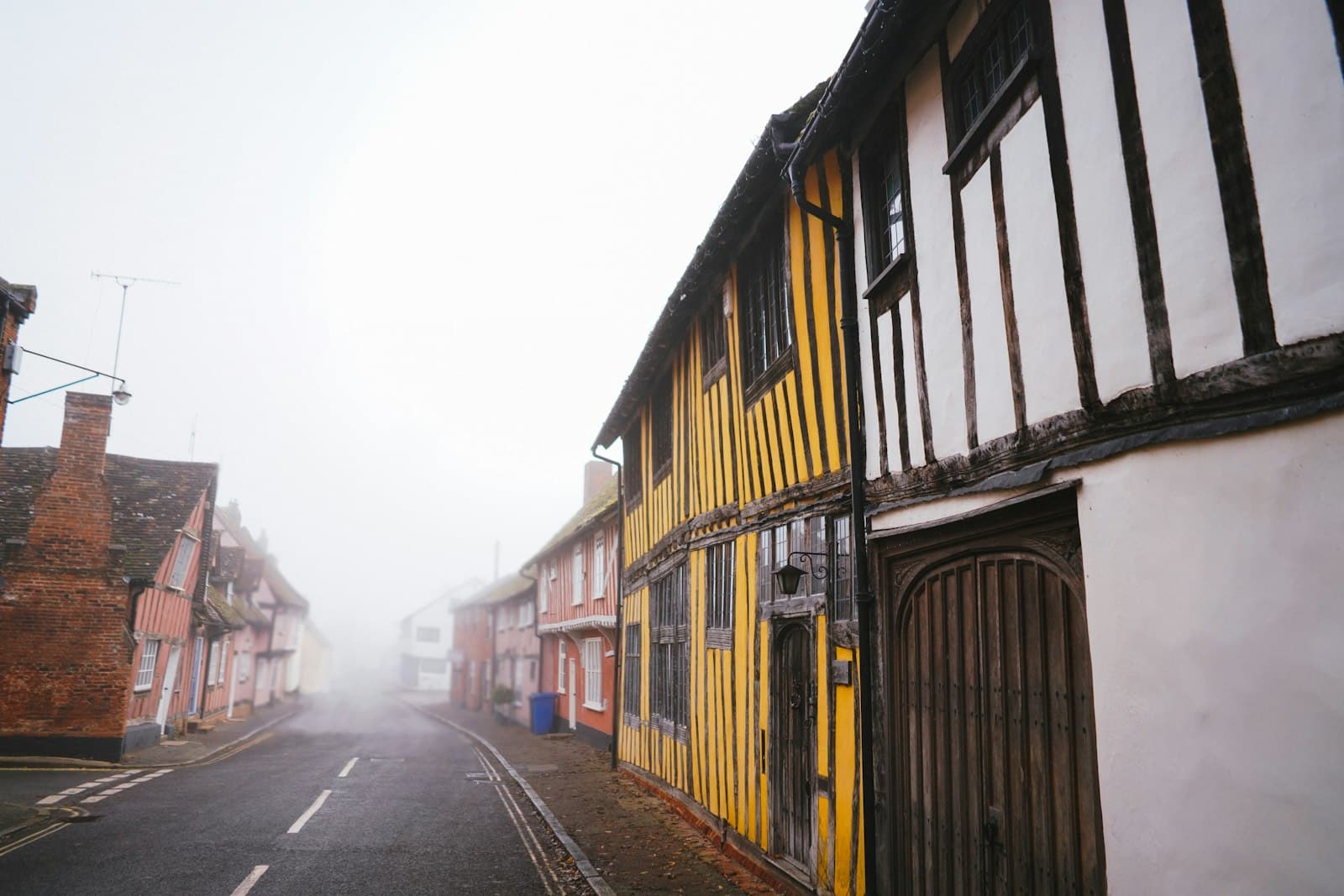
Lavenham, un village du Suffolk, en Angleterre, donne l'impression d'un voyage dans le temps. Avec plus de 300 bâtiments à colombages classés, dont beaucoup datent du XVe siècle, il est l'un des villages médiévaux les mieux conservés d'Angleterre. L'architecture distinctive du village, caractérisée par ses maisons penchées et ses façades colorées, reflète directement son histoire remarquable en tant que ville drapière prospère.
Autrefois la 14e ville la plus riche de l'Angleterre Tudor, la prospérité de Lavenham reposait sur son célèbre drap bleu, un tissu de laine de luxe exporté dans toute l'Europe et jusqu'en Russie. Cette opulence passée est évidente dans les grands bâtiments qui bordent ses rues, du Guildhall à l'imposante église paroissiale. Aujourd'hui, Lavenham offre un mélange d'histoire durable et une communauté chaleureuse, invitant les visiteurs à explorer ses sites historiques, ses boutiques indépendantes, ses cafés et ses restaurants.
Le caractère durable du village a également attiré l'attention du monde du divertissement, servant de lieu de tournage pour la maison d'enfance de Harry Potter, Godric's Hollow, dans Harry Potter et les Reliques de la Mort, partie 1, le Guildhall de Lavenham représentant la maison de James et Lily Potter. Il a également été choisi par John Lennon et Yoko Ono comme décor de leur film d'avant-garde de 1969, Apotheosis.
Bien que Lavenham soit principalement connue pour son héritage médiéval, des preuves archéologiques suggèrent que la région était habitée par les Romains, probablement en tant que communauté agricole florissante. Le village a obtenu une reconnaissance officielle au milieu du XIIIe siècle lorsque Henri III lui a accordé le statut de marché en 1257. Cela a marqué un tournant, car les commerçants ont convergé vers la région, et Lavenham a commencé à prospérer grâce au commerce florissant de la laine.
Aux XIVe et XVe siècles, Lavenham est devenu un centre important de l'industrie drapière anglaise, se spécialisant dans un drap teint à la guède, connu sous le nom de "Bleu de Lavenham". Ce tissu de haute qualité était exporté dans toute l'Europe, faisant de Lavenham l'une des colonies les plus riches d'Angleterre. En 1524, elle était classée 14e ville la plus riche du pays, dépassant même de plus grandes villes comme York et Lincoln en termes de contributions fiscales.
Cette immense richesse a financé la construction de nombreux des impressionnants bâtiments à colombages visibles aujourd'hui, y compris le Guildhall de Corpus Christi, construit vers 1529, et la grande église Saint-Pierre et Saint-Paul, achevée en 1525. Des familles de drapiers aisées, telles que les Spring et les de Vere, ont joué un rôle essentiel dans l'économie de la ville et ont été d'importants bienfaiteurs de ces merveilles architecturales.
La prospérité du commerce de la laine de Lavenham a commencé à décliner à la fin du XVIe siècle. Plusieurs facteurs y ont contribué, notamment les lourdes taxes et les sanctions commerciales imposées par Henri VIII lors de ses campagnes en France, qui ont perturbé les marchés d'exportation. De plus, les réfugiés hollandais des environs de Colchester ont commencé à tisser des tissus plus légers, moins chers et plus à la mode, ce qui a eu un impact supplémentaire sur le marché du drap spécialisé de Lavenham. En 1568, le commerce de la laine de Lavenham s'était effondré, et son classement en tant que ville riche a considérablement diminué.
Ironiquement, ce ralentissement économique a joué un rôle crucial dans la préservation du caractère médiéval de Lavenham. Avec moins d'argent pour de nouvelles constructions ou des rénovations importantes, de nombreux bâtiments du XVe siècle sont restés largement inchangés, laissant la ville telle qu'elle apparaissait à son apogée. Cet héritage d'architecture médiévale préservée fait de Lavenham une destination unique et captivante aujourd'hui.
Une promenade à travers Lavenham révèle une collection captivante de bâtiments médiévaux à colombages, dont beaucoup sont des structures classées. Les principales artères du village, y compris High Street, Water Street et Lady Street, mettent en valeur son patrimoine architectural.
Commencez par le Lavenham Guildhall sur Market Place, un remarquable bâtiment à colombages datant de 1529. Aujourd'hui un musée du National Trust, il offre un aperçu de l'histoire de la ville, du commerce de la laine et de ses divers rôles de prison et d'atelier de travail forcé. Vous pouvez également profiter de son salon de thé et de son jardin.
À quelques pas se trouve Little Hall, une maison de maître de la fin du XIVe siècle. Construite vers 1390 pour une famille de drapiers, elle a été méticuleusement restaurée et meublée par les frères jumeaux Gayer-Anderson dans les années 1920 et 30, offrant un aperçu de siècles de vie domestique. Son jardin clos anglais traditionnel est également ouvert aux visiteurs.
Dominant l'horizon se trouve la magnifique Église Saint-Pierre et Saint-Paul, une église paroissiale classée Grade I. Construite entre les années 1480 et 1520, elle est considérée comme l'un des plus beaux exemples d'architecture gothique perpendiculaire tardive d'Angleterre, témoignage de la richesse de la ville alimentée par la laine. La tour de l'église, haute de 138 pieds, est réputée être la plus haute tour d'église de village de Grande-Bretagne.
Ne manquez pas la De Vere House sur Water Street, une propriété classée Grade I connue pour sa charpente distinctive et son rôle de lieu de tournage pour Harry Potter et les Reliques de la Mort, partie 1. Pour goûter aux spécialités locales, explorez les boutiques indépendantes, les antiquaires, les cafés et les pubs du village. L'hôtel Swan, avec son historique Airmen's Bar, offre une occasion unique de se connecter à l'histoire de la Seconde Guerre mondiale.
La meilleure période pour visiter Lavenham pour les activités de plein air s'étend de fin juin à début septembre, avec un pic la dernière semaine de juillet. Pendant ces mois, le temps est généralement agréable, avec des températures diurnes moyennes allant de 20°C à 23°C. Juillet est également le mois le plus ensoleillé, avec une moyenne de 6,3 heures d'ensoleillement par jour. Septembre offre des conditions légèrement fraîches et légèrement venteuses, avec des températures comprises entre 10°C et 19°C, ce qui en fait un choix agréable pour l'exploration.
Lavenham est situé dans le Suffolk, à environ 124 km par la route de Londres via la M11, ou à environ une heure de route de l'aéroport de Stansted et à 30 minutes d'Ipswich. Bien que la gare de Lavenham ait fermé en 1961, vous pouvez rejoindre le village en transports en commun via des bus depuis Ipswich (lignes 111 ou 716) ou en prenant un train jusqu'à Bury St Edmunds ou Sudbury, puis en montant dans le bus numéro 753. Le village lui-même se visite facilement à pied.
Il y a de nombreux parkings gratuits en bord de route, ainsi que des parkings avec bornes de recharge électrique. Pour les informations touristiques, le Village Hub au 2 Lady Street est tenu par des bénévoles et fournit des cartes de sentiers, des horaires de bus, des guides cyclistes et des connaissances locales. Le Village Hub est ouvert de 10h30 à 14h30 le lundi, mardi, jeudi et vendredi, et de 11h00 à 14h00 le samedi. Des visites guidées quotidiennes de la ville partent de l'hôtel Swan tous les mercredis toute l'année, avec des visites supplémentaires les samedis et dimanches d'avril à octobre.
Lavenham en coréen, en chinois ou en hébreu — et dans 29 autres langues, chaque étape narrée par une voix native. La plus large gamme de langues de tous les audioguides autoguidés.
Disponible en :