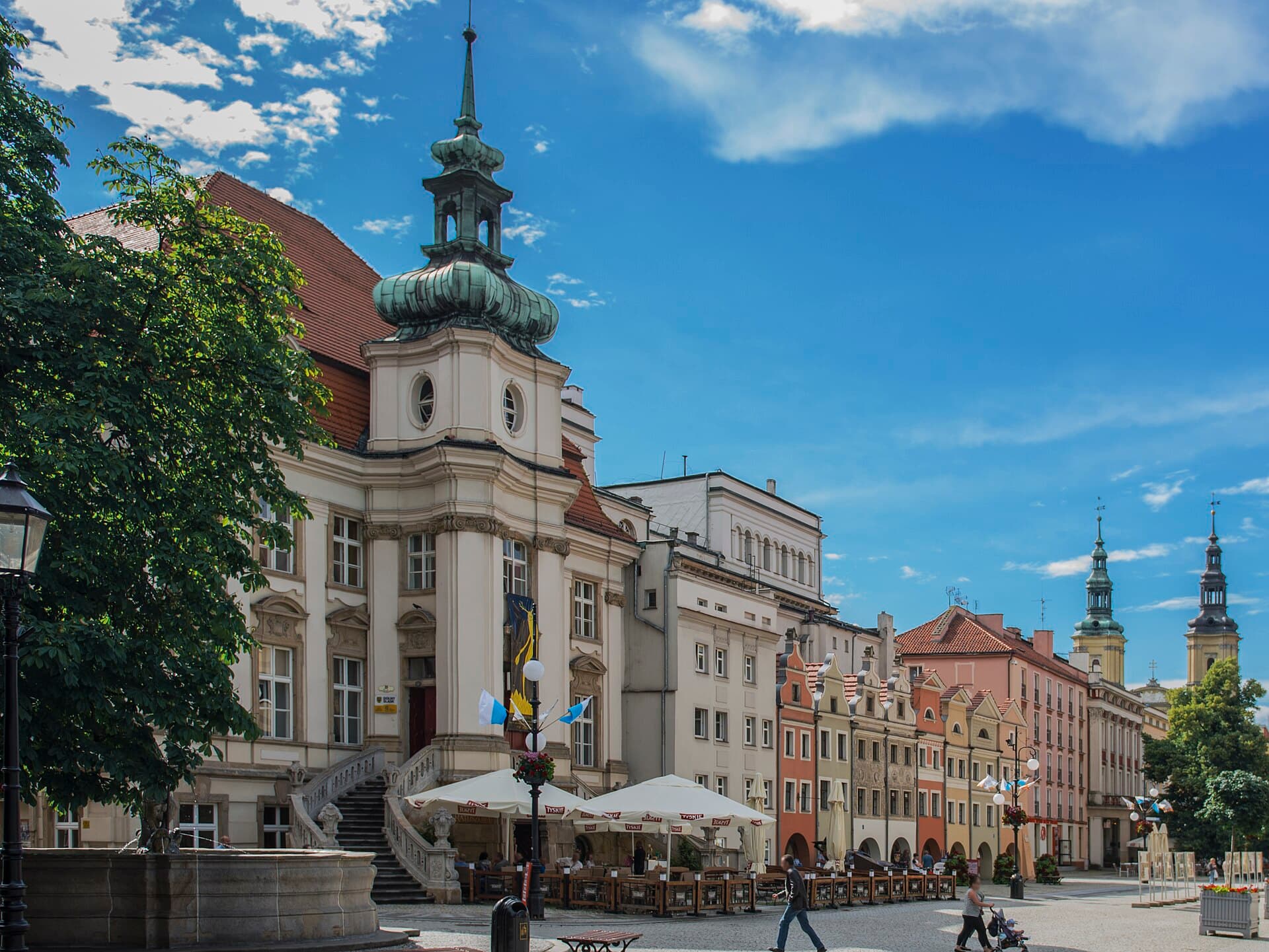
Legnica, PolandMarek Śliwecki / CC BY-SA 4.0, via Wikimedia Commons
PL

Legnica

Where centuries of history are etched in brick and whispered in the city's very stones.

The secrets of Legnica

Legnica, as no one tells it.

Not the postcards. The stories even locals don't know — whispered in your ear, right where they happened.

3 secrets below. Many more wait inside the tour.
Piast Castle

The formidable Piast Castle, among Poland's most ancient brick strongholds, conceals a tale linking medieval intrigue with a rather unfortunate royal oversight.

Full story unlocks in the tour
Market Square

Legnica's Market Square, with its colorful facades and Baroque Town Hall, reveals a peculiar detail reflecting the city's artistic heritage and enduring spirit.

Full story unlocks in the tour
Tarninów District

Beyond the Old Town, the Tarninów district enchants with its Art Nouveau villas, yet a particular feature within its verdant gardens offers a whimsical glimpse into local folklore.

Full story unlocks in the tour
The full tour

Discover every secret of Legnica

Every address, every reveal in full — in your ear, right where it happened.

Get the key to Legnica

You pick your stops. You walk. The voice reveals what the others miss.

Choose your time

How long do you have in Legnica?

No tours available yet. Check back soon — we're preparing them.

About Legnica

The story of Legnica

Legnica, a city in southwestern Poland, is a place where history echoes through its varied architecture and a palpable sense of the past. Resting in the Lower Silesia region beside the Kaczawa River, Legnica has been a significant center for ages, evolving from a medieval ducal seat to a contemporary hub for culture and economics. It is a city that slowly unveils its many layers, inviting visitors to explore its narratives and uncover its singular character.

With a population of approximately 90,000, Legnica presents a distinct blend of historical sights and modern existence. Its Old Town, though partially reconstructed after post-WWII damage, still holds an appeal with its ancient pathways and historic buildings. Legnica's strategic position, with excellent transport connections, makes it an accessible and rewarding destination for those seeking to venture beyond Poland's more frequented cities.

History

## From Piast Stronghold to 'Little Moscow' Legnica's origins trace back to the 7th century, with its first mention in chronicles in 1004 and the name 'Legnica' appearing in 1149 under High Duke Bolesław IV the Curly. For nearly 700 years, from the 10th century until 1675, Legnica served as the longest-reigning seat of the Piast dynasty, a powerful Polish ruling family, and a significant center of their authority. It became the capital of an autonomous principality in 1248. The city also holds the distinction of being a historical burial site for Polish monarchs and consorts.

A pivotal moment in Legnica's history occurred on April 9, 1241, when the Battle of Legnickie Pole unfolded nearby. In this fierce confrontation, a Polish-led Christian coalition was defeated by the invading Mongol forces. Despite this destruction, Legnica was refounded between 1242 and 1252 and swiftly developed into an important trade center, recognized for its weaving industry.

Over the centuries, Legnica experienced various rulers, falling under Habsburg rule after the last Piast duke died in 1675, and then becoming part of Prussia in the 18th century following the Silesian Wars. The 16th century also saw Legnica become a center of the Protestant movement. In the 19th century, it developed into a modern capitalist town within Prussia and later Germany.

After sustaining damage during World War II, Legnica was incorporated back into Poland. For a period after the war, it served as the capital of the Lower Silesian region when Wrocław was largely destroyed. A unique chapter in its recent history is the period from 1945 until 1993, when Legnica served as the main base for the Northern Group of Forces of the Soviet Army in Poland, earning it the moniker 'Little Moscow.' The last Russian soldier departed Legnica in 1993. Today, Legnica is a modern city that embraces its layered past, often serving as a movie set for historical productions due to its distinctive architecture and atmosphere.

What to see

Begin your journey in Legnica's Old Town, where the Market Square acts as a central point, though its dense development offers a unique character compared to other regional squares. Here, you will find the Baroque Town Hall, dating back to 1741, which now forms part of the local theater, alongside picturesque 16th-century townhouses.

A prominent landmark is the Piast Castle, constructed in the 12th century as Poland's first brick stronghold. While damaged by the Soviet Army and rebuilt in the 1960s, you can still explore parts of the castle and ascend its tower for sweeping city views during the high season (May to October). The Cathedral of Saints Peter and Paul, first mentioned in 1208, displays Gothic architecture from its construction between 1333 and 1380, with a notable rosette window between its towers.

For another perspective, ascend the over 200 steps to the tower of the Church of the Virgin Mary, offering another excellent city panorama. The Copper Museum is a repository of art, providing insights into copper and the city's narrative. Do not overlook the Knights' Academy, a significant example of Baroque secular architecture in Lower Silesia. For a tranquil interlude, the City Park, one of western Poland's most beautiful, offers winding paths, ancient trees, and multimedia fountains.

When to visit

The most favorable time to visit Legnica for agreeable weather and outdoor pursuits is during late spring (May and June) or early autumn (September and October). In these months, temperatures are mild, ranging from 10-20°C (50-68°F), ideal for walking and exploration. Summers (June to August) are also warm, with temperatures reaching 25-30°C (77-86°F), though humidity and occasional rain may occur. Legnica enjoys one of Poland's warmest climates and longest growing seasons, ensuring verdant surroundings for much of the year. Winters are cold and snowy, with temperatures often falling below freezing.

Practical

Legnica is readily accessible, particularly by train, as its historic railway station is located in the city center. There are frequent train connections from Wrocław, with travel times under an hour. The nearest major airport is Wrocław Copernicus Airport, approximately 70 km away, from which you can take a train or bus to Legnica. The city maintains a reliable public transportation system, including buses, with tickets available at kiosks, machines, or from the driver.

The currency used is the Polish złoty (PLN), and while credit and debit cards are widely accepted, it is advisable to carry some cash for smaller purchases. While knowing some basic Polish phrases is helpful, many locals, especially in tourism and younger generations, speak English. Legnica offers a range of accommodation options, from budget hostels to hotels and guesthouses, and booking in advance is recommended, particularly during peak season.

Good to know
What is Legnica known for?
Legnica is recognized for its extensive history, especially its long association with the Piast dynasty, its role as the site of the 1241 Battle of Legnickie Pole, and its diverse architecture spanning medieval to modern periods. It was also known as "Little Moscow" during the Cold War due to the presence of Soviet forces.
Is Legnica a good day trip from Wrocław?
Yes, Legnica is considered an easy and interesting day trip from Wrocław, with frequent train connections taking less than an hour.
What is the main attraction in Legnica?
One of the most important attractions in Legnica is the Piast Castle, one of Poland's oldest and largest brick strongholds, which served as the seat of the Piast dukes for centuries.
What local dishes should I try in Legnica?
When in Legnica, you should try traditional Polish dishes such as pierogi (dumplings), bigos (hunter's stew), and kiełbasa (sausage). Do not forget to sample local pastries and sweets, including the Legnicka bomba, a gingerbread delicacy.
Is Legnica safe for tourists?
Yes, Legnica is generally safe for tourists. However, as with any destination, it is important to be aware of your surroundings and take standard precautions to protect your belongings.
What cultural events or festivals are held in Legnica?
Legnica hosts several cultural events and festivals throughout the year, including the Legnica Cantat Choir Festival, the Legnica Copper Festival, and various local fairs and markets. The city also hosts the Legnica Festival of the Arts.
Legnica
From€9.00
No booking · activate anytime · 12h to walk it
Get the key to Legnica