St. Nicholas Church (Nikolaikirche)
This seemingly ordinary church played an extraordinary role in reshaping a nation.
Full story unlocks in the tour
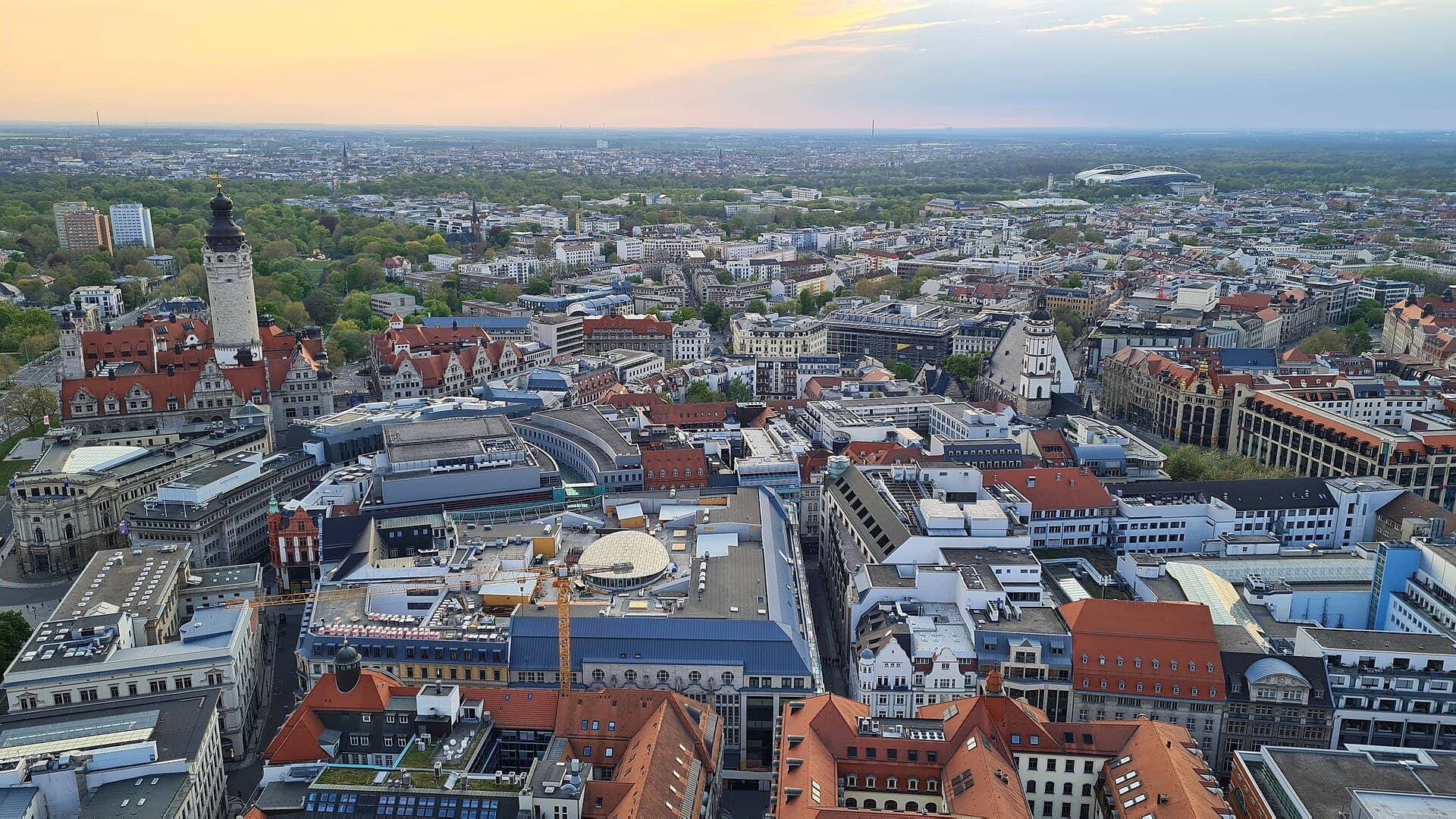 Derbrauni / CC BY 4.0, via Wikimedia Commons
Self-guided audio walking tour of Leipzig — GPS route, offline playback, story-driven narration in 32 languages.
“Leipzig: Where echoes of Bach meet the whispers of revolution.”
Not the postcards. The stories even locals don't know — whispered in your ear, right where they happened.
This seemingly ordinary church played an extraordinary role in reshaping a nation.
Leipzig claims a unique place in European coffee culture, and this establishment holds a significant part of that story.
Beyond its imposing size, this monument holds a secret within its depths, literally.
Discover every secret of Leipzig
Every address, every reveal in full — in your ear, right where it happened.
You pick your stops. You walk. The voice reveals what the others miss.


Your self-guided audio tour of Leipzig is ready — pick your landmarks, choose your language, and start the moment you arrive.
BuyLume has a built-in augmented-reality guide. Hold your phone up and its camera shows the street ahead of you, with a glowing arrow laid over the real view that always points to your next stop — no map to puzzle over, no wrong turns. Like everything in Lume, it works fully offline.
Leipzig, the most populous city in Saxony, Germany, is a dynamic urban center approximately 150 km southwest of Berlin. Situated at the confluence of the White Elster, Pleiße, and Parthe rivers, the city lies in the fertile Leipzig Bay, part of the North German Plain. Known informally as 'Hypezig' or 'The better Berlin,' Leipzig has a reputation as a lively urban center with a thriving lifestyle and creative scene, attracting a younger demographic.
Leipzig's character is a blend of historical significance and contemporary energy. It has long been a major hub for trade, culture, and music. The city's extensive network of passages and arcades, remnants of its trade fair past, now house shops and restaurants. With a profound musical heritage, a pivotal role in modern German history, and a flourishing arts scene, Leipzig offers a multifaceted experience for visitors.
Leipzig's origins trace back to its first mention in 1015 as "Urbs Libzi." By 1165, it was granted city and market privileges, establishing its importance at the intersection of two significant medieval trade routes: the Via Regia and the Via Imperii. This strategic location fostered its growth as a major commercial center, with the Leipzig Trade Fair dating back to 1190. The city's economic prominence led to it becoming a leading German commercial center by 1700.
Leipzig's intellectual and cultural life flourished early on, particularly with the founding of the University of Leipzig in 1409, one of the oldest universities in the German-speaking world. The city also became a significant center for printing and publishing between 1764 and 1945. It played a crucial role in the Reformation, with Martin Luther preaching at St. Thomas Church in 1539.
The city has witnessed several significant historical events, including major battles during the Thirty Years' War and the pivotal Battle of Leipzig in 1813, which saw Napoleon's defeat. In the 19th century, Leipzig underwent industrialization, becoming a pioneer in Germany, particularly in the Plagwitz district, which developed into a major industrial area with extensive infrastructure. The city also became a central railway hub in Germany, with the opening of the first long-distance railway line to Dresden in 1839 and the subsequent construction of Leipzig Hauptbahnhof, which became Europe's largest terminus station by 1915.
After World War II, Leipzig became a major urban center in East Germany. The city gained international recognition for its role in the "Peaceful Revolution" of 1989. Protests, initially as prayer meetings at St. Nicholas Church, grew into large-scale demonstrations that significantly contributed to the fall of the communist regime and the reunification of Germany. While its industrial importance declined after reunification, Leipzig has since reoriented itself as a trade fair city, a university city, and a lively cultural hub.
Begin your exploration in Leipzig's city center, where the Markt (Main Square) is dominated by the Old Town Hall (Altes Rathaus), a striking example of German Renaissance architecture dating from 1556/57. Inside, you'll find the Museum of City History Leipzig, detailing the city's past. Nearby, the Mädler Passage, a grand arcade from the early 1900s, houses shops and restaurants, including the famous Auerbachs Keller, immortalized in Goethe's Faust.
Leipzig's musical heritage is evident at St. Thomas Church (Thomaskirche), where Johann Sebastian Bach worked as music director from 1723 until his death in 1750, and where he is now buried. The church is also home to the renowned St. Thomas Boys Choir. Another significant church is St. Nicholas Church (Nikolaikirche), dating back to 1165 and known for its unique interior with pink columns. This church played a crucial role in the Peaceful Revolution of 1989.
Beyond the city center, the colossal Monument to the Battle of the Nations (Völkerschlachtdenkmal) commemorates the 1813 Battle of Leipzig. Standing 91 meters high, it offers impressive views from its viewing platforms. For a different perspective, the City-Hochhaus Leipzig, nicknamed the "Uniriese" (Uni Giant), is the city's tallest building and provides panoramic vistas. The Leipzig Zoological Garden is another popular attraction, particularly its Gondwanaland indoor rainforest exhibit.
The best time to visit Leipzig is generally from mid-May to late September, offering pleasant weather for exploring. Late spring (March to May) brings comfortable temperatures between 10°C and 20°C, with parks coming alive and a lively cultural season. Summer (June to August) is peak season, with warm temperatures (22°C to 30°C) and long daylight hours, perfect for outdoor activities and festivals like the Bachfest and Wave-Gotik-Treffen. Early autumn (September to November) also offers mild temperatures (12°C to 20°C) and fewer crowds, with beautiful fall foliage. Winter (December to February) is cold, but brings festive charm with the Leipzig Christmas markets.
Leipzig is well-connected and easy to navigate. The city is a major railway hub in central Germany, with Leipzig Hauptbahnhof being one of Europe's largest terminus stations. Within the city, public transportation is efficient, and the city center is compact and walkable. Consider purchasing a Leipzig Card for unlimited travel on public transport and discounts on attractions. The official tourism website, leipzig.travel, provides comprehensive information. While German is the primary language, English is often understood in tourist areas. The local currency is the Euro. For accommodation, options range from hotels in the historic center to guesthouses in the lively neighborhoods. Keep in mind that summer can mean higher accommodation prices due to festivals and increased tourism.
Leipzig in Korean, in Chinese or in Hebrew — and 29 more languages, every stop narrated by a native voice. The widest language range of any self-guided audio tour.
Available in: