Schloss Bruck
This medieval castle, once a residence for powerful counts, conceals a secret that might make you examine its ancient walls more closely.
Full story unlocks in the tour
 Bybbisch94, Christian Gebhardt / CC BY-SA 4.0, via Wikimedia Commons
Self-guided audio walking tour of Lienz — GPS route, offline playback, story-driven narration in 32 languages.
“Where the Dolomites meet Mediterranean flair.”
Not the postcards. The stories even locals don't know — whispered in your ear, right where they happened.
This medieval castle, once a residence for powerful counts, conceals a secret that might make you examine its ancient walls more closely.
Step inside Lienz's most significant religious structure and encounter a peculiar acoustic phenomenon.
The town's central square, a lively gathering place, holds a sweet secret concerning one of Austria's oldest traditions.
Discover every secret of Lienz
Every address, every reveal in full — in your ear, right where it happened.
You pick your stops. You walk. The voice reveals what the others miss.


Your self-guided audio tour of Lienz is ready — pick your landmarks, choose your language, and start the moment you arrive.
BuyLume has a built-in augmented-reality guide. Hold your phone up and its camera shows the street ahead of you, with a glowing arrow laid over the real view that always points to your next stop — no map to puzzle over, no wrong turns. Like everything in Lume, it works fully offline.
Lienz, often called the "Pearl of the Dolomites," is a captivating town in East Tyrol, Austria, where the grandeur of the Alps converges with a surprising Mediterranean influence. Positioned at the juncture of the Isel and Drava rivers, the town is framed by the rugged peaks of the Lienz Dolomites to the south and the Hohe Tauern range to the north. With a population of around 12,113, Lienz presents a blend of outdoor exploration and cultural depth.
The town's distinctive geographical placement, merely 40 km from the Italian border, contributes to its mild climate and singular atmosphere. You will encounter colorful Biedermeier palaces, animated cafes, and a relaxed rhythm that invites unhurried discovery. Lienz serves as an excellent starting point for exploring the surrounding East Tyrolean Alps, whether your inclination is for skiing in winter or hiking and cycling in summer.
The story of Lienz extends back to the Bronze Age, with evidence of human presence dating to approximately 2000 BC. Celtic people, primarily engaged in mining, inhabited the area from about 300 BC. By 15 BC, the region came under the dominion of the Roman Empire and was incorporated into the province of Noricum. Emperor Claudius established a Roman town, or municipium, called Aguntum near what is now Lienz. Aguntum even became the seat of an early Christian bishop in the 5th century, though it saw decline around 600 AD during conflicts with Slavic and Bavarian groups.
Lienz was first identified by name as Luenzina around 1030. The settlement and the neighboring Patriasdorf initially belonged to the Patriarchs of Aquileia. The formidable Meinhardiner dynasty, who later became the Counts of Görz (Gorizia), acquired Lienz and made it their residence. Its strategic location on the significant trade route connecting Venzone in Friuli to Salzburg fostered its expansion. Lienz was granted city rights on February 25, 1242. By 1278, the Counts completed Schloss Bruck, a formidable castle that served as their local seat until 1500.
Upon the extinction of the Counts of Görz family in 1500, their lands, including Lienz, passed to the Habsburg King Maximilian I, and Lienz became part of the County of Tyrol. The town experienced periods of occupation, notably twice by French troops in 1797 during the French Revolutionary Wars. After the Austrian defeat at the Battle of Austerlitz in 1805, Lienz was briefly part of the Kingdom of Bavaria and then the Napoleonic Illyrian Provinces before being re-conquered by Austrian troops in 1813.
After World War I, the Treaty of Saint-Germain separated South Tyrol from the Austrian state of Tyrol, making East Tyrol, with Lienz as its administrative center, an exclave. The construction of the Felbertauern Tunnel in 1967 significantly improved transport connections and economic development for the region. Today, Lienz flourishes as an economic and cultural center, balancing its extensive past with modern commerce, tourism, and healthcare.
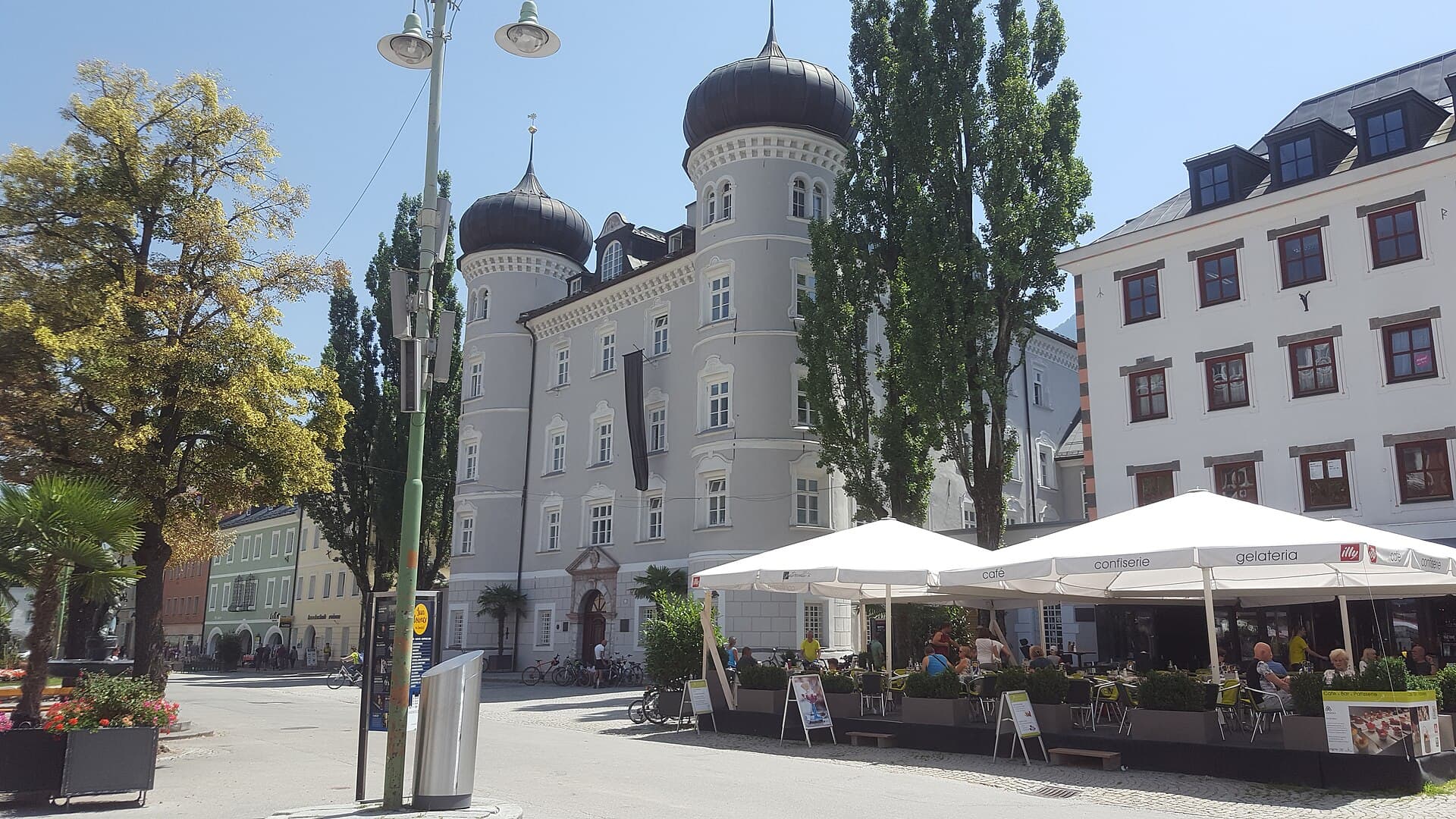
Begin your journey at the Hauptplatz, Lienz's central square, which is surrounded by buildings in the Tyrolean style, cafes, and shops. From June to September, the square is reserved for pedestrians, allowing visitors to absorb the atmosphere. Dominating the square is the Liebburg, a 17th-century castle with distinctive onion domes, now serving as the town hall.
A short stroll from the center, Schloss Bruck is a medieval fortress that once housed the Counts of Gorizia. Today, it hosts a local history museum, displaying Roman artifacts, Gothic art, Tyrolean costumes, and an art gallery dedicated to the important Austrian artist Albin Egger-Lienz, who was born in Lienz. The castle tower provides expansive views of the town and surrounding mountains.
For a glimpse into Lienz's Roman past, visit Aguntum, an ancient Roman municipium situated just beyond the city. A modern glass structure protects the remains, and the museum includes a reconstructed villa and artifacts. Those who appreciate the outdoors can explore the River Isel, one of the last untouched glacier rivers in the Alps, with pathways for walking, cycling, and rafting along its banks. Just 5 km from Lienz, Tristacher See is a natural lake perfect for swimming in summer or ice skating in winter.
Lienz offers distinct experiences depending on the season. For hiking, biking, and swimming, the months of May to October provide agreeable weather. June, July, and August are generally the warmest months, with average daytime temperatures around 16-18°C (61-65°F), ideal for sightseeing and outdoor activities, though these months also experience the most rainfall. For skiing, Christmas markets, and other winter activities, December to February is the most opportune time. January is the coldest month, with average daytime highs around -3°C (27°F).
Lienz, with an estimated population of 12,113 in 2026, is situated in East Tyrol, Austria. The local currency is the Euro (€), and German is the official language. The town's elevation is 681 meters (2234 feet) above sea level.
Lienz is well-connected by public transport. The Lienz railway station, modernized in 2022, is a hub for environmentally friendly mobility, with connections via the Drautalbahn railway line to South Tyrol and Carinthia. Numerous buses also link Lienz to all regions of East Tyrol. Within the city, free buses operate regularly between the center and ski areas or Lake Tristacher during winter and summer seasons. Lienz is compact and easily traversable on foot, making many attractions readily accessible.
Lienz in Korean, in Chinese or in Hebrew — and 29 more languages, every stop narrated by a native voice. The widest language range of any self-guided audio tour.
Available in: