Drachenbrücke
Die Drachenbrücke in Ljubljana ist berühmt für ihre vier imposanten Drachenstatuen. Aber was passiert laut lokaler Legende, wenn eine Jungfrau die Brücke überquert?
Die ganze Geschichte wird in der Tour freigeschaltet
 Andrew Milligan Sumo / CC BY 2.0, via Wikimedia Commons
Selbstgeführte Audio-Walking-Tour durch Ljubljana — GPS-Route, Offline-Wiedergabe, erzählerische Narration in 32 Sprachen.
“Wo alte Drachen Jugendstil-Träume bewachen.”
Nicht die Postkarten. Die Geschichten, die selbst Einheimische nicht kennen – dir ins Ohr geflüstert, genau dort, wo sie geschahen.
Die Drachenbrücke in Ljubljana ist berühmt für ihre vier imposanten Drachenstatuen. Aber was passiert laut lokaler Legende, wenn eine Jungfrau die Brücke überquert?
Die moderne Standseilbahn, die Besucher zur Burg von Ljubljana bringt, scheint eine neue Erfindung zu sein, aber die Idee für einen mechanischen Aufstieg reicht über ein Jahrhundert zurück. Wer hat sie zuerst vorgeschlagen und warum die lange Verzögerung?
Ljubljanas ikonische Dreifachbrücke, entworfen von Jože Plečnik, ist ein Wunder der Stadtplanung. Aber jenseits ihres einzigartigen dreifachen Designs birgt sie eine überraschende Besonderheit in Bezug auf öffentliche Einrichtungen.
Entdecke jedes Geheimnis von Ljubljana
Jede Adresse, jede Enthüllung vollständig – in deinem Ohr, genau dort, wo es geschah.
Du wählst deine Stationen. Du gehst. Die Stimme enthüllt, was andere übersehen.


Deine selbstgeführte Audio-Tour durch Ljubljana ist bereit – wähle deine Sehenswürdigkeiten, deine Sprache und starte, sobald du ankommst.
KaufenLume enthält einen integrierten Augmented-Reality-Guide. Halten Sie Ihr Handy hoch: Die Kamera zeigt die Straße vor Ihnen, mit einem leuchtenden Pfeil über dem echten Bild, der immer auf Ihren nächsten Stopp zeigt — keine Karte zum Rätseln, keine falschen Abzweigungen. Wie alles bei Lume funktioniert es komplett offline.
Ljubljana, die Hauptstadt Sloweniens, ist eine Stadt, in der sich die Fäden der Zeit verweben und eine Landschaft schaffen, in der alte Geschichten auf das moderne Leben entlang des Flusses Ljubljanica treffen. Es ist ein Ort, der sich sowohl erhaben als auch intim anfühlt, mit einem Stadtzentrum, das zu gemächlichen Spaziergängen einlädt. Das Wahrzeichen der Stadt, der Drache von Ljubljana, erscheint auf ihrem Wappen und der gefeierten Drachenbrücke und verkörpert Macht, Mut und einen Geist der Größe.
Als eine der grünsten Hauptstädte Europas anerkannt, erhielt Ljubljana 2016 den Titel „Grüne Hauptstadt Europas“. Dieses Engagement für ökologisches Wohlbefinden zeigt sich in den weitläufigen Fußgängerzonen, dem effizienten öffentlichen Nahverkehr und zahlreichen Grünflächen, darunter der weitläufige Tivoli-Park. Der lebendige Kulturkalender der Stadt bietet jährlich über 10.000 Veranstaltungen, vom großen Ljubljana Festival bis zu den alternativen künstlerischen Energien von Metelkova Mesto.
Mit rund 300.000 Einwohnern ist Ljubljana eine kompakte und gut begehbare Stadt, die es einfach macht, ihren Reiz zu Fuß zu entdecken. Ihre zentrale Lage in Slowenien macht sie auch zu einem ausgezeichneten Ausgangspunkt für die Erkundung der vielfältigen Landschaften des Landes, von den Julischen Alpen bis zur Adriaküste.
Ljubljanas Geschichte reicht bis zu einem römischen Lager aus dem 1. Jahrhundert v. Chr. zurück, bekannt als Emona. Nach der Zerstörung von Emona durch die Hunnen gründeten slawische Stämme eine Siedlung unter dem heutigen Burghügel, die sich zum mittelalterlichen Ljubljana entwickelte, damals Laibach genannt.
Seine strategische Lage an der Konvergenz wichtiger europäischer Transportwege trug zu seiner historischen Bedeutung bei. Im Jahr 1335 wurde Ljubljana zum Verwaltungszentrum der habsburgisch-österreichischen Provinz Krain. Im 15. Jahrhundert wurde die Burg von Ljubljana aufgrund türkischer Einfälle befestigt und unter Kaiser Friedrich III. von Habsburg erheblich umgebaut. Die Burg, ursprünglich eine hölzerne und steinerne Befestigungsanlage aus dem 11. Jahrhundert, wurde im 15. Jahrhundert und erneut im 16. und 17. Jahrhundert umfassend umgebaut.
Kurzzeitig unter französischer Herrschaft im frühen 19. Jahrhundert als Hauptstadt der Illyrischen Provinzen erlebte Ljubljana einen Aufschwung des slowenischen Nationalgefühls. Nach seiner Rückkehr zur österreichischen Herrschaft im Jahr 1815 diente die Burg bis 1895 als Gefängnis und erneut während des Zweiten Weltkriegs. Die Stadt wurde durch ein verheerendes Erdbeben im Jahr 1895 tiefgreifend umgestaltet, das umfangreiche Wiederaufbaubemühungen auslöste, insbesondere im Jugendstil. Der Architekt Jože Plečnik spielte im 20. Jahrhundert eine zentrale Rolle bei der Neugestaltung großer Teile der Stadt und strebte danach, Ljubljana mit seiner unverwechselbaren architektonischen Vision in ein „neues Athen“ zu verwandeln. Im Jahr 1905 erwarb Bürgermeister Ivan Hribar die Burg von Ljubljana für die Stadt mit der Absicht, ein Museum einzurichten, obwohl sie später bis in die 1960er Jahre verarmte Familien beherbergte, bevor umfassende Renovierungen begannen. Slowenien erlangte 1991 die Unabhängigkeit, mit Ljubljana als Hauptstadt.
Ljubljanas architektonisches Panorama zeigt eine Verschmelzung von Stilen, von den wenigen verbliebenen österreichischen Barockbauten bis zu den weit verbreiteten Jugendstilgebäuden, die nach dem Erdbeben von 1895 entstanden. Jože Plečniks Einfluss ist besonders spürbar, seine Entwürfe sind entlang des Flusses Ljubljanica und in wichtigen Stadtgebieten wie dem Prešeren-Platz und der Dreifachbrücke sichtbar. Sein Bestreben ging dahin, eine Stadt mit Elementen zu schaffen, die an eine antike griechische Polis erinnern, darunter ein Stadion, ein Friedhof, ein Marktplatz und eine Akropolis.
Die Drachenbrücke, fertiggestellt 1901, ist ein Paradebeispiel für Jugendstilarchitektur und eine frühe Anwendung von Stahlbeton in Europa. Sie ersetzte eine ältere Holzbrücke und war Teil einer breiteren Stadterneuerungsinitiative. Die Dreifachbrücke, ursprünglich eine einzelne Steinbrücke aus dem Jahr 1842, wurde von Plečnik in den 1930er Jahren in drei miteinander verbundene Brücken umgewandelt, um Fußgänger- und Fahrzeugverkehr zu trennen. Diese architektonischen Entwicklungen unterstreichen Ljubljanas kontinuierliche Entwicklung, während sie sorgfältig ihre tiefen historischen Schichten pflegt.
Beginnen Sie Ihre Erkundung in der Burg von Ljubljana, einer mittelalterlichen Festung, die von ihrer Anhöhe auf dem Burghügel einen weiten Blick über die Stadt bietet. Erreichen Sie sie über eine angenehme Fahrt mit der Standseilbahn vom Krek-Platz aus. Die Burg beherbergt ein Museum, das ihre Geschichte erzählt, und ist Schauplatz verschiedener kultureller Veranstaltungen.
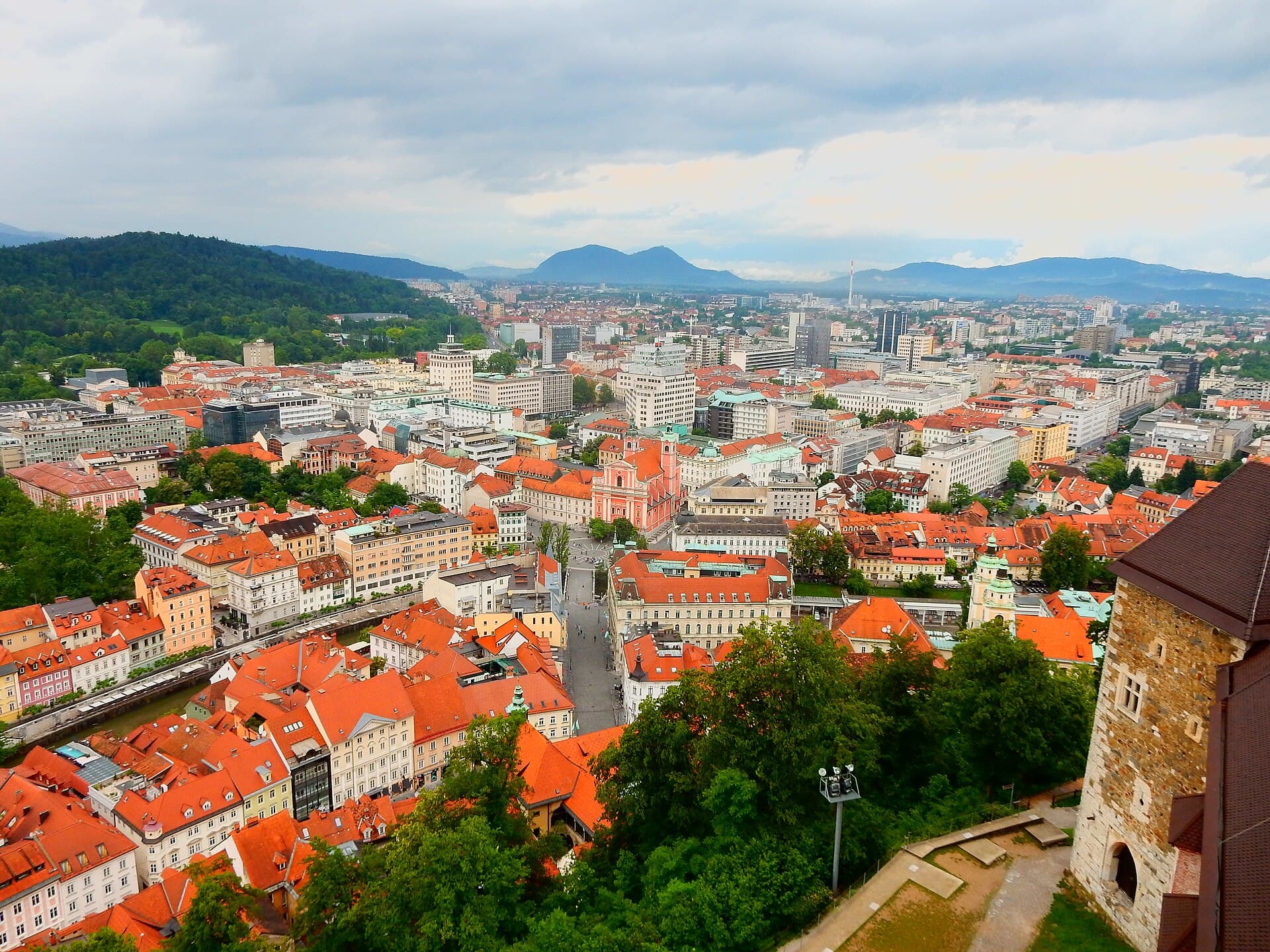
Steigen Sie in das Stadtzentrum zum Prešeren-Platz, einem lebhaften zentralen Punkt, der von der rosa Franziskanerkirche der Verkündigung eingerahmt wird. Von hier aus überqueren Sie die berühmte Dreifachbrücke (Tromostovje), Jože Plečniks unverwechselbares Design aus drei Brücken, die sich über den Fluss Ljubljanica fächern.
Folgen Sie dem Fluss zur Drachenbrücke (Zmajski most), einer Jugendstil-Kreation, die von vier imposanten Drachenfiguren, dem ewigen Wahrzeichen der Stadt, bewacht wird. Setzen Sie Ihren Spaziergang zur Metzgerbrücke (Mesarski most) fort, einer Fußgängerbrücke, die mit Skulpturen geschmückt ist und ein beliebter Ort für 'Liebesschlösser' ist. Achten Sie auf die Schusterbrücke (Čevljarski most), ein weiteres Plečnik-Design, das für seine charakteristischen Säulen bekannt ist.
Erkunden Sie den Zentralmarkt, einen belebten Bereich in der Nähe des Flusses, und schlendern Sie durch die charmante Altstadt mit ihrer Barockarchitektur und einladenden Cafés. Für eine grüne Auszeit besuchen Sie den Tivoli-Park, einen großen und sorgfältig gepflegten Stadtpark aus dem 19. Jahrhundert.
Ljubljana erlebt warme Sommer und mäßig kalte, schneereiche Winter. Die wärmsten Monate sind Juli und August mit Tageshöchstwerten zwischen 25 und 30 °C, was diese Zeiten ideal für Outdoor-Aktivitäten und Festivals macht. Im Juni kann es jedoch am meisten regnen.
Für angenehmes Wetter und weniger Andrang sollten Sie einen Besuch im späten Frühling (Mai) oder frühen Herbst (September) in Erwägung ziehen. Diese Monate bieten milde Temperaturen, lebendige Stadterlebnisse und komfortable Bedingungen für Besichtigungen. Oktober kann ebenfalls eine gute Wahl sein, obwohl es der feuchteste Monat ist, bietet er die Möglichkeit, die Stadt ohne den Hauptsommertouristenandrang zu erleben.
Die offizielle Währung in Slowenien ist der Euro (€). Kredit- und Debitkarten werden in den meisten Einrichtungen, die Besucher bedienen, weitgehend akzeptiert, aber es ist ratsam, etwas Bargeld für kleinere Geschäfte oder Cafés mitzunehmen.
Der Flughafen Ljubljana Jože Pučnik (LJU) liegt etwa 26 Kilometer nordöstlich des Stadtzentrums. Öffentliche Busse bieten eine preisgünstige Transfermöglichkeit und benötigen etwa 30-50 Minuten bis zum Hauptbusbahnhof. Taxis und private Shuttles sind ebenfalls leicht verfügbar.
Innerhalb der Stadt wird der öffentliche Nahverkehr von Ljubljana Passenger Transport (LPP) verwaltet und besteht hauptsächlich aus einem ausgedehnten Busnetz. Um die Busse zu nutzen, benötigen Sie eine Urbana-Karte oder die Urbana-Mobil-App; Barzahlungen werden an Bord in der Regel nicht akzeptiert. Die Urbana-Karte kann auch für die Standseilbahn zur Burg von Ljubljana und für BicikeLJ-Fahrradverleih genutzt werden. Für kurze Strecken innerhalb der Fußgängerzonen bietet der kostenlose elektrische Shuttle Kavalir einen bequemen Transport.
Ljubljana — Koreanisch, Chinesisch, Hebräisch und 29 weitere Sprachen, jede Station von einer muttersprachlichen Stimme erzählt. Die größte Sprachauswahl aller selbstgeführten Audiotouren.
Verfügbar auf: