Leuven Town Hall
The intricate facade of Leuven's Town Hall, adorned with 236 statues, was not always so populated.
Full story unlocks in the tour
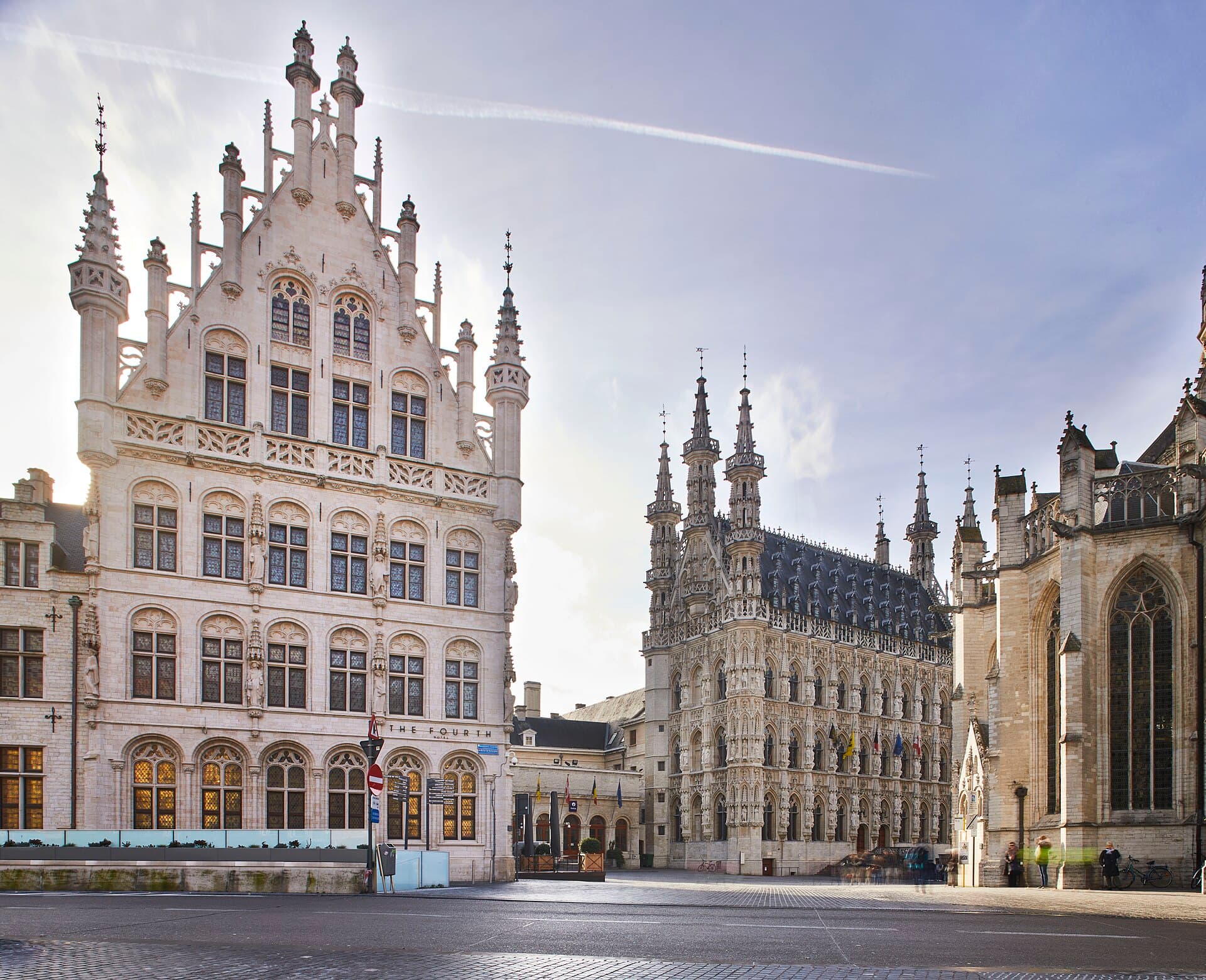 Vandevorst, Kris / CC BY 4.0, via Wikimedia Commons
“Where ancient academia meets a spirited student life.”
Not the postcards. The stories even locals don't know — whispered in your ear, right where they happened.
The intricate facade of Leuven's Town Hall, adorned with 236 statues, was not always so populated.
This Brabantine Gothic masterpiece was once envisioned to reach astounding heights, far beyond what stands today.
Leuven's iconic University Library, with its impressive belfry, carries a silent testament to international solidarity.
Discover every secret of Louvain
Every address, every reveal in full — in your ear, right where it happened.
You pick your stops. You walk. The voice reveals what the others miss.
No tours available yet. Check back soon — we're preparing them.
Leuven, often referred to by its French name Louvain, is a dynamic city in the Flemish Region of Belgium, situated approximately 25 kilometers east of Brussels. It serves as the capital of Flemish Brabant and is a prominent university town, home to the Katholieke Universiteit Leuven (KU Leuven), which was founded in 1425. This institution holds the distinction of being the oldest Catholic university in the world and the largest Dutch-speaking university globally, infusing the city with a lively, youthful atmosphere.
Beyond its academic renown, Leuven carries a deep history dating back to the 9th century when it was established around a fortress built to defend against Norman invasions. The city's architectural heritage reflects centuries of development, from its medieval prosperity as a cloth-weaving center to its resilience through two World Wars. Today, Leuven blends its medieval character with modern amenities, offering picturesque squares, a spirited cultural scene, and a strong brewing tradition, being the birthplace of Stella Artois in 1366 and the headquarters of Anheuser-Busch InBev.
Leuven's origins trace back to the 9th century, when it was founded as a fortified settlement along the Dijle River. Its strategic location quickly made it an important center for trade and defense. By the 11th century, it had become the residence of the counts of Leuven, who later became the dukes of Brabant. The city prospered as a major cloth-weaving center between the 11th and 14th centuries, with its linen cloth, known as 'lewyn,' gaining recognition in late 14th and 15th-century texts.
However, this prosperity faced challenges. A feud between the citizenry and nobility in the 14th century, including a massacre of 17 nobles in the town hall in 1379, led to the duke's vengeance and the city's decline as many weavers fled. Brussels eventually replaced Leuven as the capital of Brabant. A new golden era began in 1425 with the founding of the University of Leuven, which quickly became renowned for its Roman Catholic teaching and attracted scholars like Erasmus and Gemma Frisius. The university's influence cemented Leuven's reputation as a city of knowledge and a stronghold against the Reformation.
Leuven suffered extensive damage during both World War I and World War II. In 1914, German forces heavily damaged the city, burning the university library and the Cloth Workers' Hall. The library was again destroyed in 1944. Despite these setbacks, the city and its university were rebuilt. In 1968, tensions between Dutch-speaking and French-speaking communities led to the university's split, with the French-speaking Université Catholique de Louvain moving to Louvain-la-Neuve. Today, KU Leuven remains a leading European research university.
Begin your exploration at the Grote Markt, Leuven's main square, where you'll find the imposing Town Hall (Stadhuis). This Brabantine Late Gothic masterpiece, built between 1439 and 1469, is adorned with 236 statues depicting historical figures. Across the square stands Saint Peter's Church (Sint-Pieterskerk), a 15th-century Gothic church with an unfinished bell tower, recognized as a UNESCO World Heritage site. Inside, discover masterpieces like Dieric Bouts' The Last Supper and The Martyrdom of Saint Erasmus.
No visit to Leuven is complete without experiencing the Great Beguinage (Groot Begijnhof), a UNESCO World Heritage site. This well-preserved historic quarter, dating back to the 13th century, features a network of narrow streets, houses, and courtyards, now inhabited by students and professors of KU Leuven. For expansive city views, climb the belfry tower of the University Library on Ladeuzeplein. The library itself is a magnificent Renaissance-style building, rebuilt after its destruction in World War I. For a different perspective, consider Keizersberg Abbey for views over the city. The M-Museum Leuven offers an eclectic collection spanning Flemish masterworks and contemporary Belgian art. Do not miss the Oude Markt, nicknamed the "Longest Bar in the World," for its numerous cafés and lively nightlife. The Botanical Garden, one of Belgium's oldest, offers a tranquil green oasis.
The ideal time to visit Leuven is during the spring and summer months, from April to September. During this period, the weather is mild and pleasant, with average daily temperatures ranging from 18-23°C in summer, making it comfortable for exploring the city's outdoor attractions. These months also see Leuven come alive with various outdoor events and festivals, such as the Beleuvenissen festival in July, which transforms the historic center into an open-air music extravaganza. While precipitation occurs throughout the year, it is typically light showers or drizzle, so carrying rain gear is advisable regardless of the season.
Leuven is easily accessible, located approximately 25 kilometers east of Brussels. Brussels Airport (BRU) is the international airport for arrivals. The city center is compact and walkable, with many key attractions within easy reach of each other. Public buses serve the city center, with the Rector De Somerplein bus stop being a central hub. For those arriving by car, parking is available at locations like Ladeuzeplein and Heilig Hart. The official language is Dutch, and the currency is the Euro (EUR). Leuven experiences Central European Time (CET, UTC+1). Guided tours are available for popular sites like the Town Hall, with English tours typically offered on Fridays, Saturdays, and Sundays at 4 PM, though it's always best to check the latest schedule.