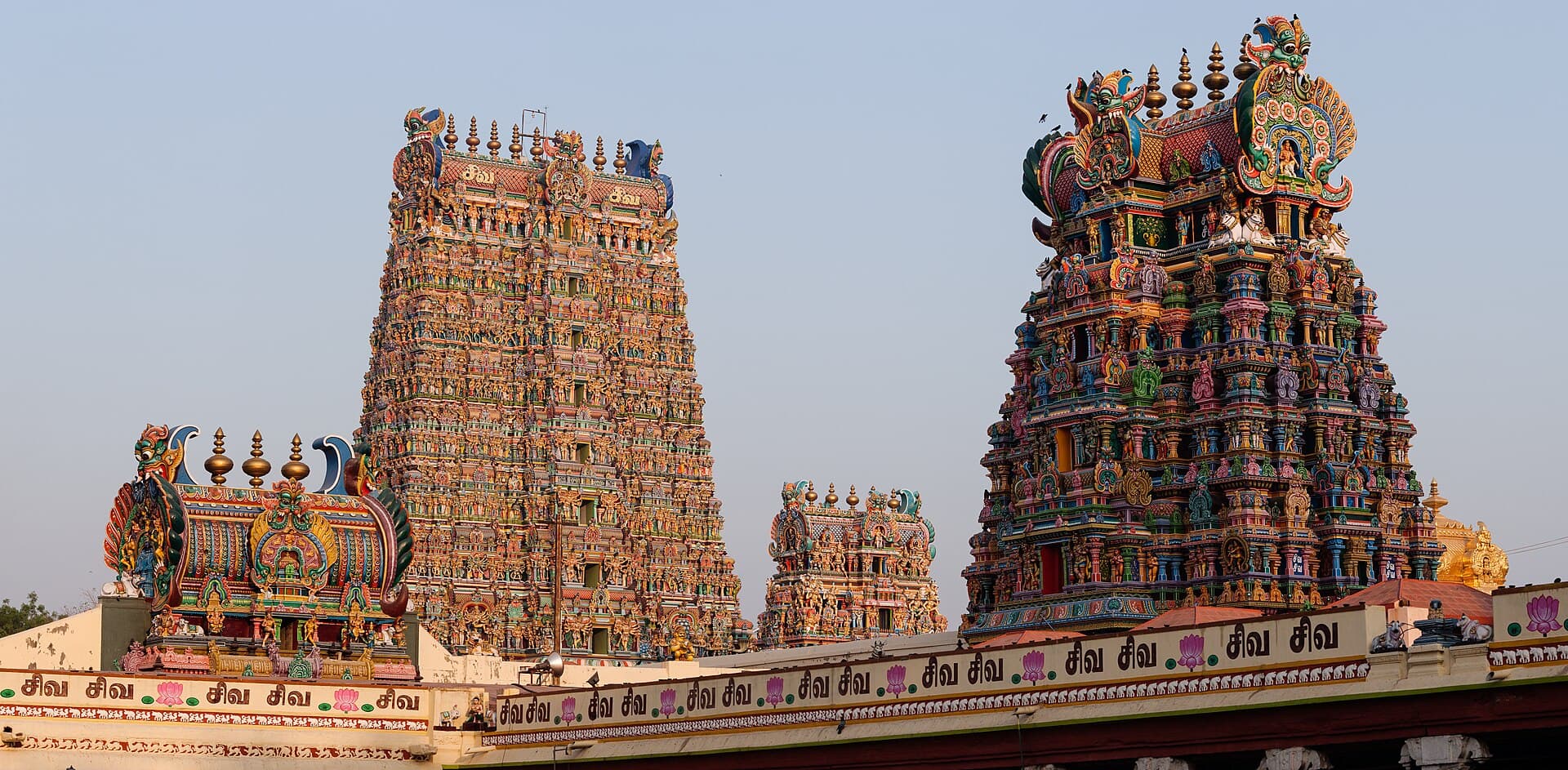
Madurai, IndiaKennyOMG / CC BY-SA 4.0, via Wikimedia Commons
IN

Madurai

Madurai: Where ancient stones breathe stories and the city's pulse never truly stills.

The secrets of Madurai

Madurai, as no one tells it.

Not the postcards. The stories even locals don't know — whispered in your ear, right where they happened.

3 secrets below. Many more wait inside the tour.
Meenakshi Amman Temple

The towering gateways of the Meenakshi Amman Temple are adorned with countless sculptures. Observe the main deity, Meenakshi, and you might notice an unusual detail about her form.

Full story unlocks in the tour
Puthu Mandapam Market

This historical pillared hall, now a lively marketplace, was originally conceived for a vastly different, more ceremonial purpose.

Full story unlocks in the tour
Madurai's Street Food

Madurai is renowned for its distinctive and flavorful street food, including a particular cold drink whose name hints at its soothing qualities.

Full story unlocks in the tour
The full tour

Discover every secret of Madurai

Every address, every reveal in full — in your ear, right where it happened.

Get the key to Madurai

You pick your stops. You walk. The voice reveals what the others miss.

Choose your time

How long do you have in Madurai?

No tours available yet. Check back soon — we're preparing them.

About Madurai

The story of Madurai

Madurai, an ancient city in the southern Indian state of Tamil Nadu, is a place where the past is not merely confined to museums but lives and breathes within its energetic streets and soaring temples. Often called the 'Athens of the East,' Madurai possesses a documented history spanning over 2,500 years, establishing it as one of India's oldest continuously inhabited urban centers. Its horizon is sculpted by the colorful, intricately carved gateway towers (gopurams) of the Meenakshi Amman Temple, a significant pilgrimage site that draws travelers from across the globe.

Beyond its architectural splendor, Madurai is a city of rich culture, delightful cuisine, and welcoming inhabitants. It offers a profound sensory journey, from the fragrant jasmine blossoms sold in its markets to the melodic cadence of the local Madurai Tamil dialect. Madurai also bears the moniker 'Thoongaa Nagaram,' meaning 'the city that never sleeps,' a testament to its animated atmosphere that persists well into the night, especially around the temple complex.

History

From Sangam Era to Modern Metropolis

Madurai's origins are deeply embedded in antiquity, with its documented history extending back to the 3rd century BCE. Both ancient Greek ambassador Megasthenes and Mauryan minister Kautilya referenced the city in their writings. Archaeological excavations in Keezhadi, near Madurai, have uncovered evidence of human habitation and Roman trade connections dating to 300 BCE.

The city served as the capital for the Pandya kings for centuries, a dynasty instrumental in the evolution of Tamil literature and culture. The third Tamil Sangam, a notable assembly of Tamil scholars, is believed to have convened in Madurai. Following the early Pandya dynasty, Madurai experienced periods under the Kalabhras and the Imperial Cholas, who held sway over the city for approximately 400 years from the early 9th century.

In the 13th century, a second Pandyan empire re-established Madurai as its capital. However, the city later came under the rule of the Madurai Sultanate and subsequently became part of the Vijayanagar Empire in 1378. It was during the Vijayanagar era and the subsequent reign of the Nayak rulers (16th to 18th century) that the Meenakshi Amman Temple, in its current magnificent form, was largely reconstructed and expanded. The Nayak rulers were pivotal in shaping the city's distinctive architecture, merging traditional Dravidian styles with Islamic influences, as exemplified by the Thirumalai Nayak Palace.

In 1801, Madurai came under the direct administration of the British East India Company, becoming a part of the Madras Presidency. The British period witnessed Madurai's transformation into a significant political and industrial hub. After India's independence in 1947, Madurai became part of the Madras state, later Tamil Nadu, and continues to be a major center for industry, education, culture, and religion.

What to see

The Meenakshi Amman Temple stands as the undeniable heart of Madurai. This sprawling complex, encompassing 14 acres, features 14 soaring gopurams adorned with thousands of vividly painted sculptures depicting deities and mythological narratives. Within, explore the two primary shrines dedicated to Meenakshi and Sundareswarar, the grand Aiyaram Kal Mandapa (Thousand-Pillar Hall) with its 985 carved columns, and the sacred Pottamarai Kulam (Golden Lotus Pond).

A short distance from the temple lies the Thirumalai Nayak Palace, an architectural marvel constructed in 1636 by King Thirumalai Nayak. This palace offers a glimpse into the lavish existence of the Nayak rulers.

For a deeper understanding of India's struggle for independence, visit the Gandhi Memorial Museum, housed in a 17th-century palace that once belonged to a Nayak queen. It displays a blood-stained garment worn by Mahatma Gandhi when he was assassinated.

Explore the lively Puthu Mandapam market, a historic pillared hall adjacent to the Meenakshi Amman Temple, known for traditional hand-woven fabrics, silk sarees, and handicrafts. Other bustling local markets include the Mattuthavani flower market and the Onion Market on East Marret Street.

For a change of scenery, venture to Samanar Hills, approximately 12 km from the city. These hills reveal Jain carvings and cave temples dating back to the 9th century, alongside expansive views.

When to visit

The most favorable time to visit Madurai spans the cooler months, from October to February. During this period, temperatures are agreeable, ranging from 20°C to 30°C, making it ideal for exploring the city's cultural landmarks without the intense heat. While the monsoon season (July to September) brings verdant landscapes and moderate rainfall, humidity levels can be elevated. Summers (March to June) are exceedingly hot, with temperatures reaching up to 41°C, rendering daytime exploration challenging.

Practical

Madurai International Airport (IXM) provides domestic flights from major Indian cities such as Chennai, Bengaluru, Mumbai, and Delhi, as well as international connections to Dubai, Singapore, and Colombo. Madurai Junction is a well-connected railway station offering direct trains to many significant Indian cities. The city also has extensive bus services, with Mattuthavani and Periyar Bus Stands serving inter-city and local routes.

Within Madurai, auto-rickshaws are a common mode of transportation for shorter distances; it is advisable to agree on the fare beforehand or request meter usage. App-based cabs like Ola and Uber are also available. The temple area is accessible on foot from hotels in the Old City. When visiting temples, dress respectfully, covering shoulders and knees. Remove footwear before entering, and consider wearing socks as temple floors can become warm. It is recommended to drink bottled water and avoid cut fruits or salads from roadside vendors.

Good to know
What is the primary language spoken in Madurai?
The primary language spoken in Madurai is Tamil, specifically the Madurai Tamil dialect, which is recognized for its distinctive pronunciation and melodic intonation. Other languages encountered include English, Saurashtra, Telugu, and Urdu.
Is Madurai safe for solo female travelers?
Madurai is generally considered secure for solo female travelers, though it is always prudent to exercise caution, particularly in crowded areas and when walking alone after dark. Adhering to local customs, such as modest dress, is also advisable.
What kind of clothing should I wear when visiting temples in Madurai?
When visiting temples in Madurai, it is essential to dress conservatively, ensuring your legs and shoulders are covered. Traditional Indian attire is recommended for both men and women.
Can I drink tap water in Madurai?
It is generally not advised to consume tap water directly in Madurai. It is best to opt for bottled water with an unbroken seal or filtered water to prevent potential health concerns.
What are the common modes of local transportation in Madurai?
The common modes of local transportation in Madurai include auto-rickshaws, city buses, and app-based cabs like Ola and Uber. For shorter distances, auto-rickshaws are popular, but it is advisable to agree on the fare beforehand.
Are cameras and mobile phones allowed inside the Meenakshi Amman Temple?
Photography is generally permitted in the outer corridors and halls of the Meenakshi Amman Temple, but it is restricted near the main sanctums. Mobile phones and other electronic devices are typically not allowed inside the temple, with designated counters available for storage.
Madurai
From€9.00
No booking · activate anytime · 12h to walk it
Get the key to Madurai