Magdeburg Cathedral
Magdeburg Cathedral, a soaring Gothic marvel, holds a secret from its very foundations.
Full story unlocks in the tour
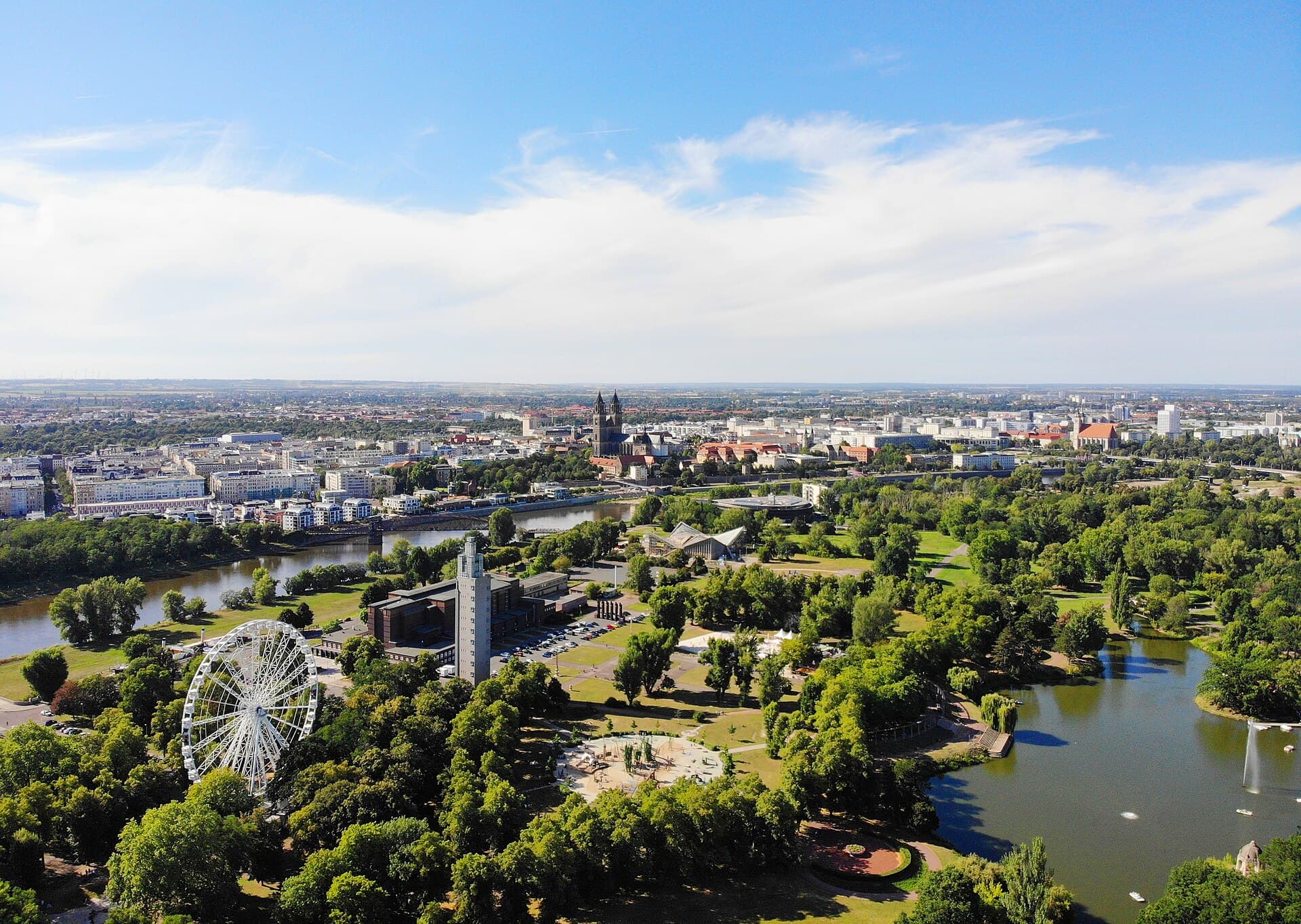 Olivier Cleynen / CC BY 4.0, via Wikimedia Commons
“Where ancient history meets audacious modernity on the Elbe River.”
Not the postcards. The stories even locals don't know — whispered in your ear, right where they happened.
Magdeburg Cathedral, a soaring Gothic marvel, holds a secret from its very foundations.
Imagine vessels gliding high above a river, completely separate from its currents.
This vivid pink edifice, envisioned by Friedensreich Hundertwasser, appears delightfully distinct among Magdeburg's more conventional architecture.
Discover every secret of Magdebourg
Every address, every reveal in full — in your ear, right where it happened.
You pick your stops. You walk. The voice reveals what the others miss.
No tours available yet. Check back soon — we're preparing them.
Magdeburg, the capital of Saxony-Anhalt, Germany, is a city where over 1,200 years of history converge with striking contemporary architecture and abundant green spaces. Situated on the Elbe River, it's a city that has repeatedly played a pivotal role in German and European history, from its early days as a trading settlement to its significance under Emperor Otto the Great. Today, Magdeburg presents a compelling blend of the ancient and the modern, inviting visitors to explore its grand cathedral, innovative museums, and a lively cultural scene.
Known as "Otto's City," Magdeburg's identity is deeply intertwined with two influential figures: Otto I, the first Holy Roman Emperor, and Otto von Guericke, a pioneering 17th-century scientist and inventor. This dual legacy is evident throughout the city, from the cathedral housing imperial tombs to the scientific museum celebrating Guericke's groundbreaking experiments with vacuums. Beyond its historical weight, Magdeburg embraces its riverside location with extensive parks, cycling paths, and lively promenades, offering a tranquil counterpoint to its urban energy.
## From Imperial Seat to Hanseatic Power Magdeburg's recorded history begins in 805, when it was mentioned as "Magadoburg" in a legal text by Charlemagne, serving as a trading outpost on the frontier of Slavic territories. The city's prominence grew significantly under Otto I (Otto the Great), who established a Benedictine abbey around 937 and later chose Magdeburg as his burial place. In 962, it became the seat of an archbishopric, playing a crucial role in German expansion eastward across the Elbe.
By the 13th century, Magdeburg had transformed into a flourishing commercial center and a leading member of the Hanseatic League. During this period, the city developed its autonomous municipal administration, known as Magdeburg Law, which was widely adopted throughout Central and Eastern Europe and became a significant legal framework.
## Reformation and Devastation Magdeburg was an early adopter of the Protestant Reformation, with Martin Luther delivering a prominent sermon there in 1524, leading many city-center parishes to convert to Protestantism. The city became a stronghold of Protestantism and a center for Reformation propaganda. However, this led to tragic consequences during the Thirty Years' War. In 1631, imperial troops under General Tilly sacked Magdeburg, resulting in the deaths of an estimated 20,000 to 25,000 residents and the widespread destruction of the city. Only about 4,000 inhabitants remained after this devastating event.
## Prussian Fortress and Post-War Reconstruction Following the Peace of Westphalia in 1648, Magdeburg was eventually assigned to Brandenburg-Prussia, becoming a significant Prussian fortress. This status, however, limited the city's growth until the fortress walls were removed in 1912. The city faced further destruction during World War II, particularly from a heavy bombing raid on January 16, 1945, which devastated much of the city center. After the war, Magdeburg became part of East Germany (German Democratic Republic) from 1949 to 1990. Since German reunification in 1990, Magdeburg has undergone extensive rebuilding and restoration, becoming the capital of the state of Saxony-Anhalt and experiencing significant economic growth. The city celebrated its 1200th anniversary in 2005.
Magdeburg offers a compelling array of sights that span centuries of history and innovative design.
Begin at the Magdeburg Cathedral (Dom zu Magdeburg St. Mauritius und Katharina), the city's defining landmark and Germany's first Gothic cathedral. Dedicated to Saints Maurice and Catherine, it houses the tomb of Emperor Otto I and his first wife Editha. Ascend the north tower for expansive views of the city and the Elbe River.
Nearby, experience the distinctive and unconventional Green Citadel of Magdeburg (Grüne Zitadelle). This striking pink building, the final project by artist Friedensreich Hundertwasser, features undulating lines, golden domes, and trees growing on its roofs and exterior walls. It contains apartments, shops, cafes, a hotel, and a kindergarten.
For a marvel of modern engineering, visit the Magdeburg Water Bridge (Kanalbrücke Magdeburg), the world's longest navigable aqueduct. This impressive structure allows ships to cross over the Elbe River, connecting the Mittelland Canal and the Elbe-Havel Canal.
Explore the expansive Elbauenpark, a vast green space featuring the Jahrtausendturm (Millennium Tower). This unique wooden tower illustrates 6,000 years of science and human history through interactive exhibits. The park also includes themed gardens and play areas.
Other notable attractions include the Kunstmuseum Kloster Unser Lieben Frauen, an art museum housed in an 11th-century monastery, and the Otto von Guericke Museum, dedicated to the pioneering scientist.
The best time to visit Magdeburg for pleasant weather and outdoor activities is from mid-May to mid-September. During this period, the weather is generally warm and sunny, with average high temperatures in July reaching around 75°F (24°C). Spring and early summer (April to June) offer mild weather and blooming parks, while autumn brings colorful foliage along the Elbe River. Winters can be cold, but the city comes alive with the festive Magdeburg Christmas Market, typically running from late November to late December.
Magdeburg is easily accessible by car, with excellent connections to the A2 and A14 motorways. For those traveling by train, Magdeburg Hauptbahnhof is centrally located and offers connections from across Germany, with trips from Berlin or Leipzig taking under 1.5 hours. The nearest major airport is Leipzig/Halle (LEJ), about an hour away, while Berlin's airports are approximately 1.5 hours by car.
Within the city, the tram system provides an efficient way to reach most major attractions. For shorter distances, walking and cycling are also excellent options, with dedicated bike lanes and parkland paths along the river.
The main Tourist Information office is located on Alter Markt, near the historic town center, and is open seven days a week. A smaller information center can be found at Magdeburg Hauptbahnhof. These offices offer assistance with accommodation, city tours, and provide brochures and practical tips for your stay.