Before it became a revered sanctuary, this cave was a simple grotto where a wounded soldier sought refuge. But what exactly transpired within its confines that would change the course of religious history?
Josep Renalias / CC BY-SA 2.5, via Wikimedia CommonsManresa
“Manresa: where medieval echoes meet modern revelation.”
Manresa, as no one tells it.
Not the postcards. The stories even locals don't know — whispered in your ear, right where they happened.
This ancient bridge, with its Romanesque foundations, has witnessed centuries of Manresa's story. But a dramatic event in the 20th century nearly erased its enduring presence.
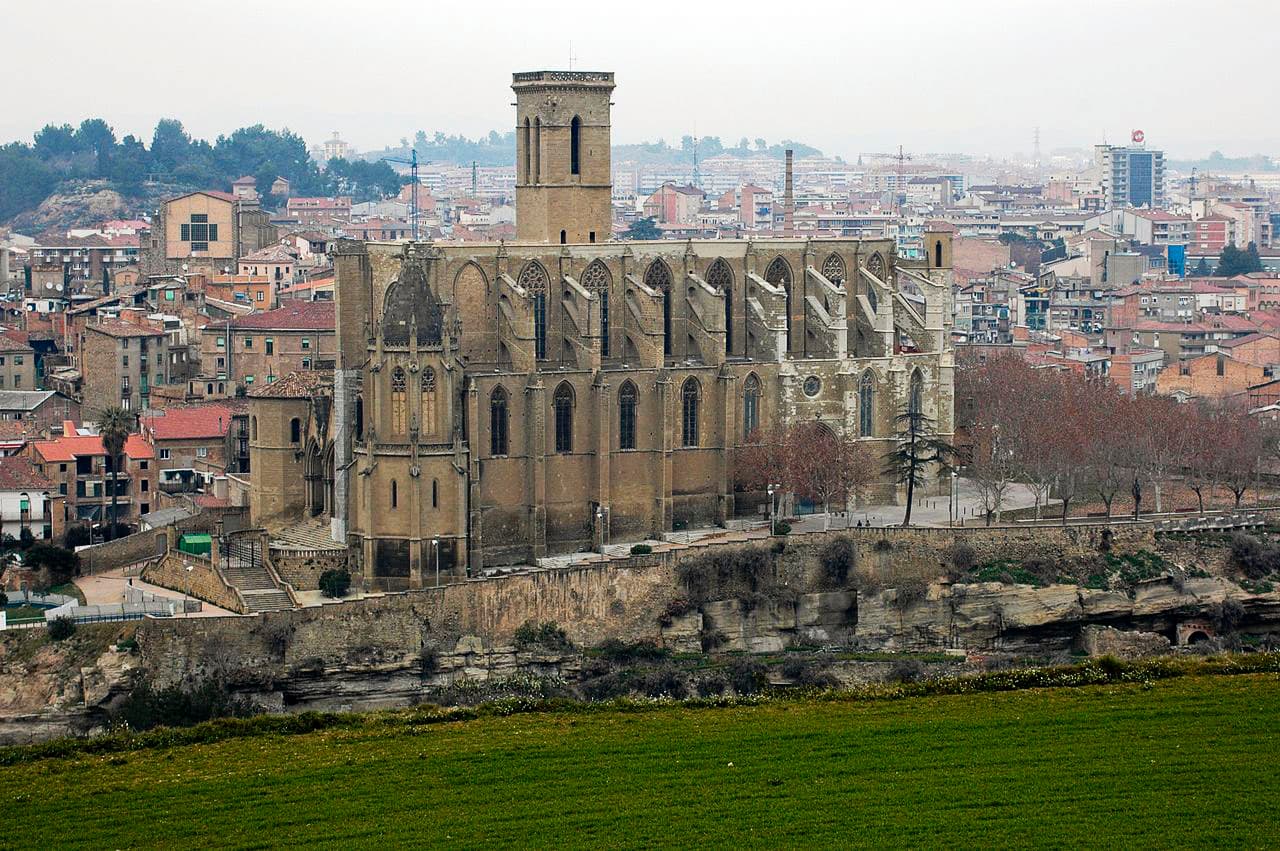
Manresa's iconic basilica, a towering example of Catalan Gothic, has a remarkable architectural secret in plain sight, connecting it to one of Spain's most celebrated architects.
Discover every secret of Manresa
Every address, every reveal in full — in your ear, right where it happened.
You pick your stops. You walk. The voice reveals what the others miss.
How long do you have in Manresa?
No tours available yet. Check back soon — we're preparing them.
The story of Manresa
Manresa, a city in the interior of the province of Barcelona, serves as the capital of the Pla de Bages region. Situated on a plain, it offers views of the Montserrat Mountains Nature Reserve. The city is bisected by the Cardener River and is characterized by a blend of medieval and Modernist architecture.
Manresa holds significant historical and spiritual importance, particularly due to its connection with Saint Ignatius of Loyola, the founder of the Society of Jesus. He resided here for eleven months in 1522, a period that profoundly shaped his spiritual journey and led to the writing of his 'Spiritual Exercises.' The city's heritage is evident in its historic buildings and cultural sites, making it a destination for those interested in history, architecture, and spirituality.
Manresa's origins can be traced back to pre-Roman times, possibly as Minorisa, the Roman capital of Jacetani. The city flourished during the Middle Ages, and its strategic location along the Cardener River contributed to its growth. Evidence of its medieval past is still visible in structures like the Pont Vell, with foundations dating to the 12th century, and the labyrinthine streets of its historic center.
A pivotal period in Manresa's history began in 1522 when Saint Ignatius of Loyola arrived after his pilgrimage from Montserrat. He spent nearly a year in the city, living a simple life and dedicating himself to prayer and penance in a natural cave. This transformative experience led to the development of his 'Spiritual Exercises,' a cornerstone of Jesuit spirituality. The city's connection to Saint Ignatius is so profound that many Jesuit retreat houses worldwide are named Manresa.
The 14th century marked a period of significant expansion for Manresa, with the construction of the Gothic Collegiate Basilica of Santa Maria, known as La Seu. Designed by Berenguer de Montagut, who also worked on Santa Maria del Mar in Barcelona, its construction spanned centuries, incorporating Romanesque, Renaissance, and Baroque elements. The city also saw the construction of the Séquia canal in the 14th century, an impressive medieval hydraulic engineering feat designed to bring water from the Llobregat river to Manresa.
Manresa faced challenges during the Napoleonic invasion, with French troops burning and demolishing much of the town in 1808 after being defeated by local volunteer forces. The city was subsequently rebuilt from the rubble. In the 19th and 20th centuries, Manresa experienced industrial growth, particularly in textiles, metallurgy, and chemicals, further shaping its urban landscape with Modernist buildings by architects like Ignasi Oms i Ponsa.
Begin your exploration at the Collegiate Basilica of Santa Maria (La Seu), Manresa's principal monument. This Catalan Gothic church, designed by Berenguer de Montagut, sits atop Puigcardener hill, offering panoramic views of the city and the Cardener River. Inside, admire the stained glass windows and a collection of altarpieces, including the 14th-century Altarpiece of the Holy Spirit by Pere Serra.
Next, visit the Cave of Saint Ignatius (Cova de Sant Ignasi), a sanctuary honoring the place where Saint Ignatius of Loyola lived for eleven months. The natural grotto now features a Baroque church and a neoclassical building, with an alabaster altarpiece depicting Saint Ignatius writing his 'Spiritual Exercises.'
Stroll across the Pont Vell (Old Bridge), a medieval bridge with eight and a half arches crossing the Cardener River. Its foundations date to the 12th century, and it offers an iconic view of Manresa, alongside La Seu and the Cave of Saint Ignatius.
Explore the Carrer del Balç Interpretation Centre, housed in an old building, which uses multimedia resources to transport visitors to 14th-century Manresa. Other notable Modernist buildings in the city include Casa Torrents, the tower of Lluvià, and the La Florinda flour factory, all designed by local architect Ignasi Oms i Ponsa.
The most favorable weather for visiting Manresa occurs from April through October, with temperatures typically ranging between 19°C and 30°C (66°F and 86°F). July is the hottest month, with an average high of 30°C (87°F), and also the sunniest, averaging 10.4 hours of sunshine per day. While there is some rainfall during these months, it is generally moderate. For hot-weather activities, late June to late August is ideal.
Manresa is approximately 60 kilometers (37 miles) northwest of Barcelona, making it accessible for a day trip. You can reach Manresa from Barcelona by train; the R5/R50 line of Ferrocarrils de la Generalitat (FGC) stops at three stations, with Manresa-Baixador being conveniently close to the city center. The RENFE Cercanías Line C4 also connects from Sants-Barcelona to a single station in the southern part of Manresa. If driving, take the C16 highway from Barcelona.
The historic center is best explored on foot, though some streets may be hilly. The official tourism office, Manresa Turisme, located at Plaça Major, 20, provides information on heritage, culture, and events.
- What is Manresa best known for?
- Manresa is primarily known for its significant connection to Saint Ignatius of Loyola, who spent eleven transformative months in the city, leading to the development of his 'Spiritual Exercises' and the founding of the Jesuit order.
- Is Manresa a good day trip from Barcelona?
- Yes, Manresa is a good day trip from Barcelona, located about an hour away by train. It offers a rich historical and cultural experience with its notable landmarks.
- What is La Seu in Manresa?
- La Seu is the popular name for the Collegiate Basilica of Santa Maria, Manresa's main monument. It is a prominent example of Catalan Gothic architecture, with elements from Romanesque, Renaissance, and Baroque periods.
- Can I visit the Cave of Saint Ignatius?
- Yes, the Cave of Saint Ignatius is a sanctuary open to visitors. It includes the natural grotto where Saint Ignatius of Loyola prayed and meditated, along with a Baroque church and a neoclassical building.
- Are there any Modernist buildings in Manresa?
- Yes, Manresa features several Modernist buildings designed by local architect Ignasi Oms i Ponsa, including Casa Torrents, the tower of Lluvià, and the La Florinda flour factory.
- What is the Festival of Light?
- The Festival of Light is an annual celebration on February 21st that commemorates the resolution of a 1345 conflict over the construction of the Séquia canal, which brought much-needed water to Manresa. Legend says a mysterious light in the Church of the Carmel signaled divine approval for the canal's completion.