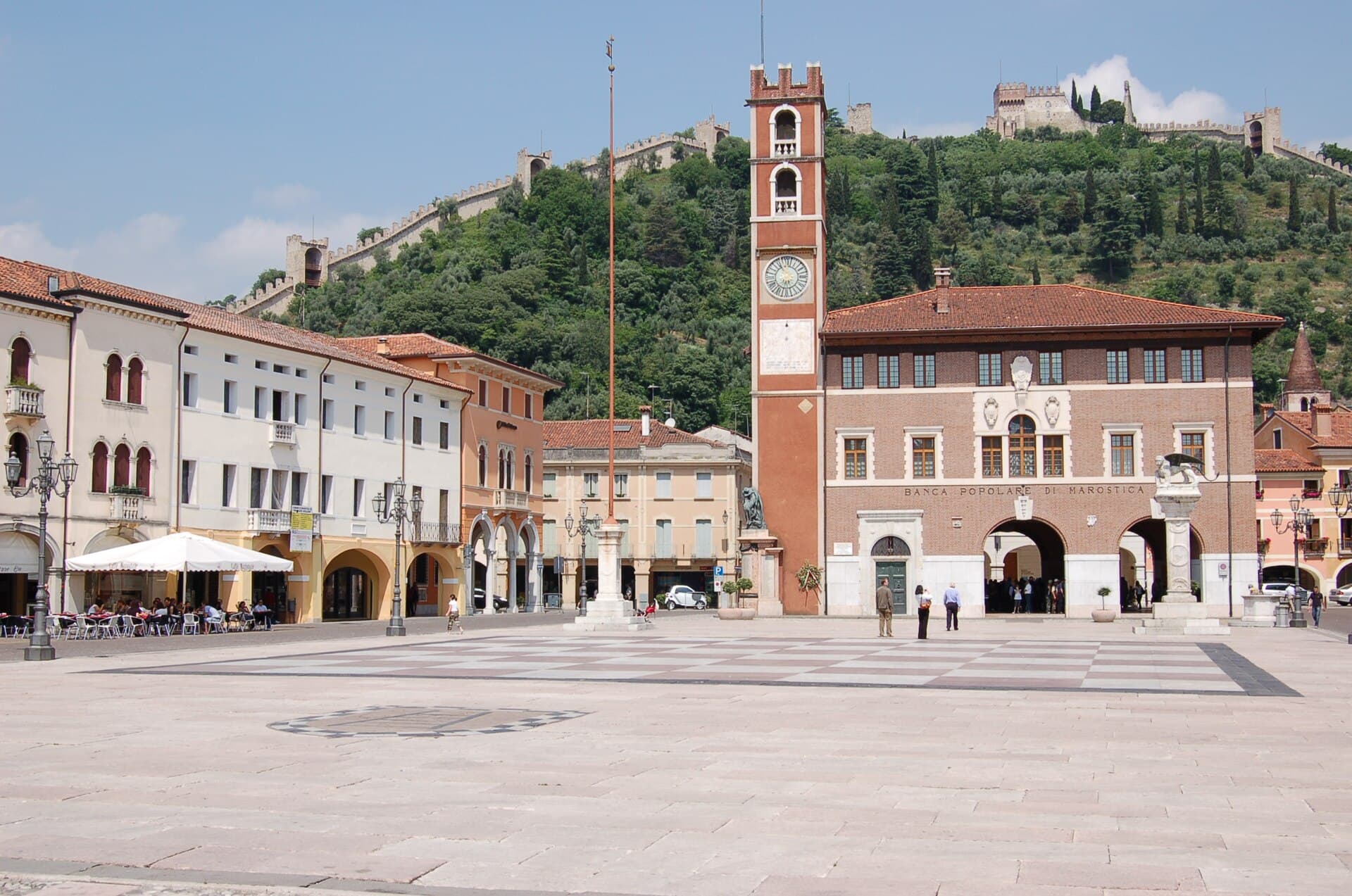
The renowned human chess game of Marostica is a spectacular re-enactment, yet the story behind it isn't quite what you might expect.
Lucamenini / CC BY-SA 3.0, via Wikimedia CommonsMarostica
“Where history plays out on a grand chessboard.”
Marostica, as no one tells it.
Not the postcards. The stories even locals don't know — whispered in your ear, right where they happened.
Beyond its medieval facade and role in the chess game, the Lower Castle once held a surprising and somber function.
The impressive defensive walls encircling Marostica aren't just for show; they bear a subtle architectural detail that hints at a historical allegiance.
Discover every secret of Marostica
Every address, every reveal in full — in your ear, right where it happened.
You pick your stops. You walk. The voice reveals what the others miss.
How long do you have in Marostica?
No tours available yet. Check back soon — we're preparing them.
The story of Marostica
Marostica, a walled town in Italy's Veneto region, is known for its distinctive Piazza degli Scacchi, a public square paved with a giant chessboard. This striking feature sets the stage every two years for a captivating human chess game, where over 600 participants in elaborate medieval costumes bring a 15th-century legend to life.
Beyond the spectacle, Marostica offers a relaxed atmosphere, medieval character, and a slower pace that stands apart from more crowded Italian destinations. It's a place where history is not just recounted but actively experienced, from its two commanding castles to its ancient city walls.
Surrounded by the gentle hills of the Asiago plateau, Marostica is also celebrated for its exquisite IGP cherries, a local delicacy that has its own dedicated festival. The town provides a blend of cultural heritage, natural beauty, and authentic regional flavors, making it an inviting stop for those seeking to explore the less-traveled paths of Veneto.
From Ancient Fortifications to Scaligeri Dominance
The origins of Marostica are deeply rooted in history, with evidence of prehistoric traces and Roman fortifications on Pausolino Hill. Between the 11th and 13th centuries, the powerful Ezzelini family heavily influenced the area until their defeat in 1260. The town's modern appearance largely stems from the 14th century when the Scaligeri family, lords of Verona, undertook significant construction. Cangrande della Scala initiated the building of the Upper Castle on the pre-existing Roman tower in 1311, followed by the Lower Castle in 1312.
Venetian Rule and a Unique Tradition
Marostica came under the rule of the Venetian Republic in 1404, a period that brought political and financial importance to the town. During this era, the Lower Castle transformed from a stronghold into a public palace, serving as the residence of the Podestà (Governor) and hosting the town council, the Consiglio dei Trenta. The Piazza Castello, the town's main square, also saw the erection of a column bearing the winged lion, the symbol of Venice.
The town's most famous tradition, the human chess game, is tied to a legend from 1454. It tells of two knights, Rinaldo D'Angarano and Vieri da Vallanora, who fell in love with Lionora, the daughter of Lord Taddeo Parisio. To avoid a duel, the Lord decreed they play a game of chess with living pieces for Lionora's hand, with the loser marrying her younger sister, Oldrada. While the legend itself was conceived in the early 20th century, the biennial re-enactment, involving hundreds of actors in medieval costumes, began in 1954, transforming the Piazza degli Scacchi into a grand theatrical stage.
From Napoleonic Era to Modern Day
After the fall of the Venetian Republic in 1797, Marostica, like the rest of the Veneto region, experienced a period of shifting control between French and Austrian forces during the Napoleonic era, before finally becoming part of the Kingdom of Italy in 1866. In the 19th century, it was a relatively poor town, leading many inhabitants to seek fortune abroad. However, Marostica saw significant growth in wealth after the Second World War. Today, the town continues to celebrate its rich heritage, from its medieval architecture to its world-renowned chess game and its cherished cherry production.
Begin your exploration in the Piazza degli Scacchi, the heart of Marostica, instantly recognizable by its large pink and white marble chessboard. This is where the famous human chess game unfolds every two years in September. Even outside of the festival, the square maintains a unique atmosphere.
Overlooking the piazza is the Lower Castle (Castello Inferiore), a medieval square-shaped building that once served as the Venetian governor's dwelling and now houses a museum showcasing the costumes and equipment from the chess game. You can explore its frescoed rooms, cells, and walk along its battlements for views of the square.
For expansive vistas, take the scenic walk up to the Upper Castle (Castello Superiore). The climb, which takes about 20-30 minutes from the center, offers impressive views over Marostica's walls and the surrounding Veneto landscape. While the Upper Castle is mostly ruins, the commanding views alone make the journey worthwhile.
The medieval city walls, almost 2 kilometers long with 24 turrets, connect the two castles. You can walk along these crenellated walls, enjoying the dramatic backdrop of cypress trees and old stone towers. Don't miss the Church of the Carmini, a historic church along one of the walking routes.
The best times to visit Marostica are from April to June or September to October, when the temperatures are comfortable for walking and exploring. May is particularly pleasant, coinciding with the town's cherry festival, a celebration of its famous IGP cherries. If you wish to witness the renowned human chess game, plan your visit for the second weekend of September in an even-numbered year. While the chess game attracts large crowds, outside of these festival periods, the town remains pleasantly relaxed.
Marostica is easily walkable, with its main attractions concentrated in and around the old town center. Half a day is sufficient for a quick visit, but allow more time if you plan to enjoy a leisurely walk or explore the surrounding hills. The easiest way to reach Marostica is by car, with connections from Vicenza, Padua, or Treviso. Parking is generally straightforward outside the old town walls. Public transport is available, though connections may be slower than in larger Italian cities.
For accommodations, consider staying overnight in the historic center or a nearby agriturismo (farm stay) to experience the town after day-trippers depart. Family-run B&Bs within the old town walls are common. While visiting, be aware that many restaurants may close on Mondays, and some may have limited hours on Sundays in the low season.
- What is Marostica most famous for?
- Marostica is most famous for its Piazza degli Scacchi (Chess Square) and the biennial human chess game, where people in medieval costumes act as chess pieces.
- When does the human chess game take place?
- The human chess game takes place every two years, on the second weekend of September, in even-numbered years.
- Is Marostica worth visiting if the chess game isn't happening?
- Yes, Marostica is still worth visiting for its medieval castles, walkable city walls, charming atmosphere, and delicious cherries, even when the chess game is not taking place.
- What are the local culinary specialties?
- Marostica is particularly known for its IGP cherries. Other regional specialties include *risotto al nero di seppia*, *sarde in saor*, *bigoli in salsa*, and *baccalà mantecato*.
- How can I get to Marostica?
- Marostica is best reached by car. It also has direct bus connections from Vicenza and Bassano del Grappa railway stations. The closest airports are Venice Marco Polo (VCE) and Verona Airport.
- Can I walk on the city walls?
- Yes, you can walk along the medieval city walls that connect the Lower and Upper Castles, offering scenic views of the town and surrounding landscape.