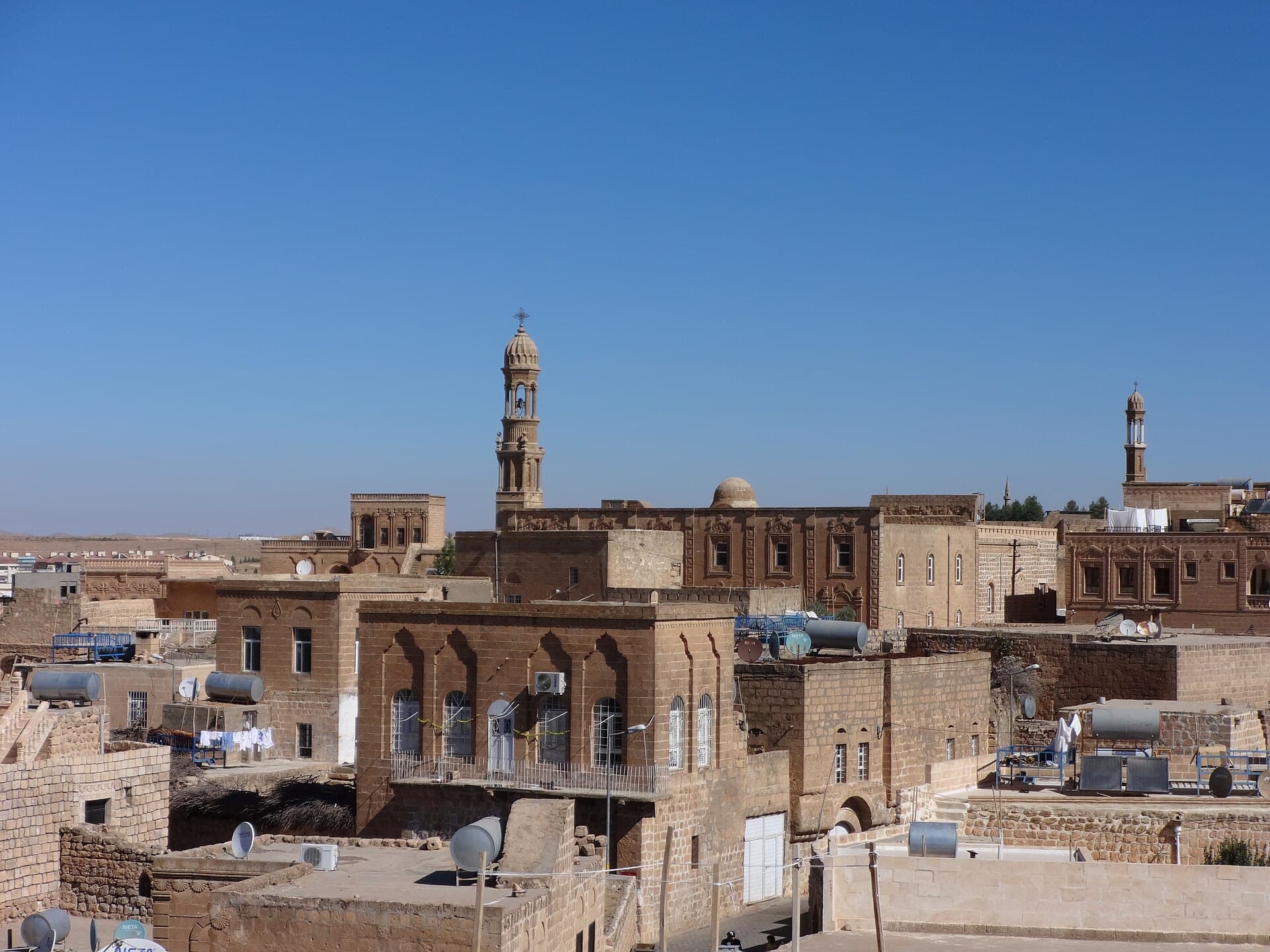
Midyat, TurkeyTobiasGr / CC BY-SA 4.0, via Wikimedia Commons
TR

Midyat

Self-guided audio walking tour of Midyat — GPS route, offline playback, story-driven narration in 32 languages.

Where ancient stones murmur stories of enduring faith and artistry.

The secrets of Midyat

Midyat, as no one tells it.

Not the postcards. The stories even locals don't know — whispered in your ear, right where they happened.

3 secrets below. Many more wait inside the tour.
Midyat Konuk Evi (Midyat Guest House)

This grand mansion, a local landmark, is admired for its intricate stone carvings and expansive views, yet it holds an unexpected connection to contemporary popular culture.

Full story unlocks in the tour
Midyat's Underground Caves

Beneath the city's charming stone houses lies a concealed world, a network of ancient subterranean chambers.

Full story unlocks in the tour
Mor Gabriel Monastery

This ancient monastery stands as a beacon of Syriac Orthodox Christianity, continuously active for over 1600 years, but it holds a unique distinction concerning the history of printing.

Full story unlocks in the tour
The full tour

Discover every secret of Midyat

Every address, every reveal in full — in your ear, right where it happened.

Get the key to Midyat

You pick your stops. You walk. The voice reveals what the others miss.

Choose your time

How long do you have in Midyat?

Your self-guided audio tour of Midyat is ready — pick your landmarks, choose your language, and start the moment you arrive.

Buy
About Midyat

The story of Midyat

Midyat, a city in Turkey's Mardin Province, unfolds as an open-air museum etched in honey-colored stone, where the echoes of ancient Mesopotamia reverberate through narrow, winding streets. This compelling destination on the Tur Abdin plateau, meaning 'Mountain of the Servants of God,' offers a singular blend of history, culture, and enduring faith. Its distinctive architecture, characterized by meticulously hand-carved stone houses, provides natural cooling in summer and warmth in winter.

Stepping into Midyat is akin to traveling back in time, where centuries-old buildings, historic mosques, and ancient Christian monasteries stand together. The city is a living testament to the peaceful coexistence of diverse cultures and religions, a place where the melodic calls to prayer intermingle with the ringing of church bells. For those seeking an authentic Turkish experience, away from the familiar tourist paths, Midyat offers a journey filled with genuine Eastern charm and a profound sense of history.

Midyat is also a significant center for the Syriac (Assyrian) Christian community, preserving ancient traditions, their liturgical language (Surayt), and exceptional artisan skills, particularly in silver filigree. The city's deep heritage and cultural fabric make it a compelling destination for travelers interested in spirituality, architecture, and a slower pace of discovery.

History

From Ancient Matiate to a Crossroads of Faith

Midyat's history extends back over 3,000 years, with its origins found in Neo-Assyrian cuneiform tablets from the 9th century BC, where it was known as Matiate. This ancient name, possibly Aramaic or Syriac in origin, translates to 'city of caves,' 'homeland,' or 'meeting place,' aptly reflecting the region's natural and man-made subterranean dwellings. The city's strategic location on the Tur Abdin limestone plateau, between the Tigris and Euphrates rivers, made it a crucial point for trade and a natural stronghold, where the soft limestone allowed for both magnificent surface structures and extensive underground cities for protection.

Throughout its long history, Midyat has been shaped by a succession of empires and cultures, including the Assyrians, Romans, Byzantines, Artukids, and Ottomans, each leaving an indelible mark on its cultural landscape. It developed as a vital spiritual center for Syriac Christians, with ancient monasteries like Mor Gabriel, founded in 397 AD, attracting pilgrims and contributing to the settlement's growth. Until the early 20th century, Midyat was notable as the only town in the Ottoman Empire with an ethnic Assyrian majority, though its population was denominationally diverse, including Syriac Orthodox, Chaldean Catholic, and Assyrian Protestants.

During the 20th century, the Assyrian population gradually diminished due to emigration and conflicts, including the Assyrian genocide in 1915, which saw significant losses. Despite these changes, Midyat remained the largest concentration of Christians in Turkey outside Istanbul until 1979. Today, while the Syriac Christian community is a minority, their heritage is deeply ingrained in the city's identity, with active churches and monasteries continuing to preserve centuries of religious art and tradition. The town's architectural style is a unique blend, combining Syriac Christian, Arabic, and Ottoman influences, with massive stone walls, small windows for climate control and protection, and distinctive domed vaults.

What to see

Begin your exploration in Midyat Old Town, a labyrinth of narrow stone streets, arched doorways, and ornate mansions that exemplify traditional Midyat architecture. The entire Old Town functions as an open-air museum, inviting leisurely strolls. A prominent landmark is the Midyat Konuk Evi (Midyat Guest House), a magnificently preserved historic stone mansion that stands at the highest point of the old town, offering expansive city views. Its authentic architecture has made it a popular filming location for Turkish TV series.

Beyond the city center, the region contains some of the world's oldest continuously active Christian monasteries. Just 23 km southeast of Midyat lies Mor Gabriel Monastery (Deyrulumur Manastırı), founded in 397 AD. This sprawling complex is a working religious community and a significant center of Syriac Orthodox learning, featuring monumental architecture, ancient churches, and a peaceful atmosphere. Another important site is the Deyrulzafaran Monastery (Mor Hananyo Monastery), located near Mardin, which served as the official seat of the Syriac Orthodox Church's Patriarchs for centuries. It is built on the site of an ancient Mesopotamian sun temple and presents impressive domes and intricate stone engravings.

For a glimpse into a different kind of history, explore the Midyat Caves, an ancient underground network that once served as shelter. While in Midyat, be sure to visit the local bazaars, where you can find traditional Syriac handicrafts, including exquisite silver filigree jewelry (telkari), carpets, and towels.

When to visit

The most favorable times to visit Midyat are during the spring (April to early June) and autumn (September to October). During these months, the weather is mild and agreeable, with average temperatures ranging from 20°C to 27°C, making it ideal for exploring the city's stone streets and historical sites. Summers (late June to August) can be intensely hot, with temperatures often exceeding 35°C, while winters (November to March) are cold and rainy, with temperatures sometimes falling to freezing.

Practical

To reach Midyat, fly into Mardin Airport (MQM), which is approximately 75 km away, a drive of about 1 hour and 15 minutes. Alternatively, Batman Airport (BAL) is about 61 km from Midyat. From either airport, you can take a taxi or bus. Long-distance buses connect Midyat to major Turkish cities, though journeys can be lengthy. Renting a car offers the most flexibility for exploring the wider region.

Within Midyat, the Old Town is best explored on foot. Taxis are available for longer distances, and minibuses connect the old and new towns. The official language is Turkish, though Kurdish and Arabic are also common. English may be understood in tourist areas, but learning a few basic Turkish phrases is recommended. The local currency is the Turkish Lira (TRY); while credit cards are accepted in some places, it's advisable to carry cash for local markets and smaller establishments.

Midyat is generally considered safe for tourists, but standard precautions apply: keep an eye on your belongings, especially in crowded areas, and avoid poorly lit alleys at night. Locals are known for their hospitality; modest dress and respectful behavior are appreciated, especially when visiting religious sites.

Good to know
What is Midyat known for?
Midyat is celebrated for its distinctive stone architecture, ancient Syriac Christian monasteries, and exquisite silver filigree craftsmanship.
What is the primary language spoken in Midyat?
The official language is Turkish, but Kurdish and Arabic are also commonly spoken. Syriac (Surayt), an ancient Aramaic dialect, is still spoken in some homes and churches.
Are there any active monasteries in Midyat?
Yes, Mor Gabriel Monastery, situated near Midyat, is one of the oldest continuously active Christian monasteries in the world, founded in 397 AD.
What kind of souvenirs can I buy in Midyat?
Midyat is famous for its Syriac handicrafts, particularly intricate silver filigree jewelry (telkari), as well as carpets and towels.
Is Midyat safe for solo female travelers?
Midyat is generally considered safe for solo female travelers, but it's always advisable to take standard precautions, such as dressing modestly and avoiding poorly lit areas at night.
What are the local transportation options in Midyat?
Within Midyat, you can explore the Old Town on foot. Taxis are available for longer distances, and minibuses connect the old and new parts of the city.
On the map
Midyat
From€9.90
No booking · activate anytime · 12h to walk it
Get the key to Midyat