IT

Montalcino

Montalcino: Where medieval stone meets liquid gold.

The secrets of Montalcino

Montalcino, as no one tells it.

Not the postcards. The stories even locals don't know — whispered in your ear, right where they happened.

3 secrets below. Many more wait inside the tour.
The Fortezza

This imposing 14th-century fortress, a symbol of Montalcino's enduring spirit, holds a surprising secret within its ancient walls.

Full story unlocks in the tour
Piazza del Popolo

Montalcino's main square, with its historic Palazzo dei Priori and elegant loggia, once had a different name with a curious political backstory.

Full story unlocks in the tour
Montalcino's Wine History

While Montalcino is now globally celebrated for its deep red Brunello, the town's early wine reputation was built on something entirely different.

Full story unlocks in the tour
The full tour

Discover every secret of Montalcino

Every address, every reveal in full — in your ear, right where it happened.

Get the key to Montalcino

You pick your stops. You walk. The voice reveals what the others miss.

Choose your time

How long do you have in Montalcino?

No tours available yet. Check back soon — we're preparing them.

About Montalcino

The story of Montalcino

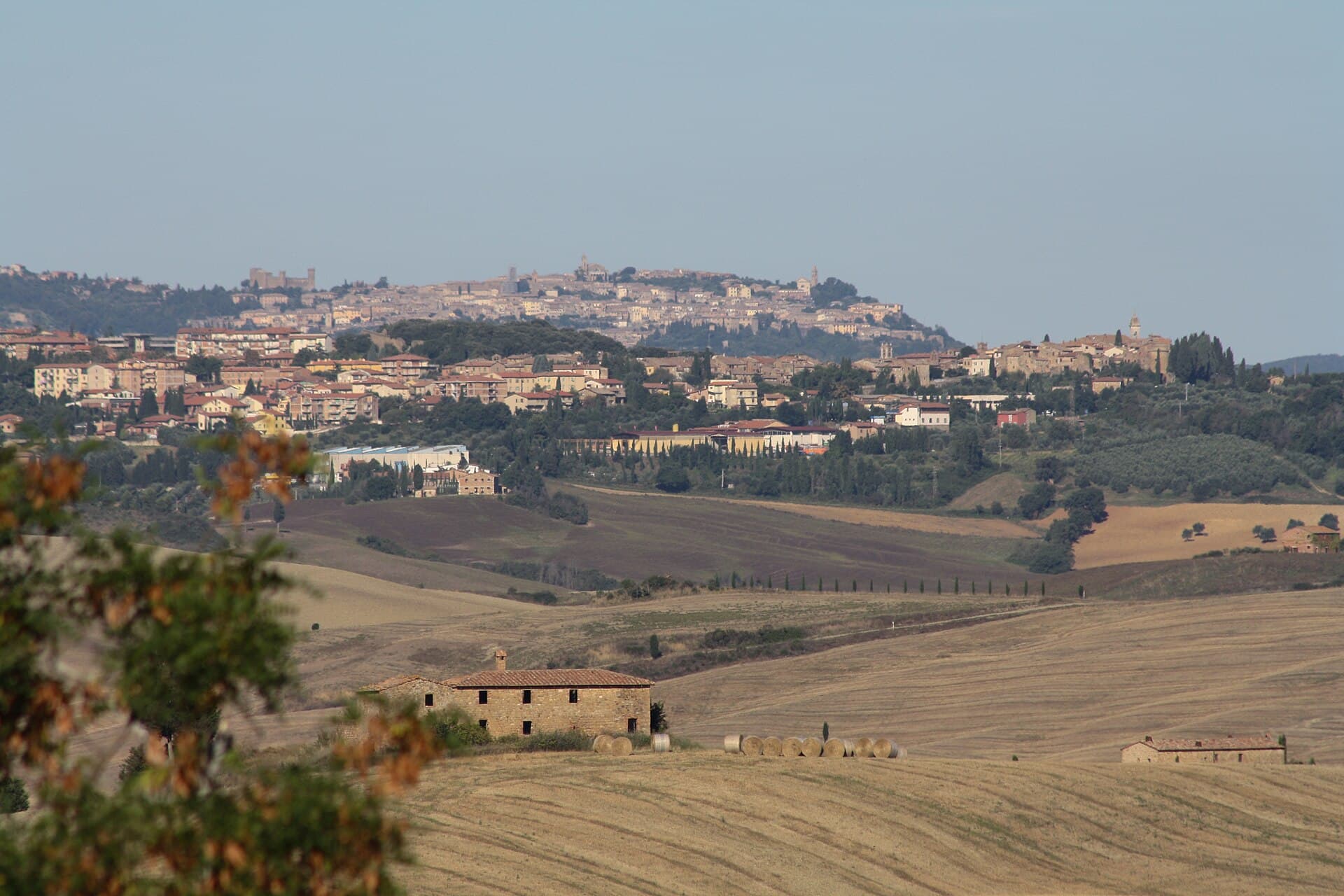
Situated on a hilltop in Tuscany, Montalcino is a town that feels suspended in time, its medieval character largely unchanged since the 16th century. Surrounded by fortified walls and dominated by a formidable 14th-century fortress, it offers expansive views across the Val d'Orcia, a UNESCO World Heritage site of rolling hills, vineyards, and olive groves.

While its picturesque streets and historic architecture are captivating, Montalcino's global renown largely stems from its exquisite Brunello di Montalcino wine. This prestigious red, made exclusively from Sangiovese grapes grown in the region, has transformed the town into a destination for wine enthusiasts. But beyond the cellars and tasting rooms, Montalcino invites visitors to wander its stone alleys, discover ancient churches, and immerse themselves in a slower pace of life that is quintessentially Tuscan.

History

## From Etruscan Roots to Sienese Stronghold Montalcino's origins stretch back to Etruscan and Roman times, with evidence of settlements dating to 800 BC. The town's name is thought to derive from 'mons ilcinus,' referring to the holm-oak trees that once covered the hill. Its first historical mention appears in an 814 AD document, suggesting the presence of a church built by monks from the nearby Abbey of Sant'Antimo.

During the Middle Ages, Montalcino's strategic hilltop location made it a crucial defensive point. It became deeply entwined in the conflicts between Siena and Florence, often serving as a satellite of Siena. The imposing Fortezza, a pentagonal fortress, was constructed in 1361 to defend the southernmost border of the Sienese Republic. After Florence conquered Siena in 1555, Montalcino famously held out for almost four years, becoming the last bastion of Sienese freedom and even declaring itself the 'Republic of Siena Retired to Montalcino.' It eventually fell to the Florentines, remaining under their control until Tuscany was unified with Italy in 1861.

## The Rise of Brunello For centuries, Montalcino was known for its tanneries and leather goods. While wine had been produced in the area since Etruscan times, it was a sweet white wine called Moscadello that dominated until the mid-19th century. The transformation began with Clemente Santi, a local pharmacist and passionate viticulturist, who started experimenting with 100% Sangiovese Grosso grapes. His grandson, Ferruccio Biondi-Santi, continued this pioneering work, and in 1888, the first official vintage of Brunello di Montalcino was released. Brunello gained DOC status in 1968 and became one of Italy's first four DOCG wines in 1980, solidifying Montalcino's place on the world wine map.

What to see

Begin your exploration at the Fortezza di Montalcino, the town's iconic 14th-century fortress. Walk along its ramparts for expansive views of the Val d'Orcia and Monte Amiata. Inside, you'll find an enoteca offering tastings of local wines.

Stroll through the Piazza del Popolo, Montalcino's main square, home to the 13th-century Palazzo dei Priori (also known as Palazzo Comunale) with its tall bell tower and a characteristic Gothic loggia. The town's historic center is a maze of narrow, stone-paved streets, perfect for wandering and discovering artisan shops, cafes, and wine bars.

Visit the Civic and Diocesan Museum of Sacred Art, housed in part of the former convent of Sant'Agostino, which displays a collection of Sienese school paintings and wooden sculptures. The Neoclassical Cathedral of Santissimo Salvatore and the Romanesque Abbey of Sant'Antimo, a monumental 13th-century structure located just 10km outside of town, are also worth exploring. For wine enthusiasts, the Temple of Brunello Museum offers an interactive journey into the history of Brunello di Montalcino.

When to visit

The best times to visit Montalcino are spring (April–June) and fall (September–October) for mild, pleasant weather. Spring brings verdant green hills and wildflowers, while fall offers the grape harvest season. Summers (July–August) are warm and sunny, ideal for enjoying outdoor activities, though daytime temperatures can be high. July also hosts the Jazz & Wine in Montalcino festival. Winters (December–February) are colder and quieter, with many shops and restaurants closed for the season.

Practical

Montalcino is best reached by car, offering flexibility to explore surrounding vineyards and towns. It's approximately a 45-minute drive from Siena and about two hours from Florence. Parking can be found around the Fortezza. The town itself is small and best explored on foot, though its stone-paved streets can be steep, so comfortable, non-slip shoes are recommended. Public transportation is limited, with a bus system available but requiring careful planning for winery visits. For wine tastings, many enotecas are available in town, and vineyard visits typically require advance appointments.

Good to know
What is Montalcino best known for?
Montalcino is best known for its prestigious red wine, Brunello di Montalcino, made from 100% Sangiovese grapes.
Is Montalcino worth visiting if I'm not a wine lover?
Absolutely. Beyond its wine, Montalcino offers a captivating medieval town center, historic fortress, expansive panoramic views of the Val d'Orcia, and delicious Tuscan cuisine.
What is the difference between Brunello di Montalcino and Rosso di Montalcino?
Brunello di Montalcino is a more structured and complex wine with a longer aging period (at least two years in oak barrels and six months in the bottle). Rosso di Montalcino is a younger, more approachable wine with a shorter aging period and a fresher, fruitier profile.
Can I go truffle hunting in Montalcino?
Yes, Montalcino and the surrounding Crete Senesi area are known for truffles, including the valuable white truffle. Guided truffle hunting experiences with expert hunters and their dogs are available year-round, with different truffle varieties found seasonally.
How far is Montalcino from Siena and Florence?
Montalcino is approximately 42 kilometers (26 miles) from Siena and about 110 kilometers (68 miles) from Florence.
Are there any festivals in Montalcino?
Yes, Montalcino hosts the Jazz & Wine in Montalcino festival in July, featuring live concerts in the fortress. The Festa Europea Della Musica has also had editions in Montalcino.
Montalcino
From€9.00
No booking · activate anytime · 12h to walk it
Get the key to Montalcino