The Danzantes Gallery
The carved figures here were long thought to be dancers, frozen in ritualistic poses. But their true meaning is far more stark.
Full story unlocks in the tour
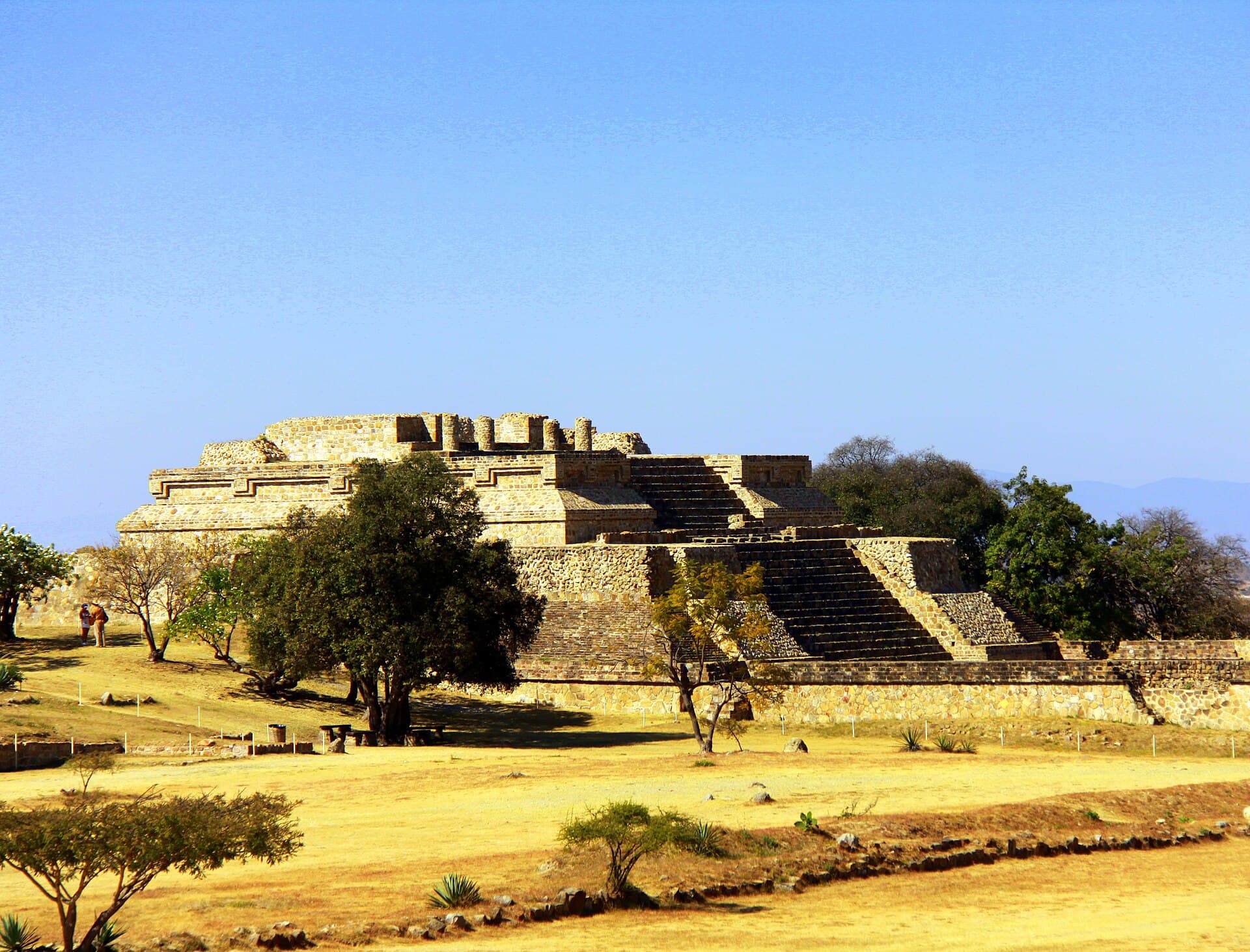 nsaum75 !Dígame¡ / CC BY-SA 3.0, via Wikimedia Commons
Self-guided audio walking tour of Monte Alban — GPS route, offline playback, story-driven narration in 32 languages.
“Where Zapotec echoes meet the Oaxacan sky.”
Not the postcards. The stories even locals don't know — whispered in your ear, right where they happened.
The carved figures here were long thought to be dancers, frozen in ritualistic poses. But their true meaning is far more stark.
This arrow-shaped structure stands out from the other buildings in the Main Plaza due to its unusual orientation. It's a deliberate choice, but why?
While many tombs at Monte Albán were looted over centuries, one particular burial chamber yielded a discovery so rich it reshaped our understanding of ancient Mesoamerican wealth.
Discover every secret of Monte Alban
Every address, every reveal in full — in your ear, right where it happened.
You pick your stops. You walk. The voice reveals what the others miss.


Your self-guided audio tour of Monte Alban is ready — pick your landmarks, choose your language, and start the moment you arrive.
BuyLume has a built-in augmented-reality guide. Hold your phone up and its camera shows the street ahead of you, with a glowing arrow laid over the real view that always points to your next stop — no map to puzzle over, no wrong turns. Like everything in Lume, it works fully offline.
Rising dramatically above the Oaxaca Valley in southern Mexico, Monte Albán occupies an artificially flattened mountaintop. This UNESCO World Heritage Site served as the political, religious, and economic heart of the Zapotec civilization for over a millennium, from its founding around 500 BCE. The monumental core, encompassing a vast Main Plaza, pyramids, temples, and tombs, offers a profound glimpse into a sophisticated ancient society.
Monte Albán's strategic elevation, approximately 1,940 meters (6,400 feet) above sea level, afforded its rulers a commanding view of the entire Central Valleys region. The site is not merely a collection of ruins; it stands as a testament to the ingenuity and artistry of the Zapotec people, who developed one of the earliest writing systems in the Western Hemisphere and possessed advanced knowledge of astronomy and architecture. A visit here offers a rare connection to a deep and extraordinary human story, with sweeping vistas that have remained largely unchanged for two millennia.
Monte Albán was established around 500 BCE, making it one of the earliest cities in Mesoamerica. The Zapotec people, who called themselves the 'cloud people,' began leveling the mountaintop, creating the Great Plaza and early structures. The site's strategic location, 400 meters above the valley floor, was chosen for its defensibility and symbolic power. During its first phase (500-200 BCE), the city began to take shape, with the construction of significant buildings like Building L, which features early glyphs and ritual imagery.
Between 200 BCE and 700 CE, Monte Albán reached its zenith, flourishing as the capital of the Zapotec civilization. At its peak, the city may have housed a population of 25,000 to 35,000 people. During this period, monumental architecture expanded, including Building J, the uniquely aligned observatory, and the imposing South Platform. The Zapotecs were sophisticated astronomers, architects, and traders whose influence extended far beyond the Oaxacan valleys. Their writing system, one of the oldest in the Western Hemisphere, has been found carved into stone monuments throughout the site.
By 700 CE, the centralized structure of Zapotec society began to fragment, leading to a decline in population and the eventual abandonment of Monte Albán as a political capital. However, it maintained its ceremonial importance. Around 800 CE, the Zapotecs fortified Monte Albán, possibly due to threats from the Mixtecs, who eventually took over the site. The Mixtecs reoccupied parts of Monte Albán in later periods, often reusing existing structures and burying their leaders in Zapotec tombs, such as the famous Tomb 7, around 1400 CE. The site was deserted some seven hundred years before the arrival of the Spanish. Large-scale excavations of Monte Albán began in 1931 under the direction of Mexican archaeologist Alfonso Caso, who, along with his colleagues, excavated and reconstructed much of what is visible today.
The expansive Main Plaza forms the heart of Monte Albán, a large open space once used for ceremonial gatherings. Surrounding it are the site's most significant structures. To the south, the South Platform is the tallest pyramid, offering sweeping views of the surrounding valleys and Oaxaca City. At the northern end, the North Platform is the largest structure on the site, also providing extensive vistas.
Building J, an arrow-shaped structure in the center of the Main Plaza, is notable for its unusual orientation, believed to be an astronomical observatory. Nearby, Building L houses the Danzantes Gallery, a collection of carved stone slabs depicting human figures. While once thought to be dancers, these figures are now largely interpreted as sacrificed captives or enemies.
The Ball Court, one of the oldest in Mesoamerica, highlights the ritual importance of the Mesoamerican ballgame in Zapotec society. Other features include the Sunken Patio and the VG Complex, with its four flanking temples. Before or after exploring the ruins, visit the on-site museum near the entrance, which displays artifacts recovered from tombs, including intricate jewelry and pottery, providing valuable context to the site.
The dry season, from November through April, offers the most comfortable conditions for visiting Monte Albán, with clear skies and cooler temperatures. Mornings are ideal to avoid both the heat and larger crowds. November through February are slightly cooler, making the exposed hilltop more pleasant for exploration. While the rainy season (May-September) brings lush green valleys and fewer visitors, afternoon rains can make paths slippery. Avoid Sundays if you prefer fewer crowds, as Mexican citizens receive free admission.
Monte Albán is located approximately 9 kilometers (5.5 miles) west of Oaxaca City. The most common ways to get there from central Oaxaca are by taxi or tourist bus, a scenic 25-35 minute ride. Shuttles are also available and can be booked from various points in Oaxaca.
The site is open daily from 8:00 AM to 5:00 PM, with the last entry around 4:00 PM. The entrance fee is 210 MXN for adults and includes access to both the archaeological site and the museum; children under 13 enter free. Plan to spend at least two to three hours exploring the site, especially if you include the museum. Comfortable walking shoes are essential due to uneven stone surfaces and steep grades. The hilltop offers limited shade, so bring water, a hat, and sunscreen.
Monte Alban in Korean, in Chinese or in Hebrew — and 29 more languages, every stop narrated by a native voice. The widest language range of any self-guided audio tour.
Available in: