The Mausoleum of Moulay Idriss I
For centuries, those outside the faith were not permitted to enter the town after sunset, and only since 2005 have they been allowed to stay overnight.
Full story unlocks in the tour
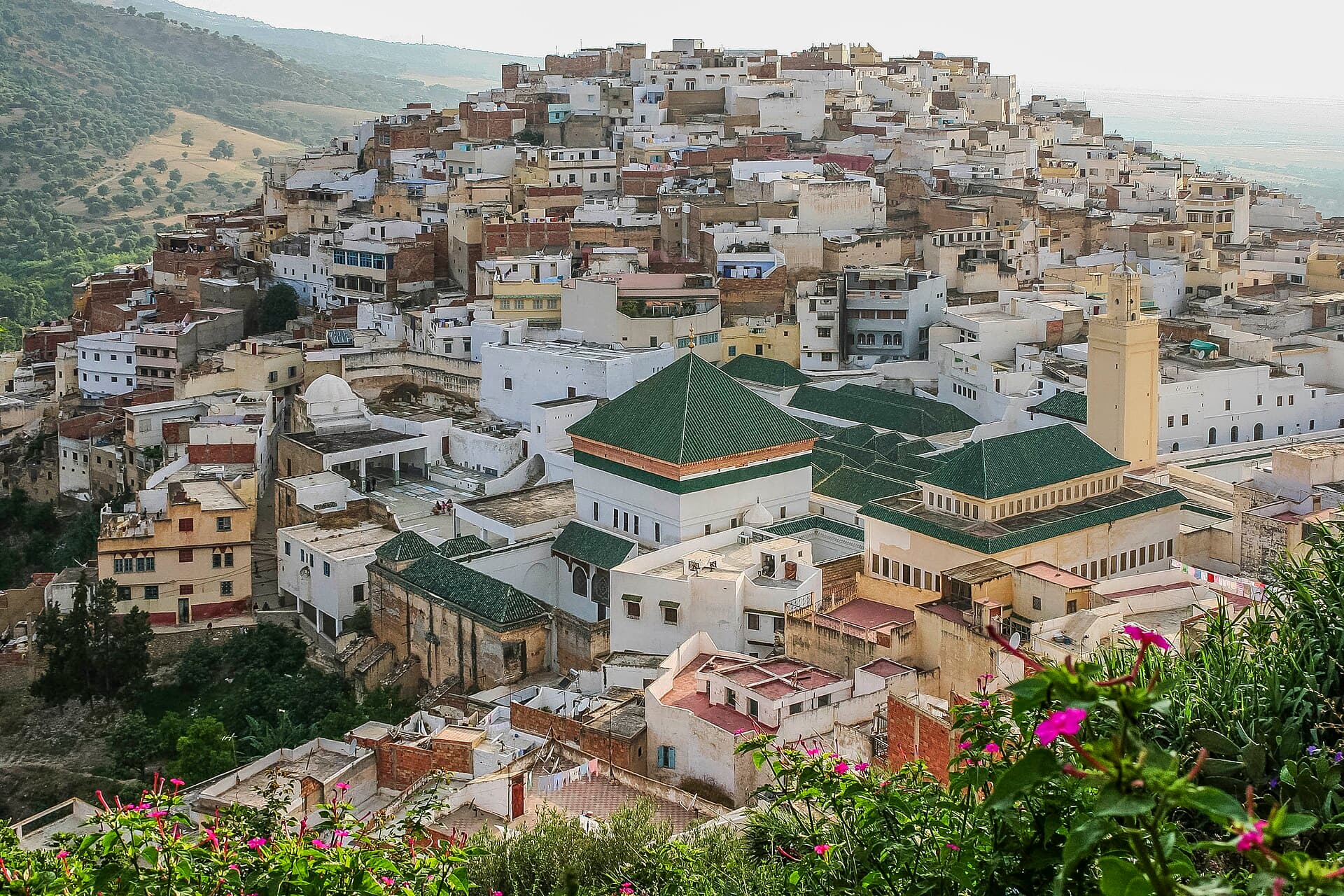 Ninara from Helsinki, Finland / CC BY 2.0, via Wikimedia Commons
“Where white streets climb and faith finds its echo.”
Not the postcards. The stories even locals don't know — whispered in your ear, right where they happened.
For centuries, those outside the faith were not permitted to enter the town after sunset, and only since 2005 have they been allowed to stay overnight.
Among the traditional square-topped minarets of Morocco, one in Moulay Idriss presents a distinctly different form.
The landscape surrounding Moulay Idriss has a longstanding reputation for a particular agricultural bounty.
Discover every secret of Moulay Idriss
Every address, every reveal in full — in your ear, right where it happened.
You pick your stops. You walk. The voice reveals what the others miss.
No tours available yet. Check back soon — we're preparing them.
Moulay Idriss, also known as Moulay Idriss Zerhoun, unfolds across two hills at the base of Mount Zerhoun in northern Morocco. This consecrated town bears the name of Moulay Idriss I, a great-grandson of the Prophet Muhammad and the architect of Morocco's first Islamic dynasty. For many Moroccans, it stands as a profound pilgrimage destination, considered by some a spiritual alternative to the Hajj to Mecca.
The town's whitewashed buildings cascade down the hillsides, creating a striking visual tableau. Its narrow, winding streets offer a window into traditional Moroccan life, with local shops and cafes lining the pathways. Moulay Idriss also serves as a gateway to the Zerhoun Mountains, presenting scenic hiking trails and expansive views of the surrounding olive groves and fertile plains.
Moulay Idriss I, a descendant of the Prophet Muhammad, sought refuge from Abbasid-controlled territory after a battle in 786 AD and arrived in northern Morocco. He established himself at Oualili, the former Roman town of Volubilis, then home to Berber tribes. Utilizing his lineage, he forged an alliance with local Berber tribes, most notably the Awraba, in 789. This alliance swiftly elevated him to a prominent religious and political leader in the region, marking the birth of the Idrisid state and Morocco's transition from tribal governance to an independent Islamic state.
Recognizing the vulnerability of Volubilis on an open plain, the settlement relocated a few kilometers towards the mountains, to the site of the current town of Moulay Idriss. Moulay Idriss I died in 791 AD, possibly poisoned, and was laid to rest in the mountain town he founded. His son, Idriss II, born shortly after his father's death, continued to expand the Idrisid state, playing a crucial role in the early Islamization of Morocco and founding the city of Fes.
While the town became an early pilgrimage site, its historical weight was somewhat eclipsed by Fes. However, during the Marinid period in the 14th century, the Idrisid founders were once again honored, and their religious importance rekindled. The annual moussem, a religious festival commemorating Moulay Idriss I, was instituted during this time and remains a major event each August, drawing thousands of pilgrims. Until 1912, non-Muslims were not permitted to enter the town, and it was not until 2005 that they were allowed to stay overnight, a testament to its enduring sanctity.
The spiritual core of Moulay Idriss is the Mausoleum of Moulay Idriss I, a religious complex encompassing a mosque and the tomb of the town's founder. While entry to the inner sanctuary is reserved for Muslims, visitors can admire its green tiled pyramidal roof and the richly decorated passage leading to the entrance.
Another distinctive landmark is the Cylindrical Minaret of the Sentissi Mosque. Built in 1939, its unique round shape, adorned with green mosaic tiles and Qur'anic verses, distinguishes it from other minarets in Morocco.
Beyond the religious sites, explore the town's main square, a lively gathering place lined with arcaded shops and outdoor cafes, ideal for observing local life. Wander through the whitewashed, stair-cased streets that ascend the two hills, revealing unexpected vistas at every turn. For expansive views of the town, the Zerhoun Mountains, and the surrounding olive groves, seek out the panoramic viewpoints, often called the 'Grande Terrasse' and 'Petite Terrasse'.
Just 4 kilometers away, the Roman ruins of Volubilis offer a remarkable journey back in time. This UNESCO World Heritage site displays well-preserved Roman buildings, arches, and mosaics, providing a striking contrast to the Islamic heritage of Moulay Idriss.
The most pleasant times to visit Moulay Idriss are during spring (March to May) and fall (September to November). During these months, the weather is mild, with average temperatures ranging from 19°C to 28°C, making it ideal for exploration on foot. Summers (July and August) can be quite warm, with daytime highs reaching 35°C, though the town's elevation can provide cooler evenings. The annual moussem, a spirited religious festival, occurs in August, transforming the town with an influx of pilgrims.
Moulay Idriss is best discovered on foot due to its steep, narrow, and often stair-cased streets. Taxis are useful for traveling to nearby attractions like Volubilis. The town is approximately 30 kilometers north of Meknes and about 60 kilometers west of Fes. You can reach Moulay Idriss by grand taxi from Fez (about an hour's drive) or by taking a train to Meknes and then a grand taxi. Parking is available at the village entrance if you arrive by car.
When visiting, dress modestly, especially at religious sites, to show respect for the town's spiritual importance. Always ask permission before photographing people. Accommodation options include guesthouses and riads, with more extensive choices available in nearby Meknes. Local eateries offer traditional Moroccan cuisine, and mint tea is a staple in cafes.