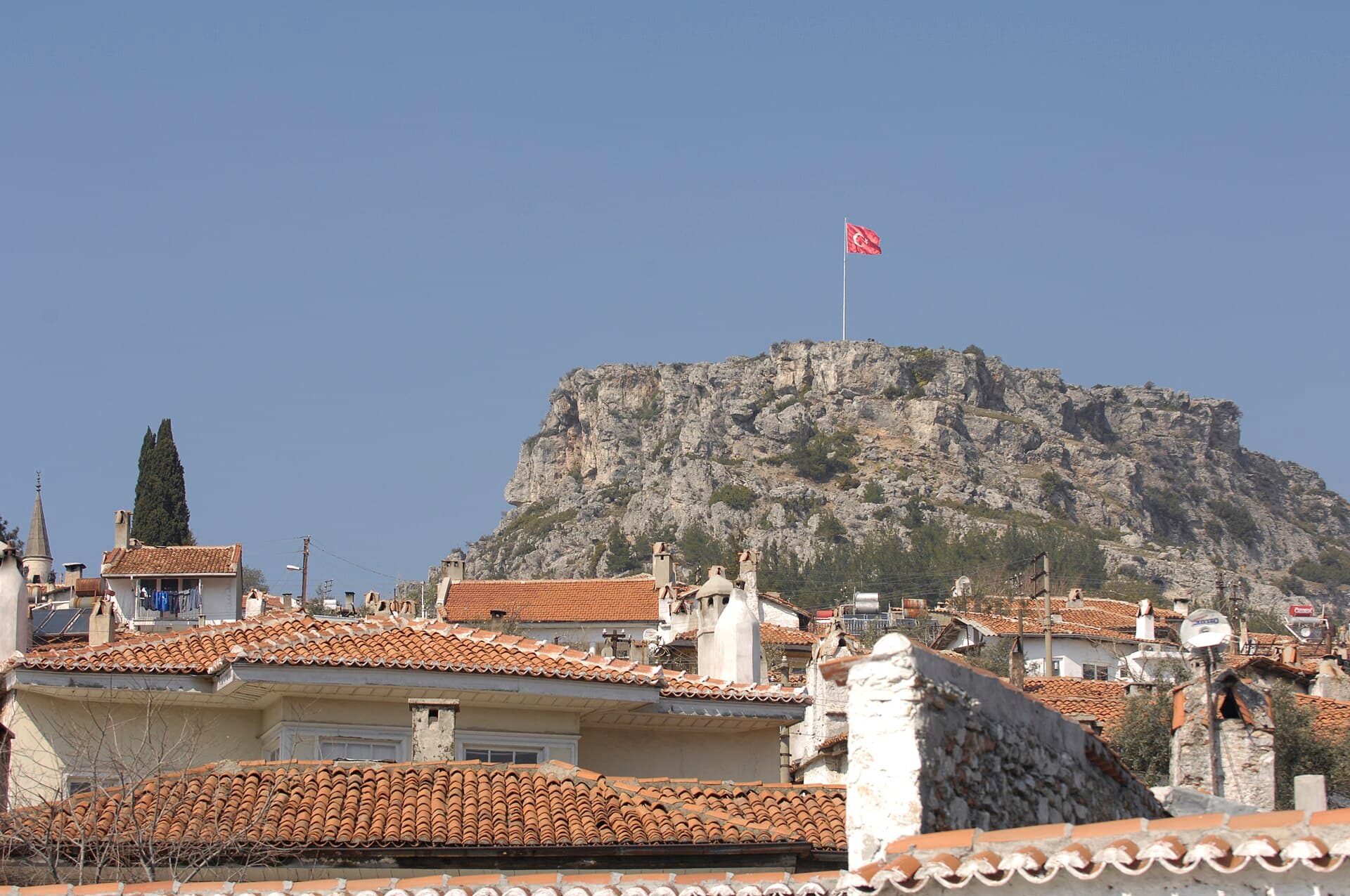
Muğla, TurkeyDosseman / CC BY-SA 4.0, via Wikimedia Commons
TR

Muğla

Self-guided audio walking tour of Muğla — GPS route, offline playback, story-driven narration in 32 languages.

Where ancient echoes meet Aegean currents.

The secrets of Muğla

Muğla, as no one tells it.

Not the postcards. The stories even locals don't know — whispered in your ear, right where they happened.

3 secrets below. Many more wait inside the tour.
Diagoras of Rhodes' Tomb

A pyramid in Turkey? It sounds like a legend, but a surprising find in Muğla Province connects this land to an ancient Greek boxer and a distinctive burial site.

Full story unlocks in the tour
Muğla's Ottoman-era Chimneys

Gaze upward in Muğla's old town and you will observe something particular about the rooftops. These are more than mere chimneys; they are a subtle marker of a bygone epoch.

Full story unlocks in the tour
The Mausoleum at Halicarnassus

One of the Seven Wonders of the Ancient World once stood in Muğla Province, but its ultimate demise was not a singular dramatic event.

Full story unlocks in the tour
The full tour

Discover every secret of Muğla

Every address, every reveal in full — in your ear, right where it happened.

Get the key to Muğla

You pick your stops. You walk. The voice reveals what the others miss.

Choose your time

How long do you have in Muğla?

Your self-guided audio tour of Muğla is ready — pick your landmarks, choose your language, and start the moment you arrive.

Buy
About Muğla

The story of Muğla

Muğla, a city in southwestern Turkey, functions as the administrative center of a province celebrated for its varied coastal panoramas and deep historical layers. Positioned inland at an elevation of 660 meters, it provides a peaceful respite from the lively beach resorts of its namesake province, yet remains a doorway to them. The city center, with its carefully preserved old town, invites exploration of its Ottoman-era architecture and a more deliberate pace of existence.

While many travelers journey to the globally recognized destinations like Bodrum, Marmaris, and Fethiye within Muğla Province, the city of Muğla itself offers a distinct encounter. It is a place where the Aegean and Mediterranean worlds meet, presenting a blend of ancient ruins, traditional villages, and active local markets. Whether you seek a historical expedition, a culinary exploration, or simply a quiet immersion in Turkish culture, Muğla provides a compelling starting point.

History

From Carian Stronghold to Ottoman Center

The story of Muğla reaches back to the ancient Carian civilization, the earliest known inhabitants of the territory. In antiquity, the area was largely identified as Caria, and Muğla itself was a minor settlement named Mobolla, serving as a transit point between the Carian cities of Idrias (later Stratonicea) and Idyma (modern Akyaka). The region was also a part of the Rhodian Peraea from at least 167 BC until the 2nd century AD.

Over centuries, various empires established authority, including the Romans and Byzantines, during which period the town's name evolved through Mogolla to its present form, Muğla. The city gained regional significance in the 13th century when it was taken by the Turks and subsequently organized under the Menteşe dynasty, based in Milas. This Turkmen dynasty, which governed from 1290 to 1425, profoundly shaped the local architecture, culture, and economy, particularly through their naval fleet. Their cultural impact endures in local art, textiles, music, and the design of villages.

Muğla was eventually absorbed into the Ottoman Empire in 1425, replacing Milas as the seat of the subprovince (sanjak) in 1420. During the Ottoman period, the sanjak retained the name Menteşe until the Republican Era when it was renamed Muğla. The city's historical importance is evident in its landmarks, such as the 19th-century Ottoman and early Republican period wooden houses and the 600-year-old Arasta Bazaar, a former Silk Road trading hub. Muğla's strategic location and deep past have left it with a wealth of archaeological sites and cultural inheritance, reflecting 6,000 years of continuous human habitation.

What to see

Begin your journey in Muğla's old town, Eski Muğla, where 19th-century wooden houses with distinctive chimneys line narrow passages. Here, the 1895 Muğla Clock Tower stands near the Ottoman-era Arasta Bazaar, a 600-year-old trading hub where traditional crafts like copper-smithing and leatherwork are still practiced. Nearby, you can visit the 16th-century Muğla Şeih Bedrettin Mosque and the classical Ottoman architecture of the 1495 Kurşunlu Mosque.

For a deeper exploration of history, consider a 40-minute drive to the ancient city of Stratonicea, a Hellenistic settlement with remnants of a theater, agora, temples, and walls. Another important archaeological site is Kaunos, near Dalyan, known for its impressive Lycian rock tombs carved into cliffs, a theater, and views over wetlands. Do not miss the opportunity for a traditional Turkish bath experience at the Sekibaşı Hamamı or the 13th-century Vakıflar Hamamı.

Those who appreciate nature can explore Masa Dağı, a mountain overlooking the city with traces of the ancient Castle of Mobolla, or venture to the nearby Mendos and Eğriboz mountains for walking. The Muğla Museum offers insights into the region's archaeology, ethnography, and natural history, including fossils dating back millions of years.

When to visit

The most pleasant times to visit Muğla are during spring (April to June) and autumn (September to October). These shoulder seasons offer mild weather, comfortable temperatures for sightseeing and outdoor pursuits like walking, and fewer visitors. Spring brings blooming nature, ideal for exploring ancient cities and paths. Early autumn still provides warm sea temperatures for swimming and a more relaxed atmosphere. While July and August are peak summer months, they are also the warmest and busiest, with higher prices and crowded attractions. Winter is quieter and offers a more local encounter.

Practical

Muğla is an inland city, approximately 30 kilometers from the nearest coastline at the Gulf of Gökova. The closest airports are Milas-Bodrum Airport (BJV), about 77 km west, and Dalaman Airport (DLM), roughly 100 km southeast. Carrying Turkish Lira is advisable, as cash is useful for markets, taxis, and smaller establishments, although cards are accepted in tourist areas. If planning a summer visit, reserving accommodations, boat trips, and car rentals in advance is recommended due to high demand. The city is easily explored on foot, especially its old town with its narrow passages and historic areas. Muğla's central location makes it a convenient base for exploring the wider province, with popular coastal destinations like Marmaris, Fethiye, and Bodrum within a few hours' drive.

Good to know
What is Muğla known for?
Muğla is recognized for its charming 19th-century Ottoman-era wooden houses, its historical importance as a former Menteşe principality center, and as the administrative capital of a province celebrated for popular tourist resorts like Bodrum, Marmaris, and Fethiye.
Are there beaches in Muğla city?
Muğla city itself is inland, about 30 kilometers from the nearest seacoast in the Gulf of Gökova. However, the province of Muğla is well-regarded for its numerous beaches and coastal destinations.
What ancient ruins can I visit near Muğla?
Near Muğla, you can visit the ancient city of Stratonicea, known for its Hellenistic ruins, and Kaunos near Dalyan, recognized for its Lycian rock tombs, theater, and ancient baths.
When is the best time to visit Muğla to avoid crowds?
To avoid the largest gatherings of people and enjoy pleasant weather, the shoulder seasons of spring (April to June) and autumn (September to October) are ideal for visiting Muğla.
What kind of local cuisine can I expect in Muğla?
Muğla's cuisine is shaped by coastal life and village traditions, featuring seafood, olive oil-based dishes, and local produce. You can find traditional Turkish flatbreads (pide), Çökertme kebab, and various mezes.
Is Muğla a good destination for hiking?
Yes, Muğla offers good opportunities for walking. You can explore trails on Masa Dağı, the Mendos and Eğriboz mountains, or sections of the long-distance Lycian Way that passes through the wider province.
On the map
Muğla
From€9.90
No booking · activate anytime · 12h to walk it
Get the key to Muğla