Palamidi Fortress
The ascent to Palamidi Fortress is famously associated with 999 steps, a daunting climb for many. But what if there was a different way to reach the top?
Full story unlocks in the tour
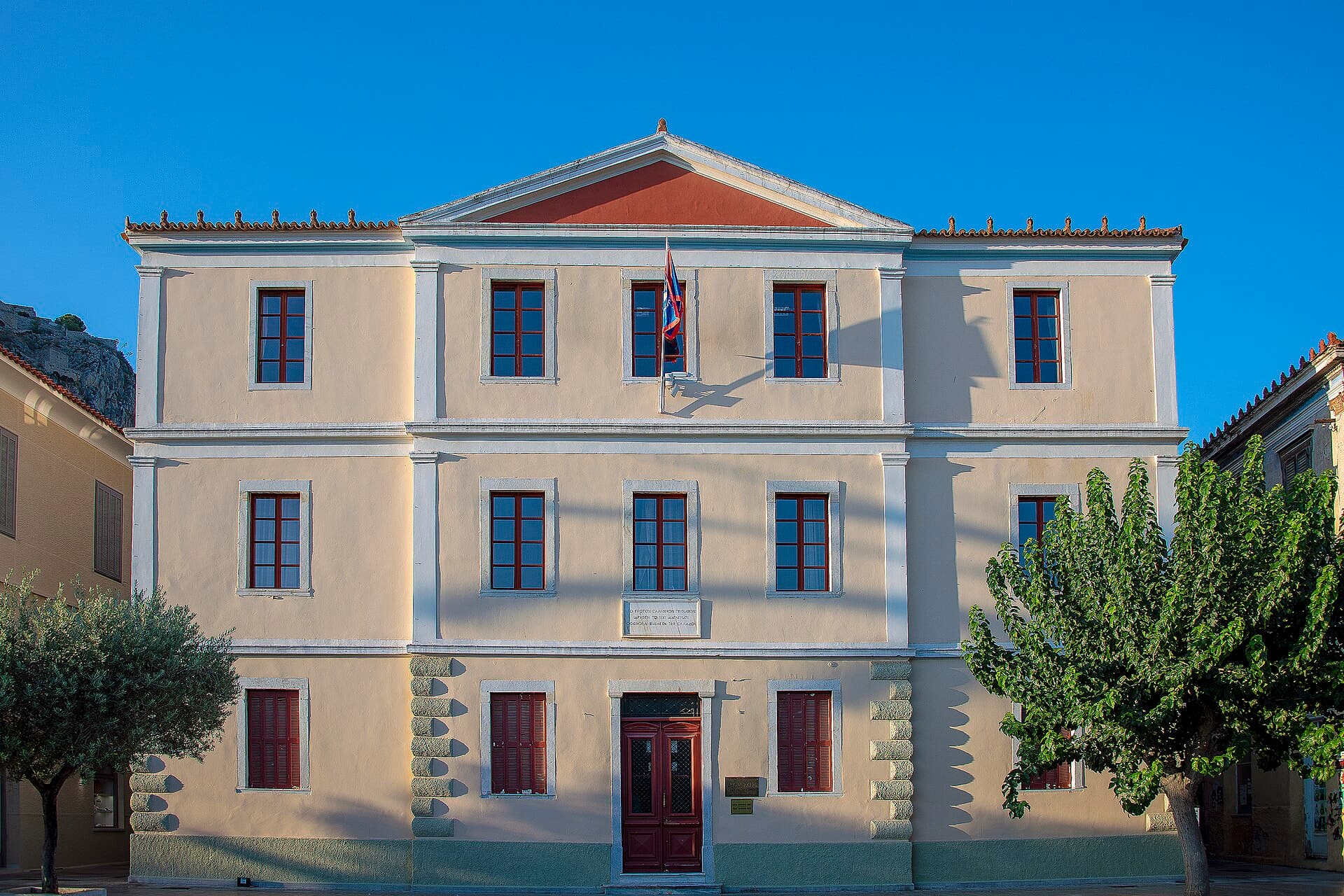 Apaleutos25 / CC BY-SA 4.0, via Wikimedia Commons
“Where Venetian elegance meets Greek history, and every stone tells a story.”
Not the postcards. The stories even locals don't know — whispered in your ear, right where they happened.
The ascent to Palamidi Fortress is famously associated with 999 steps, a daunting climb for many. But what if there was a different way to reach the top?
This picturesque island fortress in Nafplio's harbor appears as a romantic escape, but its past holds a surprisingly grim secret.
This unassuming church in the Old Town holds a tangible, violent reminder of a pivotal moment in modern Greek history.
Discover every secret of Nauplie
Every address, every reveal in full — in your ear, right where it happened.
You pick your stops. You walk. The voice reveals what the others miss.
No tours available yet. Check back soon — we're preparing them.
Nafplio, also known as Nauplie, is a captivating coastal city in the Peloponnese region of Greece, celebrated for its compelling history, striking architecture, and romantic atmosphere. It was the first capital of the modern Greek state from 1827 to 1834, a period that significantly shaped its character and left a legacy of impressive historical buildings. The city's unique blend of Venetian, Ottoman, and neoclassical influences is evident in its appealing old town, with narrow streets paved with stone, colorful buildings adorned with bougainvillea, and elegant squares.
Situated on the Argolic Gulf, Nafplio is flanked by formidable fortresses and offers wide views of the sea and surrounding hills. It serves as an ideal base for exploring some of Greece's most legendary archaeological sites, including ancient Epidaurus and Mycenae, both UNESCO World Heritage Sites, which are less than an hour away. Whether you're drawn to its historical significance, its picturesque scenery, or its lively local life, Nafplio provides a memorable experience that seamlessly blends the past with the present.
The area around Nafplio has been continuously inhabited since ancient times, with its origins tracing back to mythology. According to legend, the city was founded by Nafplios, the son of the sea god Poseidon and Amymone. In antiquity, it served as the port of Argos.
Nafplio gained considerable importance during the Middle Ages. After the Fourth Crusade, it came under Frankish rule as part of the lordship of Argos and Nauplia. In 1388, it was sold to the Republic of Venice, who considered it a crucial outpost in the Levant. During this first Venetian period, the lower city was expanded and fortified. The city then fell to the Ottoman Empire in 1540, becoming the capital of the Peloponnese under Turkish rule.
The Venetians recaptured Nafplio in 1686, initiating a second period of Venetian rule. This era saw significant repairs and the construction of the formidable Palamidi Fortress between 1711 and 1714, a masterpiece of military architecture. However, the Ottomans regained control in 1715.
Nafplio played a pivotal role in the Greek War of Independence. In November 1822, Greek rebels, led by Theodoros Kolokotronis, captured the Palamidi Fortress, marking a significant victory. Due to its strong fortifications, Nafplio became the seat of the provisional Greek government. In 1828, Ioannis Kapodistrias, the first head of state of newly liberated Greece, arrived in Nafplio and officially declared it the capital in 1829. His assassination in 1831 at the Church of Agios Spyridon is a stark reminder of the turbulent early years of the modern Greek state. The capital was eventually moved to Athens in 1834, but Nafplio's historical significance as the first capital remains a source of local pride.
Begin your exploration in the heart of the Old Town at Syntagma Square, a lively hub surrounded by neoclassical buildings, cafes, and historic sites like the Archaeological Museum and the Trianon (a former mosque). From here, wander through the narrow, stone-paved streets, admiring the Venetian and Ottoman architectural influences.
Dominating the skyline is the Palamidi Fortress, a sprawling Venetian citadel offering wide, sweeping views of the city and the Argolic Gulf. You can reach it by climbing the famous (or infamous) 999 steps, or by a more convenient drive to the East Gate. Just off the harbor, the Bourtzi Castle, a Venetian fortress on a small islet, is one of Nafplio's most photographed landmarks. Small boats regularly ferry visitors to the castle, which has served various roles, including a prison and a hotel.
Do not miss a stroll along the Arvanitia Promenade, a scenic coastal path that hugs the base of the Acronafplia hill, providing expansive sea views and leading to Arvanitia Beach. The Acronafplia Fortress itself, the oldest of Nafplio's three castles, offers another layer of history and impressive vistas. For those interested in local culture, the Komboloi Museum showcases a unique collection of worry beads.
Nafplio is a year-round destination, but the most pleasant times to visit are spring (April-May) and early autumn (September-October). During these months, the weather is agreeable with comfortable temperatures, fewer crowds, and blooming landscapes. Average temperatures range from 20-30°C. Summer (July-August) is the hottest and busiest period, with temperatures often exceeding 30°C, making it ideal for swimming but crowded in town and at beaches. Winters are mild, with average highs around 12-15°C, offering a quieter experience for exploring museums and tavernas.
Nafplio is easily accessible from Athens, approximately a two-hour drive or bus journey. Renting a car offers the most flexibility for exploring the Peloponnese and nearby archaeological sites, as public transport can be limited. The town itself is very walkable, with most attractions in the Old Town easily reached on foot. Consider visiting popular sites like Palamidi Fortress early in the morning or late afternoon to avoid crowds and the midday warmth. For dining, while Staïkopoulo street has many tavernas, exploring the streets between Syntagma Square and the waterfront (Yialos) can yield excellent food, often reflecting authentic Greek quality due to the high number of Greek tourists. Many restaurants also offer house wine, which is typically of good quality and reasonably priced.