Place Masséna's Sun Fountain
The grand statue of Apollo in the center of Nice once caused quite a stir, leading to an unexpected alteration.
Full story unlocks in the tour
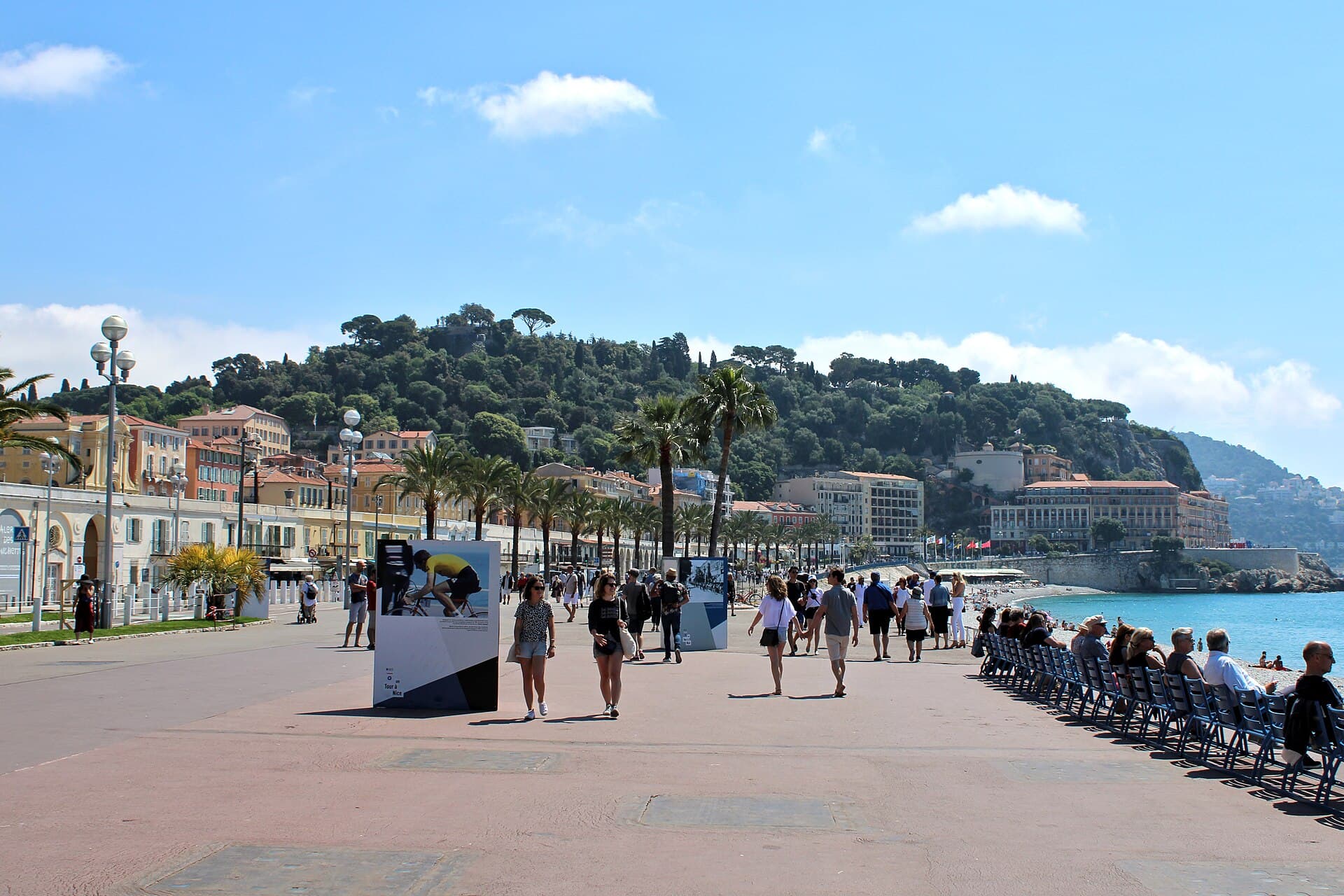 Alexander Migl / CC BY-SA 4.0, via Wikimedia Commons
Self-guided audio walking tour of Nice — GPS route, offline playback, story-driven narration in 32 languages.
“Where azure meets ochre, and history unfurls through sun-drenched streets.”
Not the postcards. The stories even locals don't know — whispered in your ear, right where they happened.
The grand statue of Apollo in the center of Nice once caused quite a stir, leading to an unexpected alteration.
Unlike many Mediterranean destinations, Nice's celebrated beaches aren't what you might expect underfoot.
Despite its designation, you won't find a standing castle at Nice's Castle Hill, and the reason dates back centuries.
Discover every secret of Nice
Every address, every reveal in full — in your ear, right where it happened.
You pick your stops. You walk. The voice reveals what the others miss.


Your self-guided audio tour of Nice is ready — pick your landmarks, choose your language, and start the moment you arrive.
BuyLume has a built-in augmented-reality guide. Hold your phone up and its camera shows the street ahead of you, with a glowing arrow laid over the real view that always points to your next stop — no map to puzzle over, no wrong turns. Like everything in Lume, it works fully offline.
Nice, the unofficial capital of the French Riviera, is a city that gracefully combines old-world character with a lively, modern pulse. With a past reaching back to Greek times, and centuries of Italian influence, Nice offers a distinctive cultural blend that sets it apart from other French cities. Its location on the Baie des Anges (Bay of Angels), framed by the Mediterranean Sea and sheltering hills, ensures a pleasant climate year-round, making it a favored destination for travelers seeking both relaxation and exploration.
The city's appeal lies in its contrasts: the animated Cours Saleya flower and produce market, the serene gardens of Cimiez, and the bustling Promenade des Anglais, where the rhythm of the sea meets the energy of city life. From its distinctive pebble beaches to its ochre-colored Old Town, Nice invites visitors to slow down, savor local flavors, and discover the layers of its compelling past.
The history of Nice extends back approximately 400,000 years, with evidence of prehistoric human settlement in the region. The city's official beginnings trace back to around 350 BCE, when Phocaean Greeks from Marseille established a town named Nikaia, likely in honor of a victory (nikē in Greek). This early settlement was a busy trading center. Later, during the 1st century CE, the Romans conquered the area, establishing the strategic center of Cemenelum on a hill above the city, complete with an amphitheater and extensive Roman baths, the ruins of which can still be explored in the Cimiez district today.
Nice spent centuries under various rulers, including the counts of Provence in the 10th century. In 1388, it came under the protection of the counts of Savoy, a powerful Italian dynasty, and remained largely under Italian influence for nearly 500 years until 1860. This long period of Italian rule is still evident in Nice's architecture, cuisine, and even its local dialect, Nissart. The city was captured and occupied by the French several times during the 17th and 18th centuries. Finally, in 1860, Nice was ceded to France by the Treaty of Turin, a decision ratified by a local referendum.
The 19th century marked a significant turning point for Nice, as affluent English travelers began to frequent the city to escape colder climates, drawn by its mild weather. They even funded the construction of the iconic seaside walkway, which eventually became known as the Promenade des Anglais (Walkway of the English). This period solidified Nice's reputation as a leading resort city on the French Riviera. The 20th century saw further modernization, the development of its airport, and its establishment as a significant artistic and cultural hub, attracting renowned artists like Henri Matisse and Marc Chagall, both of whom have dedicated museums in the city.
Begin your exploration in Vieux Nice, the Old Town, a maze of narrow, winding streets with pastel-colored buildings that recall its Italian past. Here, you'll find the animated Cours Saleya market, overflowing with flowers, fresh produce, and local specialties. Don't miss the Cathédrale Sainte-Réparate de Nice in Place Rossetti, a baroque creation dedicated to the city's patron saint.
A walk along the Promenade des Anglais is essential, offering expansive views of the Baie des Anges and a chance to observe local life. For the best panoramic vistas of the city, the port, and the coastline, make your way up Castle Hill (Colline du Château). While no castle remains, you'll discover a beautiful park, a waterfall, and the ruins of an ancient church.
Art enthusiasts can delve into the works of renowned masters at the Musée National Marc Chagall and the Musée Matisse, both shaped by the Mediterranean light. For a surprising architectural marvel, visit the Saint-Nicolas de Nice Orthodox Cathedral, a 19th-century Russian Orthodox church.
Nice enjoys a Mediterranean climate with around 300 sunny days per year. The shoulder seasons—April to May and September to October—are often considered the best times to visit. During these months, the weather is pleasant, ideal for sightseeing and outdoor activities, and the crowds are thinner than in the peak summer months. September offers warm sea temperatures for swimming. While summers (June-August) are hot and sunny, they bring larger crowds and higher prices. Winters (December-February) are mild, with fewer tourists and more affordable accommodation, offering a different, festive character.
Nice is a very walkable city, especially its Old Town, and most attractions are easily accessible on foot. For longer distances, an efficient public transportation system includes trams and buses, operated by Lignes d'Azur. Tickets can be purchased at vending machines, and a multi-ride pass is a convenient option. Driving within Nice is generally not recommended due to challenging parking and congested traffic. Taxis and Uber are available for convenience.
The local currency is the Euro (€). Standard power sockets are two-round-pin style (Type C and E), so an adapter may be necessary. Tap water is safe to drink, and bringing a reusable water bottle is encouraged. Most shops and offices close on Sundays, and many close for national holidays. Be mindful of pickpockets in crowded tourist areas.
Nice in Korean, in Chinese or in Hebrew — and 29 more languages, every stop narrated by a native voice. The widest language range of any self-guided audio tour.
Available in: