Nizhny Novgorod Kremlin
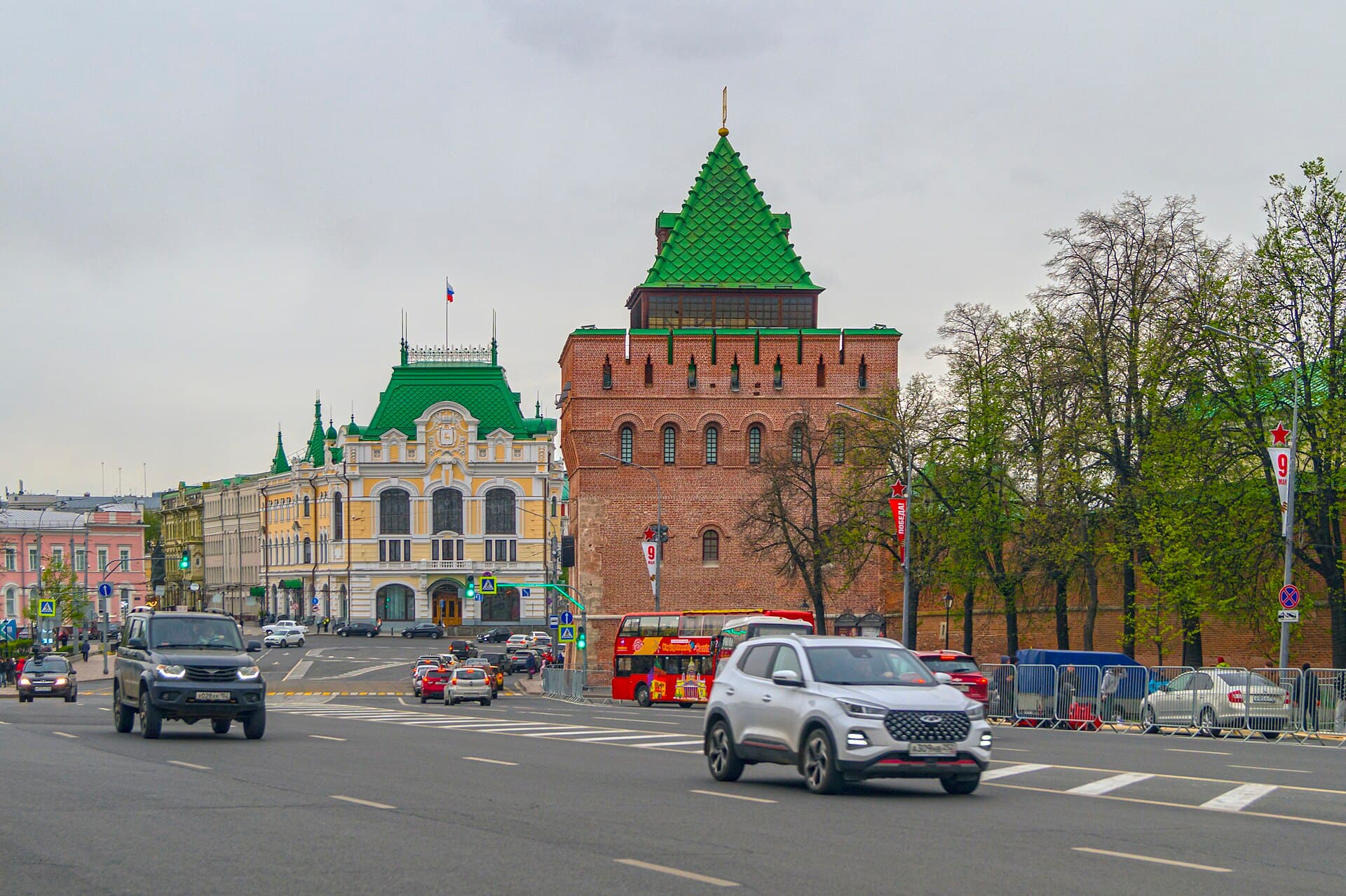
The formidable red-brick walls of the Nizhny Novgorod Kremlin hold more than just centuries of history.
Full story unlocks in the tour
 AlexTref871 / CC BY-SA 4.0, via Wikimedia Commons
“Where two great rivers meet, and history echoes through ancient walls.”
Not the postcards. The stories even locals don't know — whispered in your ear, right where they happened.
The formidable red-brick walls of the Nizhny Novgorod Kremlin hold more than just centuries of history.
This monumental staircase, Russia's longest, wasn't always intended to honor its namesake pilot.
Crossing the Volga River by cable car offers sweeping vistas, but the journey itself holds a unique European distinction.
Discover every secret of Nijni Novgorod
Every address, every reveal in full — in your ear, right where it happened.
You pick your stops. You walk. The voice reveals what the others miss.
No tours available yet. Check back soon — we're preparing them.
Nizhny Novgorod, often affectionately shortened to 'Nizhny' by locals, is a city where the powerful Volga and Oka rivers converge, creating a dramatic landscape that has shaped its destiny for centuries. Established in 1221 by Prince George II of Vladimir, it swiftly became a crucial frontier post and a significant trading crossroads between Russia and the East.
This storied city, once a restricted industrial center known as Gorky during the Soviet era, has reopened its doors to reveal a compelling blend of ancient fortifications, grand merchant mansions, and a lively cultural fabric. Its strategic location and deep past have earned it recognition from UNESCO as one of the world's 100 cities of considerable historical and cultural importance. With its impressive Kremlin, scenic embankments, and animated pedestrian avenues, Nizhny Novgorod invites exploration, offering expansive river panoramas and a profound immersion into Russian heritage.
Nizhny Novgorod's narrative commences in 1221, founded as a wooden fortress by Prince Yuri Vsevolodovich at the confluence of the Volga and Oka rivers. This strategic position made it a vital defensive stronghold against militant tribes and a blossoming trade center. In the 14th century, it became the capital of its own principality before being absorbed by Moscow in 1392.
The city's importance as a commercial nexus grew considerably with the establishment of large, thriving trade fairs, drawing merchants from across Europe, Asia, and Siberia. By 1817, the renowned Makaryev Fair relocated to Nizhny Novgorod, cementing its status as the Russian Empire's trade capital and earning it the moniker 'the Pocket of Russia.' The city also emerged as a center for early industrialization, particularly in heavy industry and engineering, due to the high volume of commerce.
The early 20th century saw Nizhny Novgorod transform into a major industrial hub. During the Soviet era, from 1932 to 1990, the city was renamed Gorky in honor of the writer Maxim Gorky, who was born there. In this period, it became a 'closed city' due to its significant military research and production facilities, including the Gorky Automobile Plant (GAZ), which manufactured the first Soviet tank. Foreigners were restricted from entering until the ban was lifted in 1990, and the city's original name was reinstated. Today, Nizhny Novgorod continues to be an important economic, architectural, educational, and cultural center, dynamically blending its profound past with contemporary development.
Begin your exploration at the Nizhny Novgorod Kremlin, a formidable red-brick fortress dating back to the early 16th century. Walk along its two-kilometer walls, the longest Kremlin wall circuit in Russia, for unparalleled views of the Volga and Oka rivers. Within its walls, you'll find the 17th-century Cathedral of the Archangel Michael, the resting place of Kuzma Minin, a hero who helped repel a Polish invasion.
Descend the Chkalov Staircase, Russia's longest staircase with approximately 560 steps, connecting the Kremlin to the Lower Volga Embankment and offering striking sunset views. Wander along Bolshaya Pokrovskaya Street, a pedestrian thoroughfare lined with historic buildings, cafes, and street performers, often compared to Moscow's Arbat Street. Nearby, Rozhdestvenskaya Street is an open-air museum of 19th-century architecture and a lively center for restaurants and cafes.
Do not overlook the Nizhny Novgorod Cableway, which offers a scenic 13-minute ride across the Volga River to the town of Bor, providing expansive city views. For a glimpse into the city's industrial past, visit the GAZ History Museum or the Open-Air Locomotive Museum. The Alexander Nevsky Cathedral, a monumental church on the Strelka (the spit where the rivers meet), is another architectural marvel.
The ideal time to visit Nizhny Novgorod is from late spring to early autumn, specifically May through September, when the weather is most agreeable for exploring. May brings blooming lilacs and city birthday celebrations, while June offers very mild temperatures, perfect for river cruises and outdoor activities. July is the warmest month, with average highs around 24°C, suitable for extended walks. September offers cooler, crisp air and the golden hues of autumn foliage along the riverbanks, creating a calm atmosphere as summer crowds dissipate.
Nizhny Novgorod is readily accessible, situated approximately 400 km east of Moscow. High-speed trains from Moscow take about 3.5 to 4 hours, and overnight trains are also available. Strigino International Airport (GOJ) is about 17 km from the city center, with regular flights from Moscow and Saint Petersburg. Within the city, public transport includes a metro, trams, trolleybuses, and marshrutka minibuses. A unified transport card is available for convenience. Taxis are also easily found and affordable for shorter distances. While many locals speak Russian, having a translation app or a phrasebook can be helpful. SIM cards purchased outside the Volga region may incur roaming charges.