Beyond the impressive architecture and tranquil grounds, a unique ritual connects visitors to an ancient legend of an ogre and a boiling cauldron.
水だらけのプール / CC BY-SA 4.0, via Wikimedia CommonsOkayama
“Okayama: Where ancient legends meet sun-drenched gardens and a quiet, creative spirit.”
Okayama, as no one tells it.
Not the postcards. The stories even locals don't know — whispered in your ear, right where they happened.
The castle's distinctive dark exterior earned it a dramatic nickname, but its original appearance was lost to history before a remarkable modern reconstruction.
One of Japan's Three Great Gardens, this expansive landscape was designed not just for beauty, but with a specific, surprising purpose for its feudal lord.
Discover every secret of Okayama
Every address, every reveal in full — in your ear, right where it happened.
You pick your stops. You walk. The voice reveals what the others miss.
How long do you have in Okayama?
No tours available yet. Check back soon — we're preparing them.
The story of Okayama
Okayama, often called the 'Land of Sunshine' due to its mild climate and many clear days, offers a compelling blend of historical depth and natural splendor in Japan's Chugoku region. This capital city of Okayama Prefecture serves as a vital transportation hub, connecting Honshu with Shikoku and providing easy access to other major Japanese cities via the Shinkansen. While sometimes overlooked by international travelers, Okayama presents an authentic Japanese experience, full of folklore, exquisite gardens, and a distinct culinary heritage.
Okayama's allure stems from its strategic location along the Seto Inland Sea, benefiting from fertile agricultural lands that yield prized white peaches and Muscat grapes, earning it the moniker 'Fruit Kingdom.' The city is famously associated with the legend of Momotaro, the 'Peach Boy,' a beloved Japanese folk hero, with references to the tale woven throughout the area. From its iconic black castle to one of Japan's most celebrated landscape gardens, Okayama invites exploration beyond the well-trodden paths, promising a journey into a region proud of its unique character and history.
## From Ancient Kibi to Feudal Powerhouse Okayama's origins trace back to the ancient Kingdom of Kibi, established in the 4th century AD, with temples and remains of this early civilization found in the city's northwest. The modern city's growth is closely tied to the construction of Okayama Castle. Construction of the castle began in 1573 under Ukita Naoie and was completed by his son, Ukita Hideie, in 1597, during the Azuchi-Momoyama period. Hideie, a powerful feudal lord and vassal of Toyotomi Hideyoshi, played a key role in the city's rise, leveraging its strategic location on a fertile plain at the confluence of rivers flowing into the Seto Inland Sea.
After the Battle of Sekigahara in 1600, control of Okayama passed to the Ikeda clan, who governed the region throughout the Edo period (1603–1868). Under their administration, Okayama flourished as a prosperous castle town, becoming the political and economic center of Bizen Province. The Ikeda clan were patrons of the arts, notably completing the magnificent Korakuen Garden in 1700, now recognized as one of Japan's Three Great Gardens. The city's economy thrived on rice trade and the development of crafts, including the renowned Bizen-style ceramics.
## Modern Development and Resilience In 1871, with the Meiji Restoration, Okayama became the capital of Okayama Prefecture. The city was officially founded in 1889, and the opening of a railway station on the San'yo line in 1891 transformed Okayama into a significant transportation hub in western Japan. Educational institutions like the Sixth Higher Middle School and Okayama Medical College were established, further contributing to the city's development.
Okayama suffered extensive destruction during World War II bombings on June 29, 1945, which included the burning of the original main tower of Okayama Castle. However, the city rapidly developed during Japan's economic boom in the 1960s. The castle's keep was reconstructed in 1966. The San'yō Shinkansen began service to Okayama in 1972, and the Seto-Ōhashi Bridge, connecting Okayama with Shikoku by rail and road, opened in 1988, solidifying its role as a major regional center.
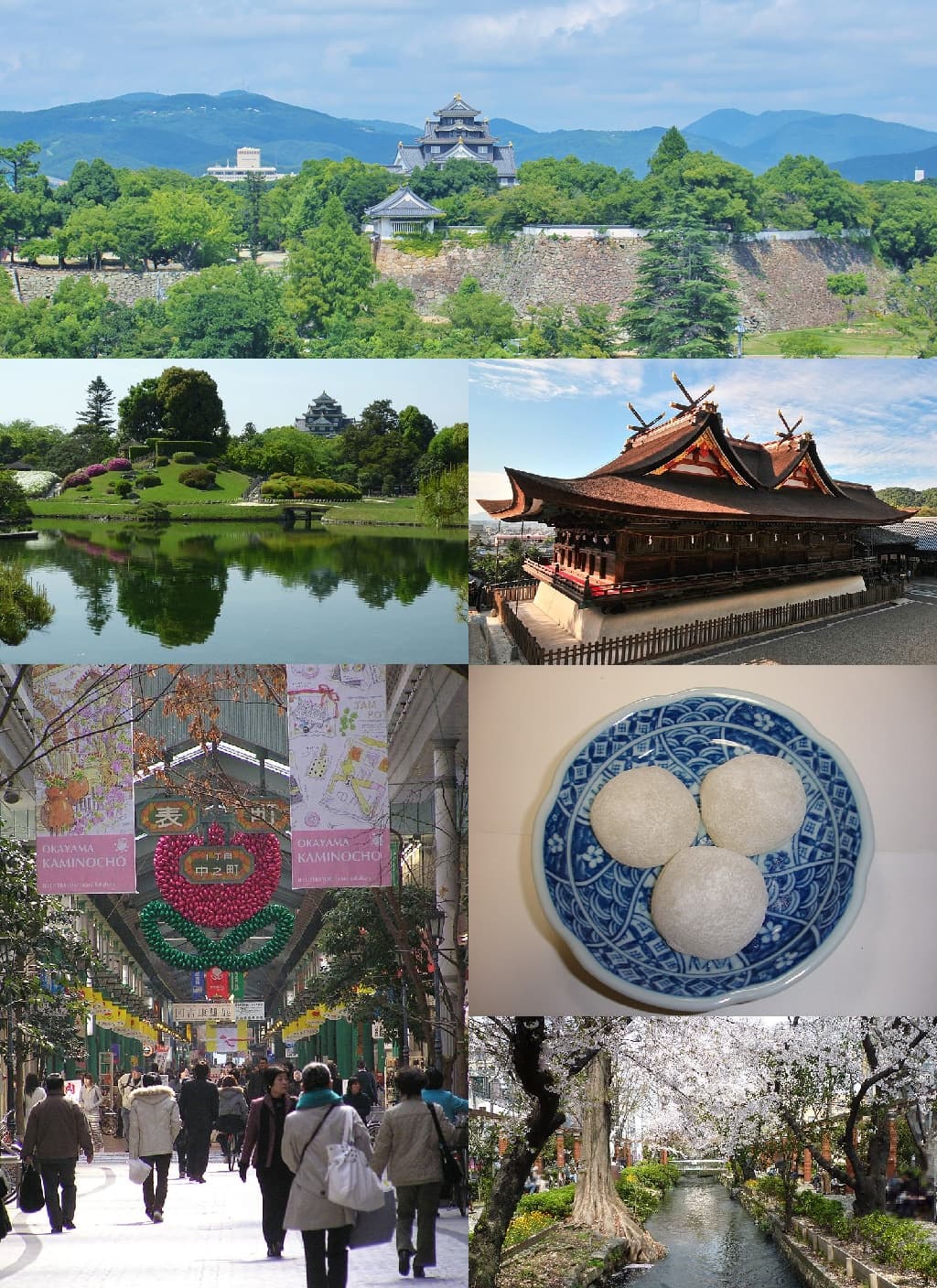
Okayama offers a variety of attractions that blend natural beauty with cultural heritage. A visit often begins with Okayama Korakuen Garden, considered one of Japan's Three Great Gardens. This expansive landscape garden, dating back to 1700, features meticulously maintained lawns, ponds, tea fields, and a cherry blossom grove, with views of the nearby castle. Just across the Asahi River stands Okayama Castle, also known as 'Crow Castle' due to its striking black exterior. The reconstructed keep offers sweeping views of the city and Korakuen Garden.
For a deeper dive into local folklore, Kibitsu Shrine is a compelling destination. This important Shinto shrine is deeply connected to the Momotaro legend and displays a unique architectural style, Kibitsu-zukuri, designated as a National Treasure. A highlight is its impressive 360-meter covered wooden corridor. Beyond the city center, the Kibiji Bike Trail offers a scenic route through rice fields to ancient temples, providing a glimpse into the region's historical landscape. The nearby Kurashiki Bikan Historical Quarter, a short train ride away, is famed for its picturesque canals and preserved traditional merchant houses, offering a charming atmosphere for strolling and exploring.
Okayama's mild climate makes it suitable for travel throughout the year, earning it the nickname 'Land of Sunshine.' The most pleasant times to visit are generally spring (mid-April to mid-May) and autumn (late October to mid-November) for comfortable temperatures and lively scenery. Spring brings cherry blossoms to Korakuen Garden and along the Asahi River, typically peaking around early April. Autumn offers beautiful foliage, with maples and ginkgo trees coloring the gardens from mid-November to early December. Summers are warm and humid, with average highs around 31-32°C (88-90°F) in August, though it's a good season for fruit picking. Winters are mild with little heavy snowfall, with average temperatures around 5-7°C (41-45°F) in the southern part of the prefecture.
Okayama is easily accessible, primarily via the JR Tokaido-Sanyo Shinkansen, connecting it to major cities like Tokyo (3.5-4.5 hours), Kyoto (1-1.5 hours), Osaka (50 minutes), and Hiroshima (40 minutes). Okayama Momotaro Airport also offers domestic flights, with buses connecting to Okayama Station in about 30 minutes. Within the city, two tram lines, the Higashiyama Line and Sekibashi Line, depart from Okayama Station, with a flat fare of 160 yen per ride or a 400 yen day pass available. Buses also cover areas not served by the trams. Taxis are available, and major attractions like the castle and garden are walkable from the Shiroshita tram stop. Japan is known for its low crime rate, and Okayama is considered very safe for travelers. The local currency is the Japanese Yen (JPY). While credit cards are widely accepted, it's advisable to carry some cash for smaller establishments. English is not universally spoken, so having a translation app can be helpful.
- What is Okayama famous for?
- Okayama is known for Okayama Korakuen Garden (one of Japan's Three Great Gardens), Okayama Castle (the 'Crow Castle'), its association with the Momotaro (Peach Boy) folk legend, Bizen-yaki pottery, and exceptional white peaches and grapes.
- How do I get to Okayama?
- Okayama is easily reached by the JR Tokaido-Sanyo Shinkansen from major cities like Tokyo, Kyoto, Osaka, and Hiroshima. Okayama Momotaro Airport also offers domestic flights, with bus connections to the city.
- What are some local dishes to try in Okayama?
- Local specialties include Okayama Barazushi (scattered sushi), Kibi Dango (millet dumplings), Hinase Kakioko (oyster okonomiyaki), Hiruzen Yakisoba, and Chiya Beef. Okayama is also known for its white peaches and muscat grapes.
- Is Okayama safe for tourists?
- Yes, Okayama is known for its remarkably low crime rate and is considered very safe for tourists, including solo female travelers. Japan as a whole is recognized as one of the safest countries to visit.
- What is the best way to get around Okayama City?
- Within Okayama City, trams are a convenient way to get around, with two lines departing from Okayama Station. A one-day pass is available for unlimited rides. Buses and taxis are also options, and many central attractions are walkable.
- What is the 'Land of Sunshine' nickname about?
- Okayama is called the 'Land of Sunshine' because it experiences a mild climate with a high number of sunny days and relatively low rainfall throughout the year, especially compared to other parts of Japan.