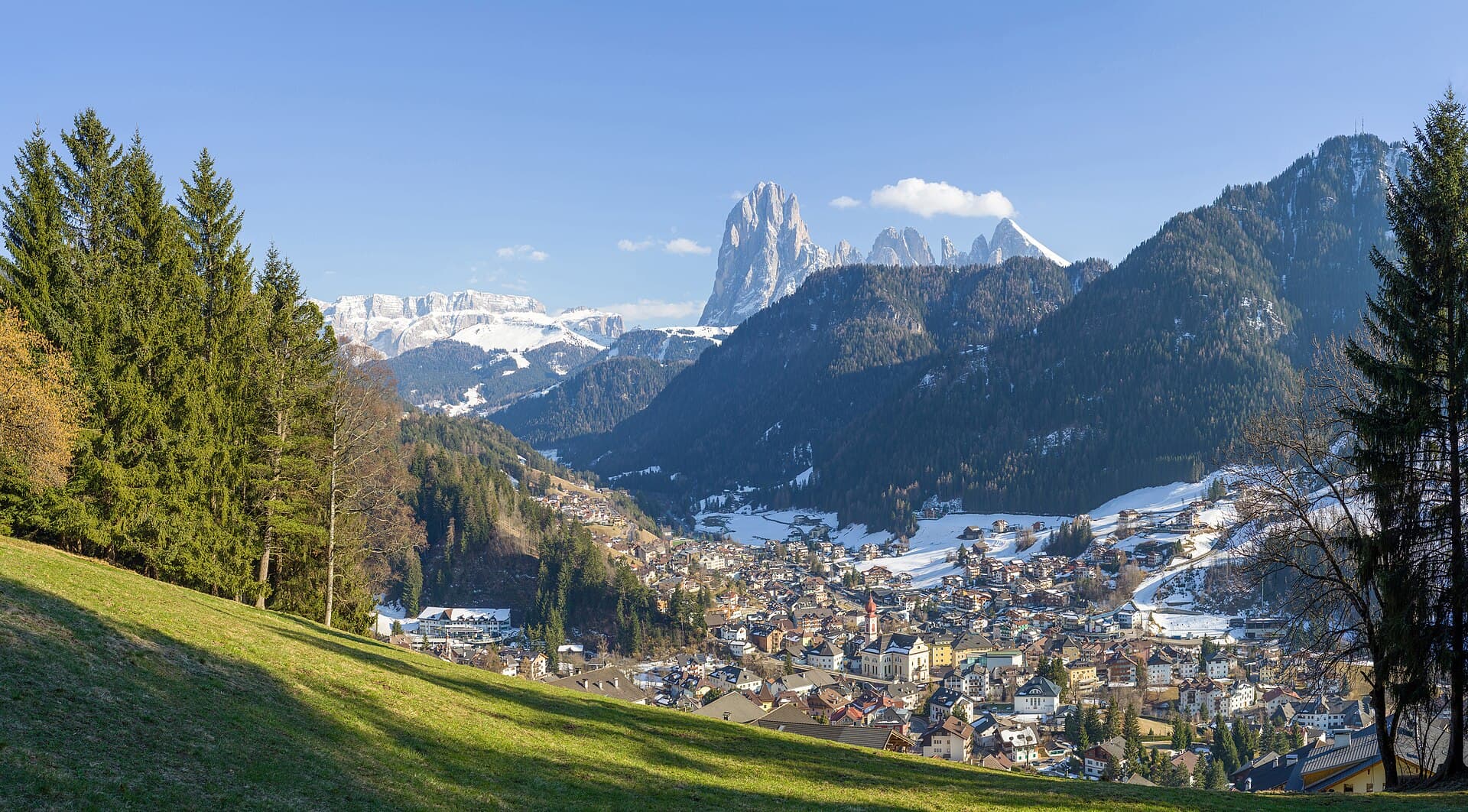
Most people know Ortisei for its mountain scenery and artisan woodcarvings, but few realize the town is a stronghold of one of Europe's oldest languages.
This Photo was taken by Wolfgang Moroder. Feel free to use my photos, but please mention me as the author and send me a message. This image is not in the public domain. Please respect the copyright protection. It may only be used according to the rules mentioned here. This specifically excludes use in social media, if applicable terms of the licenses listed here not appropriate. Please do not upload an updated image here without consultation with the Author. The author would like to make corrections only at his own source. This ensures that the changes are preserved.Please if you think that any changes should be required, please inform the author.Otherwise you can upload a new image with a new name. Please use one of the templates derivative or extract. / CC BY-SA 4.0, via Wikimedia CommonsOrtisei
“Where ancient traditions meet alpine grandeur.”
Ortisei, as no one tells it.
Not the postcards. The stories even locals don't know — whispered in your ear, right where they happened.
You might expect Italian coffee culture in the Dolomites, but there is a specific local drink that locals prefer, especially when observing the flow of people.
The exquisite woodcarvings of Ortisei are world-renowned, but the tradition began not just as an art form, but out of necessity.
Discover every secret of Ortisei
Every address, every reveal in full — in your ear, right where it happened.
You pick your stops. You walk. The voice reveals what the others miss.
How long do you have in Ortisei?
No tours available yet. Check back soon — we're preparing them.
The story of Ortisei
Ortisei, known as St. Ulrich in German and Urtijëi in Ladin, is a village in Italy's South Tyrol, cradled within the Val Gardena valley. Surrounded by the dramatic peaks of the Dolomites, a UNESCO World Heritage site, Ortisei serves as a gateway to an array of outdoor adventures and a lively cultural experience. The village center, largely pedestrianized, invites visitors to wander among traditional alpine houses, artisan shops, and inviting cafes, all set against a backdrop of towering cliffs and verdant meadows.
At an elevation of 1,236 meters (4,055 feet), Ortisei is the largest and most animated village in Val Gardena, offering a blend of historical charm and modern amenities. It is a place where three languages—Ladin, German, and Italian—coexist, reflecting the region's unique heritage. Whether seeking exhilarating winter sports, serene summer hikes, or a deeper dive into local craftsmanship and culture, Ortisei presents a distinctive Dolomitic experience.
From Ancient Settlements to Artisan Hub
The history of Ortisei stretches back centuries, with archaeological evidence pointing to prehistoric human settlements in the area. The Ladin name, Urtijëi, and its Italian counterpart, Ortisei, are believed to originate from a 13th-century farmstead called Ortiseyt, derived from the Latin word urtica, meaning 'nettle.'
For many centuries, the challenging alpine climate meant that the valley's soil yielded only a modest livelihood for its inhabitants. This scarcity spurred the development of alternative income sources, most notably woodcarving, which began in the valley as early as the 15th century. By the early 17th century, woodcarving had become a significant craft, particularly in Ortisei, with families like the Vinazer and Tröbinger becoming early pioneers. These artisans initially focused on creating simple household objects and religious figurines for local churches. Over time, as the town prospered, the craft evolved into an intricate art form, influenced by skilled artisans from other parts of Italy and Europe who introduced new styles and techniques.
The Rise of Tourism and Modern Ortisei
The 19th century marked a significant turning point for Ortisei with the advent of tourism. Mountaineers discovered the beauty of the Dolomites and began using Ortisei as a starting point for their expeditions around the mid-1800s. This growing interest led to a revival and expansion of woodcarving, with artisans increasingly creating secular pieces like furniture and sculptures for visitors and collectors worldwide. The establishment of the Ortisei Art School further cemented the village's reputation as a center for woodcarving.
By the second half of the 19th century, tourism had grown in economic importance, and by the 1970s, Ortisei had become a recognized resort for winter sports. The village even hosted the Alpine Ski World Cup in 1970. Today, tourism remains the primary industry, with Ortisei attracting approximately 700,000 to 950,000 overnight guests annually. The town has successfully blended its ancient traditions with modern tourism, creating a unique environment where visitors can engage with a rich cultural heritage amidst remarkable natural beauty.
Ortisei offers a charming pedestrian zone, perfect for leisurely strolls, browsing boutiques, and enjoying local cafes and restaurants. The town is a prime location for accessing the surrounding Dolomite peaks via a network of cable cars and funiculars.
Take the Seceda Cable Car for sweeping views of the ridgeline, ideal for hiking or simply soaking in the scenery. The Rasciesa Funicular provides access to a quieter mountain area with trails and alpine huts. From Ortisei, you can also reach the Alpe di Siusi (Seiser Alm), Europe's largest high-alpine meadow, known for its picturesque mountain panoramas and family-friendly activities.
For a dose of history and culture, visit S. Giacomo Church, the oldest church in Val Gardena, dating back to the 12th century, which houses a carved wooden altar. The Museum Gherdëina, located in the House of Ladin Culture, offers a comprehensive look into the region's natural and cultural history, including its renowned woodcarving tradition, local fossils, and art collections. In summer, the Rosarium in Pufels showcases over 6,000 rose bushes.
Ortisei is a year-round destination, with each season offering distinct attractions. Summer, from June to September, is ideal for hiking, biking, and paragliding, with mild and sunny temperatures averaging around 20 °C. Fall, particularly October, brings fewer crowds, cooler temperatures, and vivid autumn colors. Winter, from December to March, transforms Ortisei into a winter sports paradise, with extensive opportunities for skiing, snowboarding, and other snow activities within the Val Gardena and Dolomiti Superski areas. Spring (April-May) is quieter, with lingering snow on the peaks and the first blossoms appearing.
Ortisei is highly walkable, with its main street featuring shops, restaurants, and bakeries easily accessible on foot. Public transportation is reliable; many hotels and apartments provide guests with a pass for the local bus system, connecting Ortisei with nearby towns like Santa Cristina and Selva. The closest major airports are Innsbruck, Austria (approximately 2 hours away), and Verona, Italy (about 3 hours away). From these airports, you can rent a car or use a combination of trains and buses to reach Val Gardena. The nearest train stations are Bolzano, Bressanone, Chiusa, and Ponte Gardena, with bus connections available to Ortisei. If traveling by bus from Bolzano, tickets can be purchased at the station. While parking is limited in Ortisei, a car is not essential once you have arrived.
- What languages are spoken in Ortisei?
- In Ortisei, the majority of the population speaks Ladin (around 84%), followed by German (9.3%) and Italian (6.5%).
- Is Ortisei good for families with children?
- Yes, Ortisei is very family-friendly, offering playgrounds, an adventure park, an ice rink in winter, family-friendly hikes, and access to the Alpe di Siusi with its animal farms and playgrounds.
- Do I need a car to get around Ortisei?
- No, you do not need a car in Ortisei. The village is very walkable, and many accommodations offer a guest pass for free public bus transit throughout Val Gardena.
- What is Ortisei famous for?
- Ortisei is known for its Dolomite scenery, its long-standing tradition of woodcarving, and as a popular destination for both summer hiking and winter sports.
- What kind of food can I expect in Ortisei?
- The local cuisine in Ortisei is a delightful blend of Italian, Tyrolean, and Ladin influences, featuring dishes like dumplings (knödel), speck, goulash, polenta, and apple strudel.
- Are the cable cars and funiculars open year-round?
- Many lifts in Ortisei and Val Gardena operate year-round, though it is always advisable to check current operating times for specific lifts, especially during shoulder seasons.