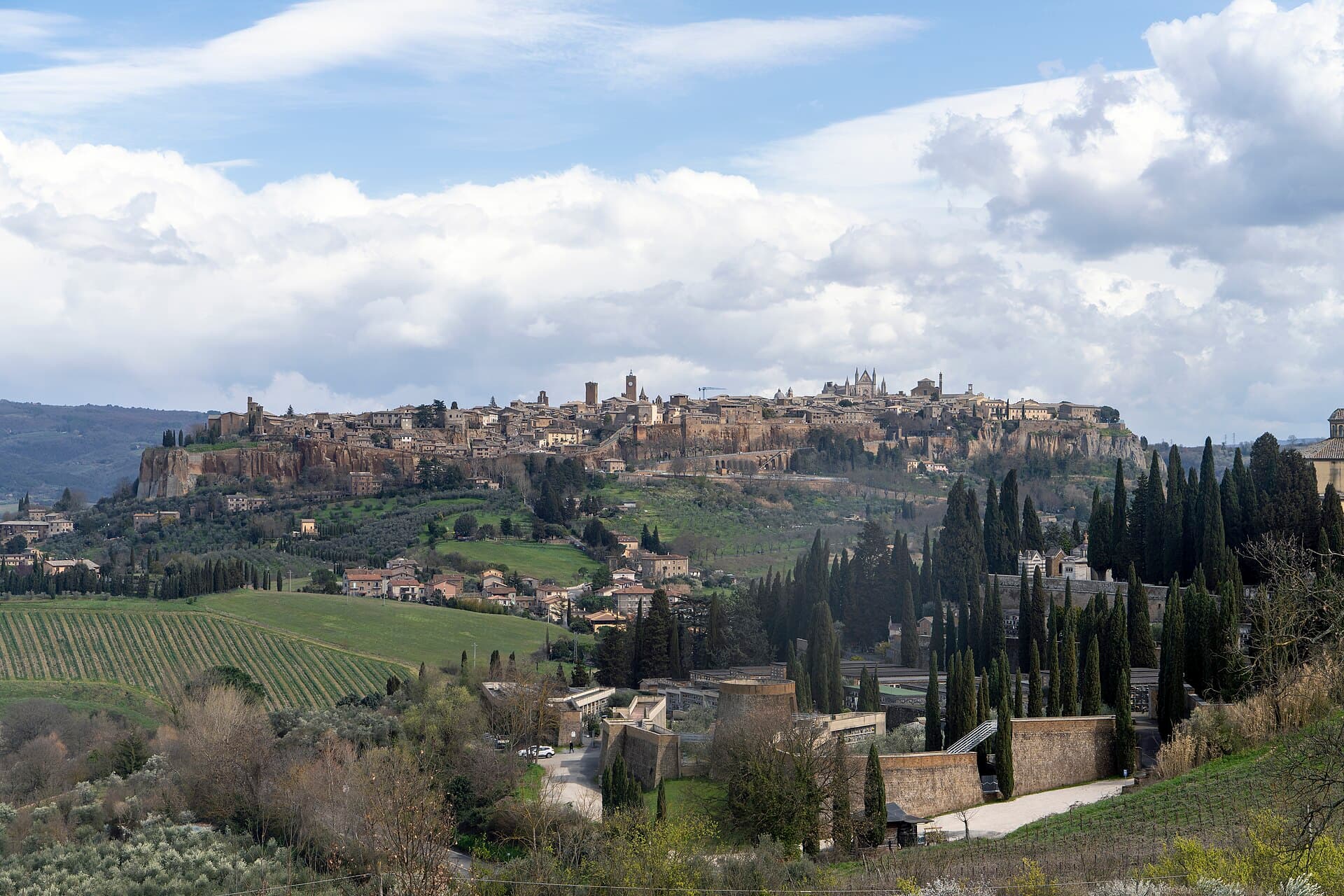
Beneath Orvieto's inviting medieval streets lies a world carved into the volcanic rock, waiting to be discovered.
NikonZ7II / CC BY-SA 4.0, via Wikimedia CommonsOrvieto
“Orvieto: A city sculpted from earth, holding millennia in its stone.”
Orvieto, as no one tells it.
Not the postcards. The stories even locals don't know — whispered in your ear, right where they happened.
This remarkable 16th-century well was constructed out of urgent necessity, its design a testament to Renaissance ingenuity.
The expansive interior of Orvieto's Duomo holds a subtle design secret, crafted to play with visual perception.
Discover every secret of Orvieto
Every address, every reveal in full — in your ear, right where it happened.
You pick your stops. You walk. The voice reveals what the others miss.
How long do you have in Orvieto?
No tours available yet. Check back soon — we're preparing them.
The story of Orvieto
Orvieto rises dramatically from a volcanic tufa cliff, a city seemingly sculpted from the earth itself. This striking Umbrian hilltop town, midway between Rome and Florence, offers a captivating blend of Etruscan mystery, medieval grandeur, and a slower pace of life. Its unique geography, with the city walls and houses appearing to grow directly from the tufa stone, creates an unforgettable first impression.
Beyond its visible beauty, Orvieto holds a profound sense of history, with layers of civilization etched into its very foundations. From its ancient origins as a significant Etruscan center to its role as a papal refuge, the city has witnessed millennia of change. Today, Orvieto invites visitors to explore its intricate past, savor its renowned wines, and wander its quiet, stone-paved streets, offering a respite from the bustle of larger Italian cities.
## Etruscan Roots and Roman Conquest Orvieto's history stretches back over 3,000 years, with its origins deeply intertwined with the Etruscan civilization. From around the 9th century BC, Orvieto, then known as "Velzna," was a prominent Etruscan center, possibly even a gathering place for representatives of the twelve major Etruscan cities. The Etruscans were masterful engineers, carving an extensive network of tunnels, wells, and cisterns into the soft volcanic tufa rock beneath the city, a practice that would continue for centuries. These subterranean passages served various purposes, including water management, storage, and even escape routes during times of conflict.
The city's natural defenses, upon its imposing cliff, made it a formidable stronghold. However, in 264 BC, the Romans eventually conquered Velzna after a two-year siege, relocating its population to an area near Lake Bolsena. This marked a period of decline for Orvieto, lasting for several centuries, with few traces of Roman occupation remaining on the cliff itself.
## Medieval Resurgence and Papal Influence Orvieto experienced a significant resurgence during the Middle Ages, becoming a thriving city-state by 1200 AD. During this prosperous era, the city expanded its control over surrounding territories, reaching from the Tiber River to the Tyrrhenian Sea. The 13th century saw the commissioning of the magnificent Orvieto Cathedral, a project that would take nearly 300 years to complete and remains a masterpiece of Italian Gothic architecture. The city also became a frequent papal residence, particularly after 1364 when it was annexed by the Church. Pope Urban IV resided here due to civil unrest in Rome, and later, Pope Clement VII sought refuge in Orvieto during the 1527 Sack of Rome. It was during this time that the iconic Pozzo di San Patrizio, or St. Patrick's Well, was commissioned to ensure a reliable water supply in case of siege.
## Modern Era and Preservation In 1860, Orvieto became part of the newly formed Kingdom of Italy. Unlike many other Italian cities, Orvieto was largely spared from significant damage during World War II, preserving its medieval buildings and its iconic Duomo. Today, Orvieto is recognized as a leader in the "Città Slow" (Slow Food) movement, reflecting its deep connection to the land and its flourishing food and wine scene. The city continues to restore its historic structures while embracing modern advancements, offering a unique blend of ancient charm and contemporary life.
Orvieto offers a wealth of sights, both above and below ground. The Duomo di Orvieto is an undeniable highlight, its dazzling Gothic façade adorned with golden mosaics and intricate sculptures. Inside, the Chapel of San Brizio features striking frescoes by Luca Signorelli depicting the Last Judgment. For a unique architectural marvel, descend into Pozzo di San Patrizio, a 16th-century well with a double-helix staircase designed to prevent congestion for those collecting water.
To delve into the city's ancient past, explore the Orvieto Underground, a vast network of Etruscan tunnels, caves, and chambers carved into the tufa rock over millennia. Guided tours reveal ancient olive presses, pigeon coops, and cisterns. For expansive views of the city and the Umbrian countryside, climb the Torre del Moro, a medieval clock tower. The Museo Claudio Faina, located opposite the Duomo, houses an important collection of Etruscan and Hellenistic artifacts. Take a leisurely stroll through the narrow, stone-paved streets of the historic center, where you'll find artisan shops specializing in ceramics and local wine.
The optimal times to visit Orvieto are during spring (April–May) and early autumn (September–October). These months offer mild temperatures, ideal for walking and exploring, with spring bringing blooming vineyards and autumn featuring truffle season and food festivals. While summer (July-August) is warm with average highs around 31°C, Orvieto's altitude provides some relief, and the city manages visitors gracefully compared to many larger Italian destinations. Winter (November–March) is quieter and cooler, with average highs of 8-10°C, and offers lower prices and fewer crowds, alongside events like the Umbria Jazz Winter festival in December.
Orvieto is easily accessible by train, located on the main Rome-Florence-Milan line. The train station is in Orvieto Scalo, the lower part of town. From there, a funicular swiftly transports visitors to the historic city center, Piazzale Cahen, in about five minutes. Electric buses connect Piazza Cahen to the Duomo and other central areas.
If arriving by car, take the A1 motorway and exit at Orvieto. Parking is available at the Parcheggio Boario-Campo della Fiera at the foot of the cliff, with lifts and escalators leading to the center, or in paid parking areas like Via Roma. The historic center itself is largely car-free. The central tourist office (IAT) is located in Piazza del Duomo and provides maps and information. The Orvieto Card, available for purchase, offers combined entry to several attractions, including the Duomo, museums, and underground tours. Luggage storage is available near the train station in Orvieto Scalo.
- Is Orvieto a good day trip from Rome or Florence?
- Yes, Orvieto is an excellent day trip. It's just over an hour by train from Rome and approximately two hours from Florence, making it easily accessible for a full day of exploration.
- How much time should I spend in Orvieto?
- While a full day is sufficient to see the main highlights, staying one night allows for a more relaxed pace and the opportunity to experience the city's quiet charm after dark.
- Is Orvieto walkable?
- The historic center of Orvieto is compact and best explored on foot. While some streets, particularly in the medieval quarter, can be steep, most areas are generally accessible.
- What is Orvieto known for?
- Orvieto is celebrated for its magnificent Gothic cathedral (Duomo), its extensive underground city of Etruscan tunnels and caves, the engineering marvel of St. Patrick's Well, and its crisp white wines.
- Are the underground tours worthwhile?
- The underground tours are highly recommended, offering a fascinating glimpse into 2,500 years of the city's history, from Etruscan water systems to medieval industries. They provide a unique perspective on the city's enduring past.
- What local products should I look for in Orvieto?
- Orvieto is known for its celebrated white wine, particularly Orvieto Classico. You'll also find a flourishing tradition of brightly painted majolica ceramics and local gastronomic specialties like truffles and cured meats.