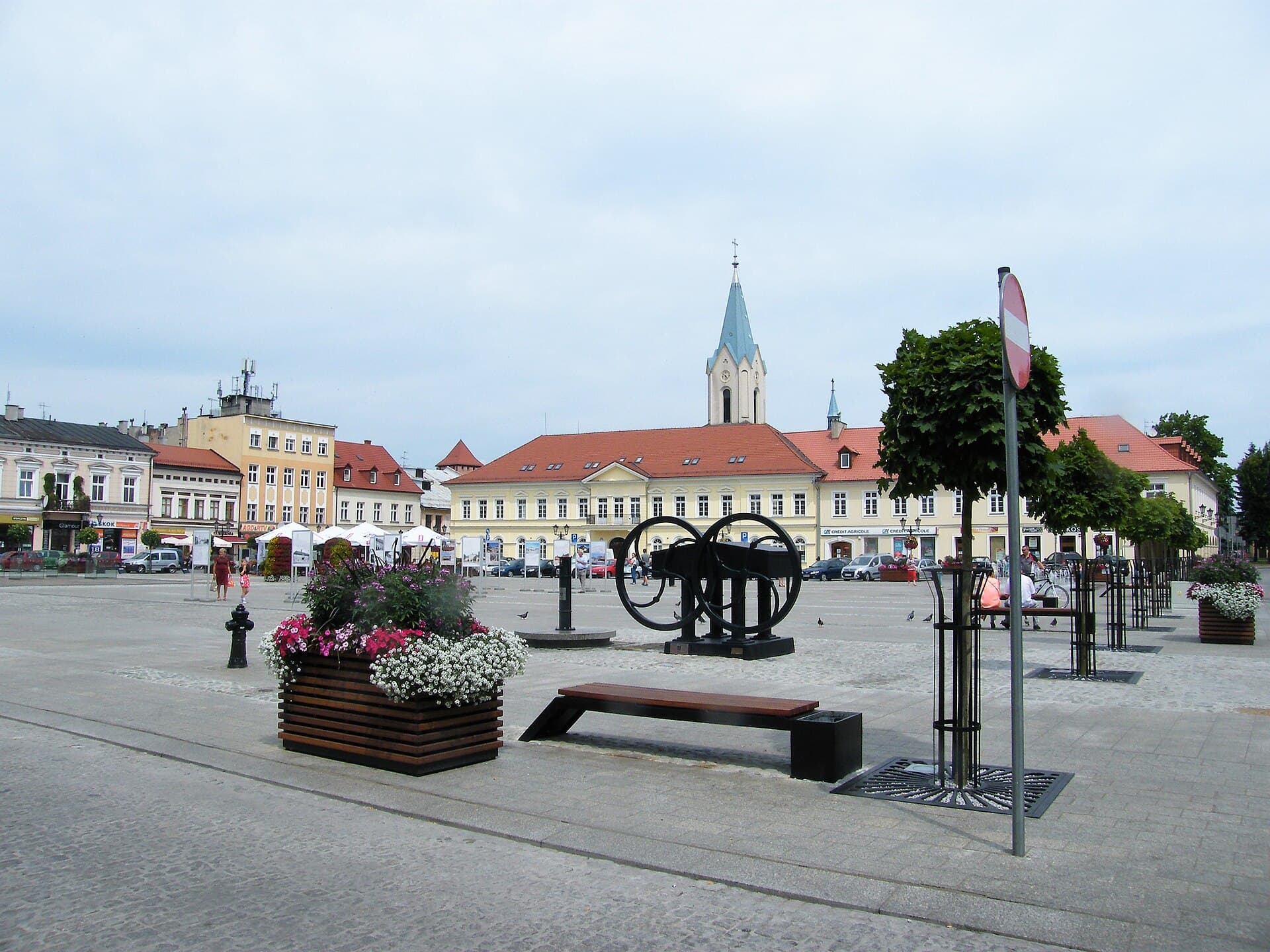
Oświęcim, PolandAneta Lazurek / CC BY-SA 3.0 pl, via Wikimedia Commons
PL

Oświęcim

Beyond the shadow of its infamous past, Oświęcim is a town reclaiming its own enduring narrative.

The secrets of Oświęcim

Oświęcim, as no one tells it.

Not the postcards. The stories even locals don't know — whispered in your ear, right where they happened.

3 secrets below. Many more wait inside the tour.
Oświęcim Castle Tunnels

Beneath the historic castle of Oświęcim lie tunnels with a surprising dual history.

Full story unlocks in the tour
The Great Synagogue of Oświęcim

Before the war, Oświęcim held a flourishing Jewish community, and its Great Synagogue was once among the largest in Poland.

Full story unlocks in the tour
Jakub Haberfeld's Vodka and Liqueurs Factory

Oświęcim was once home to a significant distillery, operated by a Jewish family, that produced a popular Polish spirit.

Full story unlocks in the tour
The full tour

Discover every secret of Oświęcim

Every address, every reveal in full — in your ear, right where it happened.

Get the key to Oświęcim

You pick your stops. You walk. The voice reveals what the others miss.

Choose your time

How long do you have in Oświęcim?

No tours available yet. Check back soon — we're preparing them.

About Oświęcim

The story of Oświęcim

Oświęcim, a town in southern Poland, is inextricably linked with the German Nazi concentration and extermination camp Auschwitz-Birkenau, a site of unparalleled human tragedy and a UNESCO World Heritage Site. While the sheer scale of the atrocities committed at Auschwitz understandably dominates its perception, Oświęcim itself possesses a history stretching back over 800 years. The local population emphasizes that they live in Oświęcim, not Auschwitz, and the town actively strives to foster peace, dialogue, and remembrance beyond the camp's somber legacy.

Today, Oświęcim is a town of around 40,000 inhabitants, serving as a local center for trade and industry. It is a place where new generations are working to build a future free from war and violence, offering a space for reflection and understanding among people of diverse nationalities and beliefs. Visitors are encouraged to explore not only the memorial sites but also the town's older parts, including its castle, churches, and institutions dedicated to preserving its complex past.

History

Oświęcim's origins trace back to the 12th century, first appearing in documents as an extensive castellan seat. Around 1272, the town was granted municipal rights, a significant milestone in its development. For centuries, Oświęcim was an important trading hub, particularly for salt from Wieliczka, even having its own salt measure. It also held judicial privileges and rights to trade in lead and collect tolls on the Soła and Vistula rivers.

The town's strategic location meant it frequently passed between Polish and Czech kingdoms. In 1457, the Duchy of Oświęcim was incorporated into the Polish Crown. The 16th century was a period of prosperity, with a parish church, market, and town hall within its walls. However, this era of growth was abruptly halted by the catastrophic Swedish invasion in 1655, which saw the town burned and subsequently decline.

In 1772, Oświęcim was annexed by the Habsburg Empire during the Partitions of Poland, becoming part of the Kingdom of Galicia and Lodomeria. It remained under Austrian rule until Poland regained independence in 1918. During the interwar period, Oświęcim flourished as an industrial center and an important railway junction, with a significant Jewish community making up 40% of its population.

The tragic turning point came with World War II. In 1939, Oświęcim was occupied by Nazi Germany and annexed into the Third Reich, with its name Germanized to Auschwitz. Between 1940 and 1945, the German Nazi concentration and extermination camp Auschwitz-Birkenau was established and expanded on the town's outskirts. The camp, initially for Polish political prisoners, quickly became a center for the mass extermination of Jews as part of Hitler's "Final Solution." Approximately 1.1 to 1.5 million people, predominantly Jews, were murdered there. The town's Polish residents were expelled from areas around the camp to create a buffer zone. Oświęcim was liberated by the Red Army on January 27, 1945.

After the war, Oświęcim slowly returned to normalcy, with new factories and housing developments. In 1947, the Auschwitz-Birkenau State Museum was founded on the site of the former camp. Today, Oświęcim continues to be a place of remembrance, dialogue, and a symbol of peace.

What to see

While the Auschwitz-Birkenau Memorial and Museum is the primary reason many visit Oświęcim, the town itself offers several sites that reflect its long history and commitment to peace and remembrance. The Auschwitz-Birkenau Memorial and Museum is a profound and essential experience, comprising Auschwitz I (the main camp) and Auschwitz II-Birkenau (the extermination camp). Visitors can explore the barracks, gas chambers, crematoria ruins, and the railway line that brought countless victims to the camps.

Beyond the memorial, the Auschwitz Jewish Center is a vital institution that commemorates the town's pre-war Jewish community. It includes a restored synagogue, a museum, a memorial park, and a cemetery, providing a deeper understanding of Jewish culture and the community that thrived in Oświęcim for centuries.

The Oświęcim Castle Museum offers insights into the town's medieval past, showcasing its history and recreating pre-war home interiors. The castle, with its defensive walls and bastion, stands on a hill overlooking the confluence of the Soła and Vistula rivers. The Old Town Hall, an 18th-century building, also contributes to the town's historic ambiance. For quiet reflection, the Soła River Embankment provides scenic views and a peaceful promenade. The Contemporary Art Museum 'Synagogue' offers a contrast to the weighty historical sites, housed in a former synagogue.

When to visit

Oświęcim experiences comfortable summers, freezing, snowy, and windy winters, and partly cloudy conditions year-round. The warm season, from late May to early September, sees average daily high temperatures above 67°F (19°C), with July being the hottest month, averaging 74°F (23°C). The cold season, from late November to early March, has average daily high temperatures below 42°F (5°C), with January being the coldest, averaging 24°F (-4°C).

For warm-weather activities and general tourism, the best time to visit Oświęcim is from mid-June to late August. Spring (April-May) and autumn (September-October) offer pleasant weather and fewer crowds, making them ideal for a more reflective visit to the memorial sites. Winter provides a somber and raw atmosphere, with snow covering the camp complex, which can enhance the reflective experience, though visitors should be prepared for extremely cold conditions. Weekdays are generally less crowded than weekends.

Practical

Oświęcim is situated in southern Poland, approximately 60 km from Kraków and 30 km from Katowice, making it accessible for day trips. The Auschwitz-Birkenau Memorial and Museum is about 3 km west of Oświęcim town center. From Kraków, travel time to Oświęcim is typically 1.5 to 2 hours by car or bus. Direct buses from central Kraków to the Auschwitz Museum building are available, or you can take a train to Oświęcim station and then walk 20 minutes or take a local bus (available April-October) or taxi to the museum.

Entry to the Auschwitz Memorial grounds is free, but a timed entry pass reserved online at visit.auschwitz.org is required, especially for afternoon slots. Guided tours with a museum educator incur a fee. It is highly recommended to book passes or tours in advance, particularly during high season (April-September), as visitor numbers are limited. Allow at least 4 hours for a thorough visit to both Auschwitz I and Auschwitz II-Birkenau. Large bags are not permitted inside the museum, so pack light. Photography is allowed in most areas, but flash photography is prohibited in buildings, and certain sections restrict photos entirely. Restrooms are available at the visitor center and within both sites. Cash is useful for small purchases or donations.

Good to know
Do I need to book tickets for Auschwitz-Birkenau in advance?
Yes, it is highly recommended to book your timed entry pass or guided tour in advance through the official website, visit.auschwitz.org, especially during peak season (April-September). Free individual passes are available for afternoon slots and must also be reserved online.
How long does a visit to Auschwitz-Birkenau take?
A guided tour typically lasts 3.5 hours, covering both Auschwitz I and Auschwitz II-Birkenau. For a self-guided visit, plan to spend at least 4 to 5 hours to explore both sites thoroughly.
Is there a fee to enter Auschwitz-Birkenau?
Entry to the grounds of the Auschwitz Memorial is free, but a fee is charged for visits with a Museum educator (guided tours).
Can I take photos at Auschwitz-Birkenau?
Photography is generally permitted, but flash photography is prohibited inside buildings. There are specific areas where photography is not allowed, and signs will indicate these restrictions.
What are the rules for visiting Auschwitz-Birkenau?
Loud talking, laughter, eating, and drinking (outside designated areas) are prohibited on memorial grounds. Do not touch exhibits, fences, or railway tracks. Respect the silence and grief of other visitors. Large bags are not allowed.
How do I get to Oświęcim from Kraków?
You can take a direct public bus from central Kraków to the Auschwitz Museum building. Alternatively, take a train to Oświęcim station, then walk about 20 minutes or take a local bus or taxi to the museum entrance.
Oświęcim
From€9.00
No booking · activate anytime · 12h to walk it
Get the key to Oświęcim