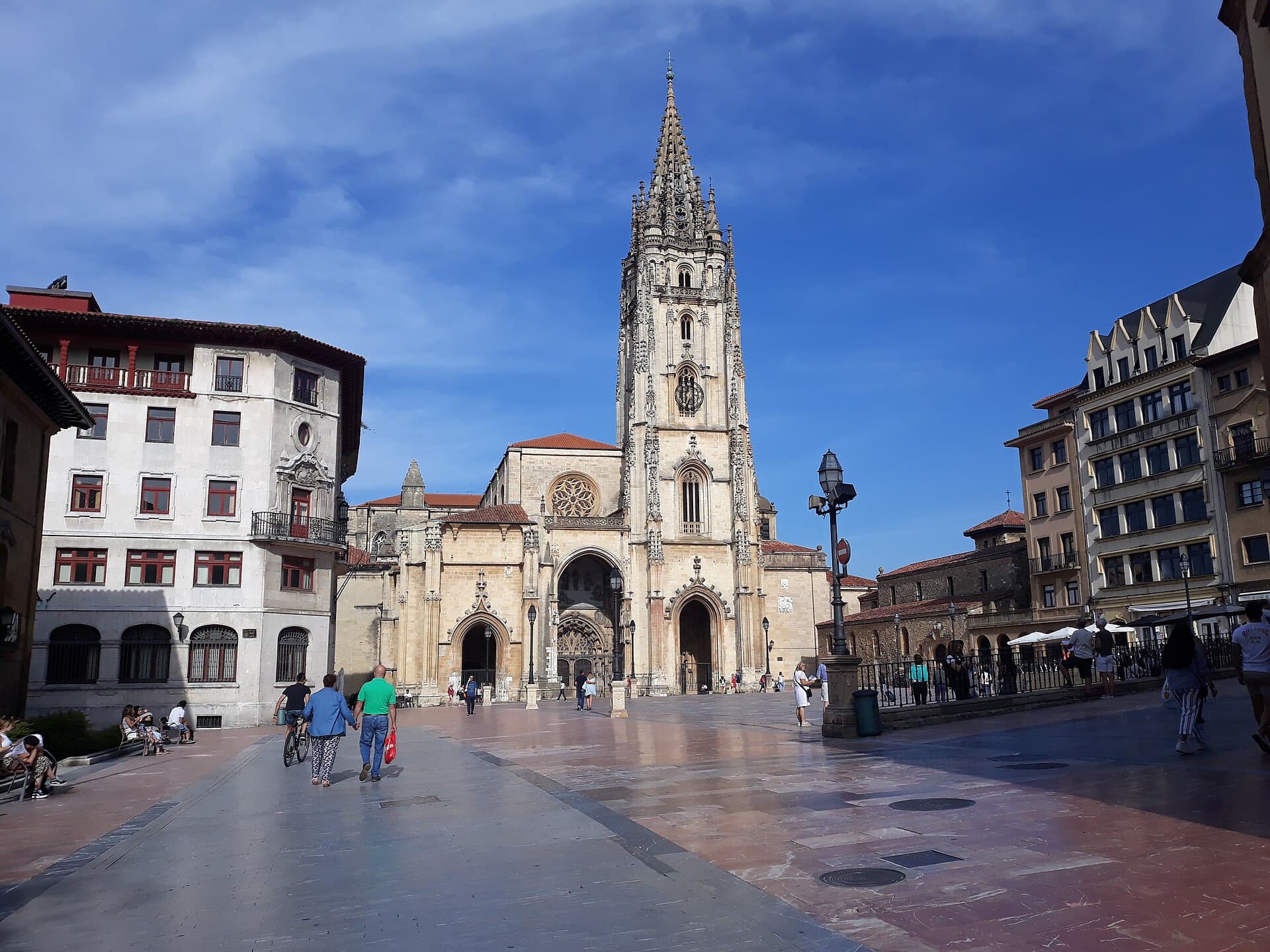
This central square has seen more name changes than a spy in a novel.
Simon Burchell / CC BY-SA 4.0, via Wikimedia CommonsOviedo
“Where ancient kingdoms murmur and cider flows.”
Oviedo, as no one tells it.
Not the postcards. The stories even locals don't know — whispered in your ear, right where they happened.
Within the cathedral, a sacred cloth holds a secret that draws pilgrims from across centuries.
The traditional Asturian cider here is not just poured; it is an art form.
Discover every secret of Oviedo
Every address, every reveal in full — in your ear, right where it happened.
You pick your stops. You walk. The voice reveals what the others miss.
How long do you have in Oviedo?
No tours available yet. Check back soon — we're preparing them.
The story of Oviedo
Oviedo, the capital of Spain's northern Asturias region, offers a captivating blend of ancient history, distinctive architecture, and a lively local culture. Recognized as one of the cleanest cities in Spain, and even purported to be the cleanest in Europe, Oviedo invites exploration on foot through its pedestrianized historic core. This elegant yet laid-back city, with a population of around 225,000, feels genuinely lived-in, offering a refreshing alternative to more crowded Spanish destinations.
From its medieval old town with ancient pathways and historic squares to its pre-Romanesque churches and abundant public sculptures, Oviedo presents a rich experience for visitors. It is a city that has inspired literary giants, with its atmosphere captured in works by Leopoldo Alas “Clarín” and Ramón Pérez de Ayala. Beyond its historical and artistic appeal, Oviedo is a regional gastronomic center, celebrated for its unique cider culture and hearty Asturian cuisine.
## From Monastic Settlement to Royal Capital Oviedo's story began in 761 AD when two monks, Máximo and Fromestano, founded a monastery on Mount Ovetao. This monastic settlement quickly grew, and by 791, King Alfonso II, known as 'the Chaste,' moved the court of the Kingdom of Asturias to Oviedo, making it the capital. During his reign, numerous churches and monasteries were constructed, solidifying Oviedo's status as a significant religious and cultural center.
## A Kingdom Untouched Unlike many other Spanish cities, Oviedo was never conquered by the Moors during the Middle Ages. This allowed the city to develop its own unique architectural style, known as Asturian Pre-Romanesque, which flourished in the 9th century. King Alfonso II also played a pivotal role in establishing Oviedo as the starting point of the Camino de Santiago pilgrimage route, with its cathedral serving as a significant site for pilgrims. The Holy Chamber within the Cathedral of San Salvador, built by Alfonso II in 802, was designed to house Christian relics rescued from the Moors, further enhancing the city's religious importance.
## Medieval Growth and Modern Transformations Throughout the Middle Ages, Oviedo continued to expand, despite facing attacks and looting. In the 9th century, King Alfonso III built the Holy Chamber with a chapel, now part of the cathedral, to house important religious relics. However, by the 10th century, the kingdom had grown too large to be effectively controlled from Oviedo, and the capital was moved to León in 910. Despite this, Oviedo retained its spiritual capital status. The city experienced a cultural and economic renaissance in the 16th century, marked by the founding of the University of Oviedo in 1608, one of Spain's oldest educational institutions. A major fire in 1521 destroyed many medieval wooden structures, leading to a significant stone reconstruction of the streets. In 1808, Oviedo was one of the first capitals to declare war on Napoleonic France, marking the beginning of the resistance in Spain. Today, much of the old town is pedestrianized, preserving its historic character while embracing modern life.
Begin your exploration in Oviedo's Old Town (Casco Antiguo), a pedestrian-friendly area filled with ancient pathways, appealing squares, and medieval buildings. The Cathedral of San Salvador is a Gothic masterpiece, housing the Holy Chamber (Cámara Santa), a UNESCO World Heritage site with sacred relics. Do not miss the opportunity to climb the cathedral tower for expansive city views.
Just outside the city, on Monte Naranco, are the extraordinary pre-Romanesque churches of Santa María del Naranco and San Miguel de Lillo, both UNESCO World Heritage sites. Originally a royal palace, Santa María del Naranco offers a glimpse into 9th-century Asturian art and architecture.
Oviedo is renowned for its extensive collection of public sculptures, with over 170 statues scattered throughout its streets and squares. Keep an eye out for the statue of Woody Allen, who famously praised Oviedo as a 'fairy-tale city,' and 'La Regenta,' honoring the protagonist of Leopoldo Alas's novel. Stroll through Campo de San Francisco, a tranquil central park, or visit El Fontán Market for a taste of local life and Asturian specialties. The Archaeological Museum of Asturias, located in a former Benedictine Monastery, offers insights into the region's ancient history, and entry is free.
Oviedo enjoys a mild oceanic climate, making it a year-round destination. However, the shoulder seasons of spring (April-June) and early autumn (September-October) are often recommended. During these periods, the weather is mild with comfortable temperatures, and the city is less crowded. Spring brings lush greenery and blooming flowers to parks like Campo de San Francisco. In early autumn, the weather remains pleasant, and you might catch the lively Fiestas de San Mateo in mid-September, a week-long celebration with music, dancing, and fireworks. Summer (July-August) is also popular, with warm but moderate temperatures, though it sees more tourists and higher prices.
Oviedo is well-connected and easily accessible. The closest airport is Asturias Airport (OVD), about 30-45 minutes away, with bus and taxi services to the city center. If traveling from cities like Madrid or Barcelona, the train is a comfortable option, with scenic routes. Once in Oviedo, a car is generally not needed, as the historic core is compact and highly walkable. Public buses are also available for exploring beyond the city center.
While Spanish is widely spoken, the local dialect is Asturian. English proficiency is not widespread, especially among older generations, so a basic understanding of Spanish will enhance your experience. Oviedo is known for its high quality of life and low crime rates, making it a safe and welcoming city. When dining, be sure to try local specialties like fabada asturiana (bean stew) and sidra natural (cider), traditionally poured from a height.
- What is Oviedo most famous for?
- Oviedo is famous for its pre-Romanesque architecture, particularly the UNESCO-listed churches on Monte Naranco, its distinct cider culture, and its status as a starting point for the Camino de Santiago. It is also recognized as one of the cleanest cities in Spain.
- Is Oviedo a walkable city?
- Yes, Oviedo's historic core is compact and largely pedestrianized, making it very walkable and easy to navigate on foot.
- What is the local drink in Oviedo?
- The local drink in Oviedo, and throughout Asturias, is *sidra natural* (natural cider), which is traditionally poured from a height to aerate it before drinking.
- Is English commonly spoken in Oviedo?
- English is not widely spoken in Oviedo, especially among older generations. While younger people may have some English proficiency, knowing some Spanish will be beneficial for visitors.
- What traditional dishes should I try in Oviedo?
- You should try *fabada asturiana*, a hearty bean stew with chorizo, morcilla, and pork, and explore the variety of Asturian cheeses, such as Cabrales.
- Is Oviedo a good base for exploring the region?
- Yes, Oviedo serves as an excellent base for exploring the wider Asturian region, including the Asturian coast and the Picos de Europa mountains, though a car is recommended for venturing beyond the city itself.