Płock Cathedral
The Płock Cathedral holds more than just religious significance.
Full story unlocks in the tour
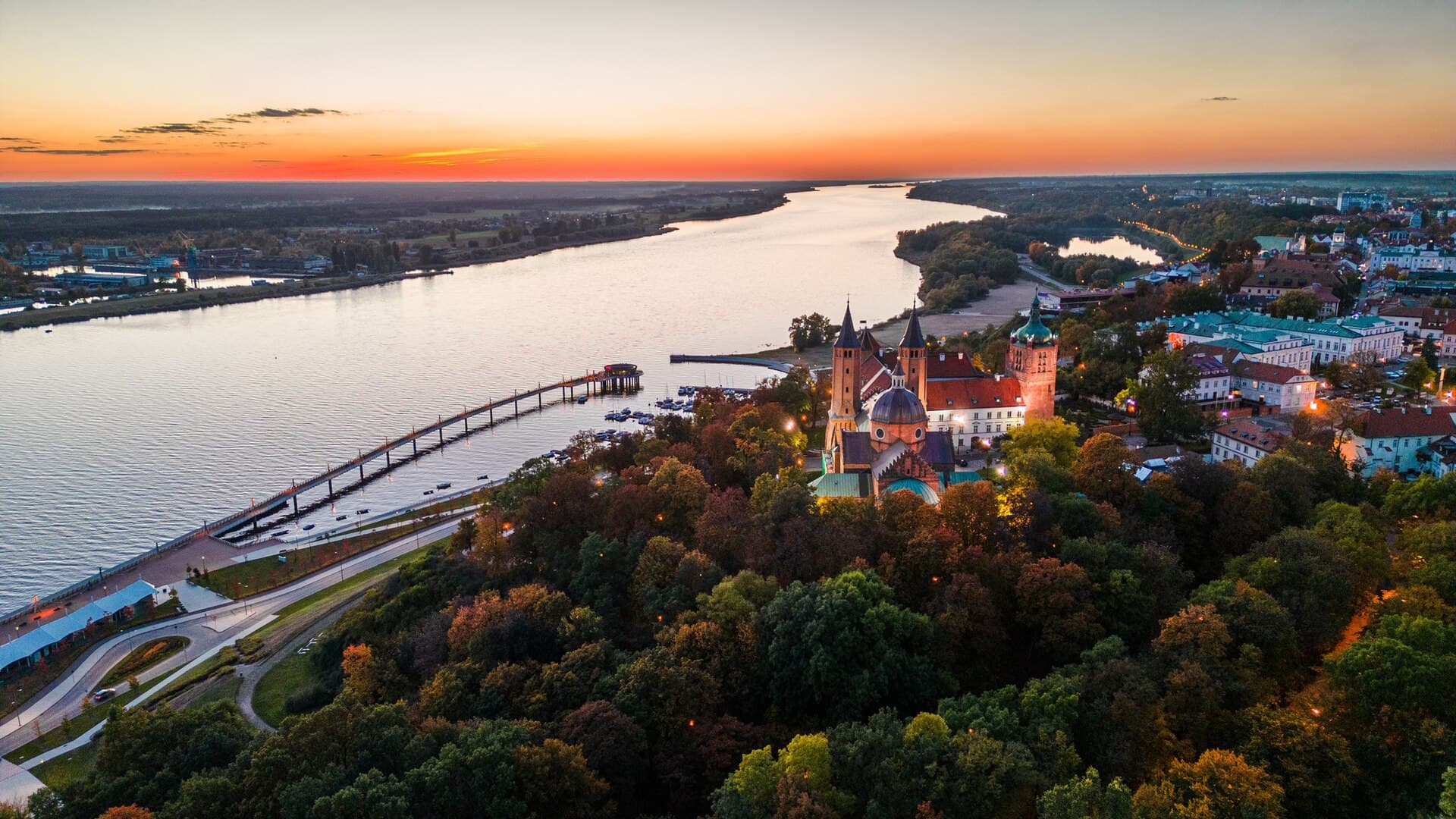 Aquarius 24 / CC BY-SA 4.0, via Wikimedia Commons
“Where history echoes along the Vistula's high banks.”
Not the postcards. The stories even locals don't know — whispered in your ear, right where they happened.
The Płock Cathedral holds more than just religious significance.
Płock is home to one of Poland's oldest museums, but its journey wasn't smooth.
The grand Town Hall in Płock's Old Market Square witnessed a pivotal moment in Polish history.
Discover every secret of Płock
Every address, every reveal in full — in your ear, right where it happened.
You pick your stops. You walk. The voice reveals what the others miss.
No tours available yet. Check back soon — we're preparing them.
Płock, officially known as the Ducal Capital City of Płock, is a city in central Poland with a history stretching back to the 10th century. Situated on the high escarpment of the Vistula River, Poland's longest river, Płock offers expansive views, especially captivating at sunset. Once the capital of Poland from 1079 to 1138, Płock served as the seat of Polish rulers, making it the oldest community in Mazovia. This deep past is evident in its well-preserved monuments and historical sites, creating a blend of old-world character and modern amenities.
The city is a significant cultural, academic, scientific, administrative, and transportation center for the western and northern Mazovian region. Beyond its historical allure, Płock is also an academic center with six universities and a strong business hub, particularly in the fuel-power, chemical, and machine industries. Its strategic location on the Vistula, at the crossroads of trade routes, has consistently played an important role in local history.
Płock's origins trace back to the 9th and 10th centuries, when a pagan center existed on Tumskie Mountain, followed by a prince's fortification and an early-medieval settlement. Its strategic position on a high Vistula bank and at the junction of shipping and land routes proved invaluable. A Benedictine monastery was established around 1009, evolving into a center for science and art. In 1075, a diocese seat was created, and from 1079 to 1138, Płock served as the capital of Poland under rulers Władysław Herman and Bolesław III the Wry-Mouthed.
Płock received town privileges in 1237, which were later extended in 1255. After 1138, with the division of the Polish realm, Płock became a major principality within the disintegrating Polish kingdom. The city prospered as a trading center through the 17th century, located on a trade route connecting Toruń with other significant Polish cities. King Casimir III the Great significantly influenced Płock in the 14th century, granting vast privileges, fortifying town walls, and constructing a new Gothic castle and parish church. In 1495, the Duchy of Płock was integrated directly with the Polish Crown, becoming the capital of its province.
The 16th century marked a golden age for Płock, with its number of buildings comparable to Warsaw in 1564. However, this period of splendor ended in the 17th century due to plague, fires, and devastating wars with Sweden. Płock passed to Prussia in 1793, then to the Duchy of Warsaw in 1807, and was incorporated into Russian Poland in 1815, remaining so until Poland regained independence in 1918. The 19th century saw a new city plan, construction of neoclassical buildings, and the founding of the Płock Scientific Society in 1820. The city played a role in the January Uprising of 1863 against Russia and was heroically defended against the Soviets in 1920 during the Polish-Soviet War. After World War II, Płock emerged as a dominant industrial center, with the establishment of its first refinery and petrochemical plants in 1960.
Begin your exploration on Tumskie Hill, a significant area featuring the Płock Castle and the Catholic Cathedral of the Assumption of the Blessed Virgin Mary. Consecrated in 1144, the cathedral houses the sarcophagi of Polish rulers Władysław Herman and Bolesław III the Wry-Mouthed, along with a replica of the famous Romanesque Płock Doors. Adjacent to the cathedral, the Diocesan Museum displays unique exhibits, including a 14th-century herma of St. Zygmunt. While only remnants of the 14th-century Gothic castle remain, including the impressive Clock Tower, they offer a glimpse into its past grandeur.
Descend to the Old Market Square, surrounded by 18th and 19th-century townhouses, and admire the 19th-century Town Hall. Nearby, St. Bartholomew's Parish Church, with its Gothic origins from 1356, features an early Baroque altar from 1640. Stroll along the Vistula river promenade and pier, especially at sunset, for scenic views. The Mazovian Museum, one of Poland's oldest, offers diverse exhibitions, including a notable Art Nouveau collection. For a unique experience, visit the Mariavite Church, known for its atmospheric interior. The Marshal Stanisław Małachowski High School, considered the oldest school in Poland, is also in Płock.
The best time to visit Płock for warm-weather activities is from mid-June to late August, when temperatures are comfortable, averaging around 75°F (24°C) in July. This period also offers the clearest skies and is ideal for enjoying outdoor festivals and events. If you prefer milder weather and fewer crowds, late spring (May-June) and early autumn (September-October) are excellent choices, with pleasant temperatures and good conditions for sightseeing. While winters are cold and snowy, Płock can still be visited for a tranquil atmosphere and cozy indoor attractions.
Płock is located approximately 110 km from Warsaw, making it a viable option for a day trip or a stop on a longer itinerary through central Poland. If traveling by public transport, buses offer numerous direct connections from Warsaw and other Polish cities, with a travel time of around two hours from the capital. Train travel is also an option, though it may involve a change in Kutno. Within Płock, an extensive bus system covers most of the city's areas of interest. Tickets are typically purchased before boarding and scanned upon entry. For those driving, a paid parking zone exists in Płock, but parking is generally free on weekends. Restaurants, many located on Grodzka Street, offer diverse culinary options.