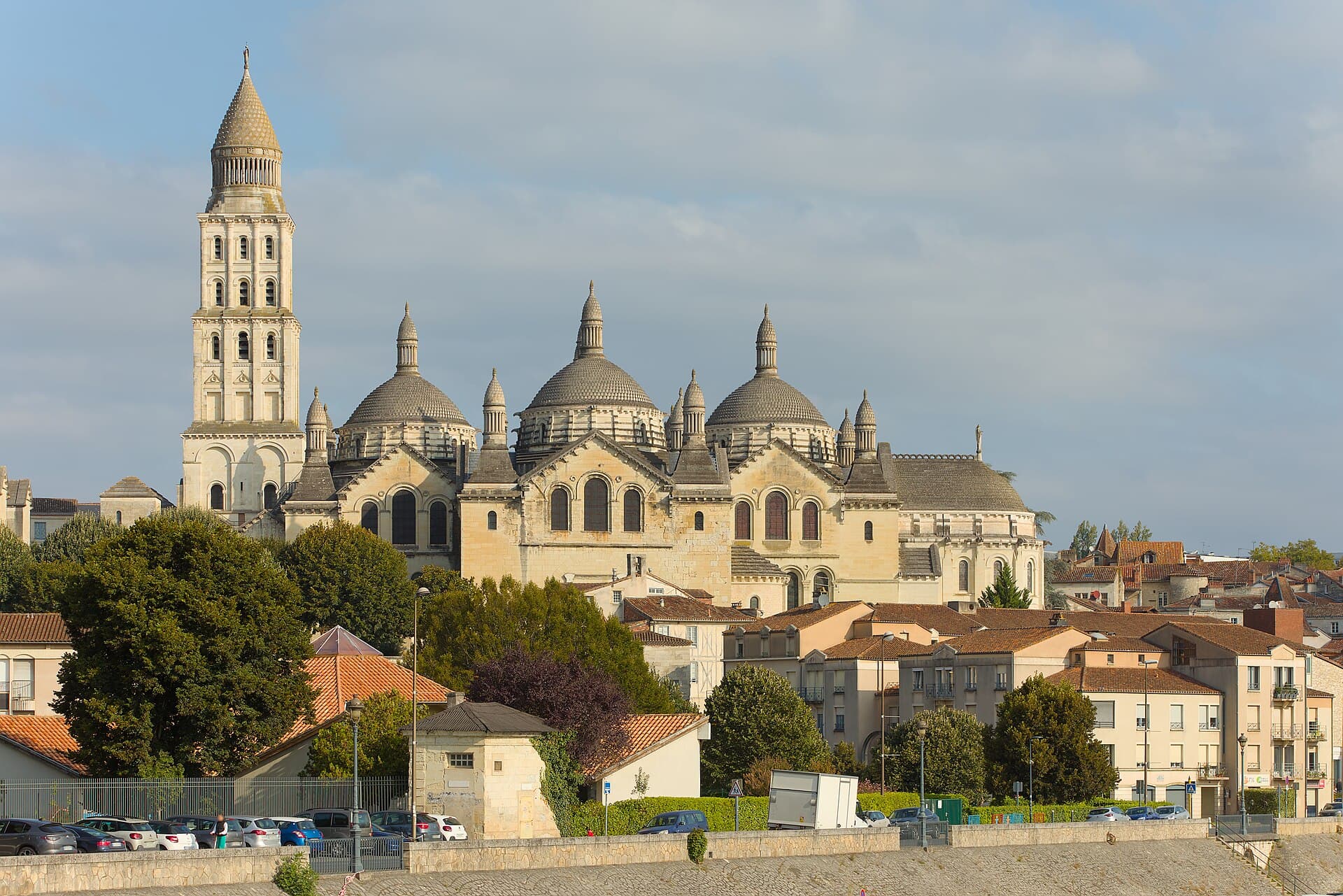
The grand central chandelier inside Cathédrale Saint-Front has a surprising past, illuminating a different, equally significant French landmark.
Benjamin Smith / CC BY-SA 4.0, via Wikimedia CommonsPérigueux
“Where Roman echoes meet Byzantine domes, Périgueux unfolds two millennia of stories.”
Périgueux, as no one tells it.
Not the postcards. The stories even locals don't know — whispered in your ear, right where they happened.
This imposing medieval tower, the last of its kind in Périgueux, was once on the brink of complete disappearance.
The modern glass and steel structure of the Vesunna Museum conceals an entire Roman dwelling, complete with an ancient heating system.
Discover every secret of Périgueux
Every address, every reveal in full — in your ear, right where it happened.
You pick your stops. You walk. The voice reveals what the others miss.
How long do you have in Périgueux?
No tours available yet. Check back soon — we're preparing them.
The story of Périgueux
Périgueux, a city in the Dordogne region of southwest France, invites exploration of its layered past. Here, the serene flow of the Isle River accompanies a landscape marked by ancient Roman foundations and the distinct domes of Byzantine-inspired architecture. The city's presence is a testament to enduring human settlement, where each street and structure tells a part of a long narrative.
Visitors can wander through districts that speak of different eras. The Roman quarter, Antona, reveals remnants of a grand amphitheater and villas, while the medieval and Renaissance sections present a maze of narrow passageways and stone facades. Périgueux offers a quiet contemplation of history, a place where the grandeur of empires and the intricacies of daily life across centuries are palpable.
From Vesunna to Périgueux
The origins of Périgueux trace back to Vesunna, a significant Gallo-Roman city established around 16 BC. This settlement grew to become the capital of the Petrocorii, a Gallic tribe, and its strategic position along the Isle River contributed to its prosperity. Evidence of Vesunna's former grandeur is widespread, with visible remains including the Vesunna Tower, a remnant of a large temple dedicated to the goddess Vesunna, and parts of an amphitheater that once entertained thousands.
Medieval Transformations
Following the decline of the Roman Empire, Vesunna faced periods of instability. The city eventually split into two distinct entities: the Cité, built around the Roman ruins, and the Puy-Saint-Front, which developed around the abbey of Saint-Front. These two parts remained separate until their unification in 1240, forming the basis of modern Périgueux. The medieval period saw the construction of defensive walls, many of which are now gone, though the Tour Mataguerre stands as a solitary reminder of this era.
Renaissance and Beyond
The Renaissance brought a period of renewed architectural flourish, evident in the elegant townhouses that line the older streets. During the Wars of Religion, Périgueux experienced significant turmoil, changing hands multiple times. Despite these conflicts, the city persevered, slowly rebuilding and expanding. The 19th century saw major urban planning initiatives, including the development of boulevards and public spaces, further shaping the city's appearance. Today, Périgueux maintains a careful balance, preserving its ancient foundations while evolving as a contemporary regional center.
Begin your exploration at the Cathédrale Saint-Front, a UNESCO World Heritage site recognized for its distinctive Byzantine-Romanesque architecture, reminiscent of St. Mark's Basilica in Venice. Its cluster of domes creates a memorable skyline. Afterwards, explore the Vesunna Gallo-Roman Museum, designed by Jean Nouvel, which thoughtfully encloses the excavated remains of a Roman villa. The museum provides a direct view into daily life during the Roman era.
Wander through the older sections of the city, where medieval and Renaissance buildings line narrow streets. Observe the intricate details of stone facades and the occasional half-timbered house. The Tour Mataguerre, the last standing medieval defensive tower, offers a glimpse into the city's military past. A stroll along the Isle River provides serene views and a different perspective of the cityscape.
The most pleasant times to visit Périgueux are during the spring (April to June) and early autumn (September to October). These seasons offer mild temperatures, fewer crowds, and the landscape is particularly inviting. Summers can be warm, drawing more visitors, while winters are generally cool and quiet, with some attractions operating on reduced schedules.
Périgueux is accessible by train, with regular services connecting it to major French cities. The city center is compact and easily navigated on foot, allowing for leisurely exploration of its historical areas. For travel further afield in the Dordogne, renting a car is advisable. Many local restaurants serve regional specialties, including duck confit and truffles. Consider visiting the local market for fresh produce and regional products. Most shops and attractions accept major credit cards, but having some euros for smaller purchases or markets is always helpful.
- What is the primary architectural style of Cathédrale Saint-Front?
- The Cathédrale Saint-Front is renowned for its Byzantine-Romanesque architectural style, characterized by its five domes arranged in a Greek cross plan, a design rarely seen in France.
- Are there guided tours available in Périgueux?
- Yes, the Périgueux Tourist Office offers various guided tours, including historical walks through the Roman and medieval quarters, often available in multiple languages during peak season.
- What local dishes should I try in Périgueux?
- Périgueux is in the Périgord region, famous for its gastronomy. You should try dishes featuring duck (like confit de canard), truffles, foie gras, and walnuts, which are local specialties.
- Is Périgueux suitable for families with children?
- Périgueux offers several attractions that can engage families, including the Vesunna Gallo-Roman Museum with its interactive displays, and the spacious public gardens for children to play.
- What is the best way to get around Périgueux?
- The city center of Périgueux is very walkable, making it ideal for exploring on foot. For longer distances or trips outside the immediate center, a local bus service is available.
- Are there any annual events or festivals in Périgueux?
- Périgueux hosts several events throughout the year, including a truffle market in winter, a summer festival with music and performances, and various historical reenactments, particularly during the warmer months.