Palace of the Kings of Majorca
The grand royal residence in Perpignan was once the capital of an unexpected kingdom.
Full story unlocks in the tour
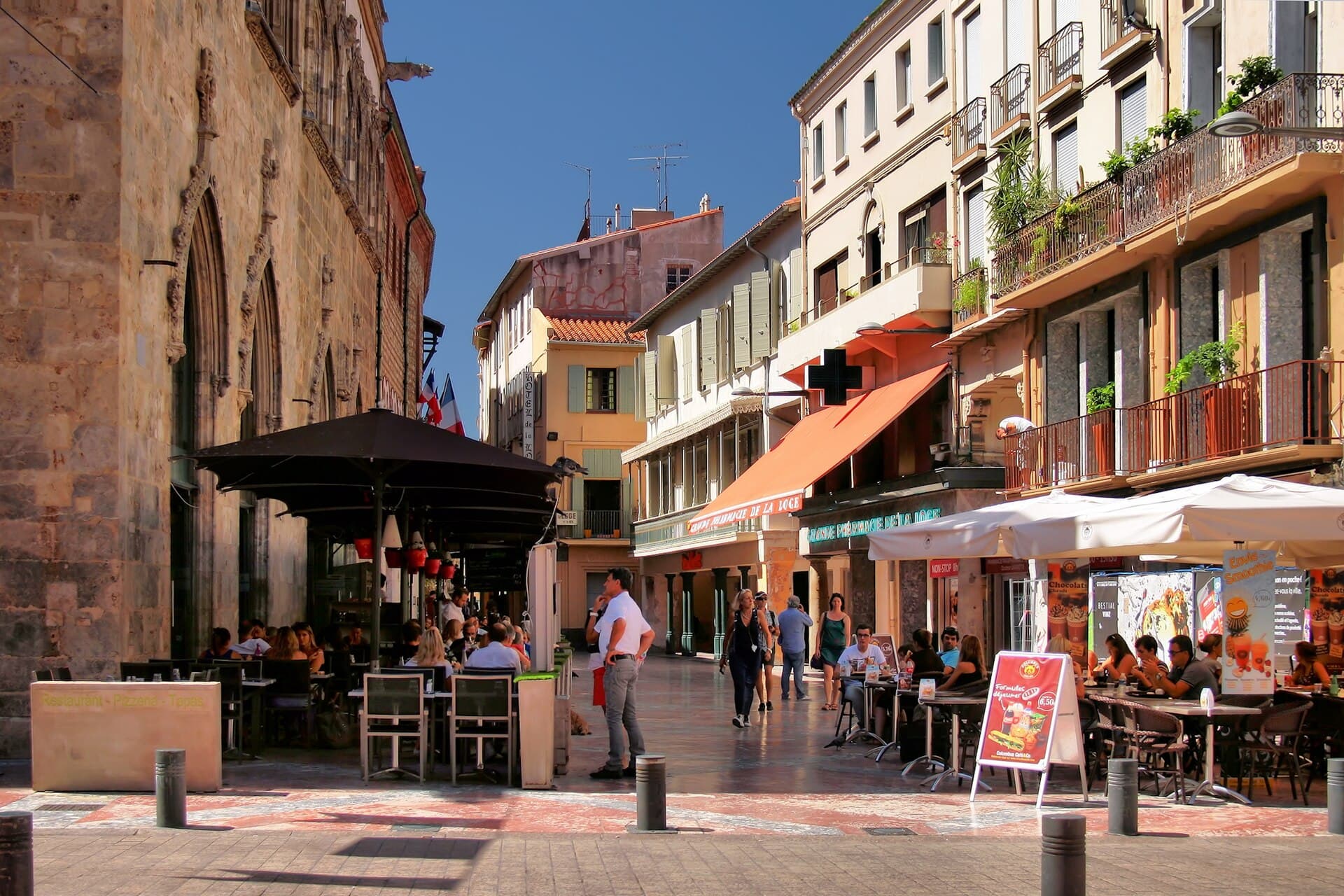 Jorge Franganillo / CC BY 3.0, via Wikimedia Commons
Self-guided audio walking tour of Perpignan — GPS route, offline playback, story-driven narration in 32 languages.
“Where French flair meets Catalan soul, under the Mediterranean sun.”
Not the postcards. The stories even locals don't know — whispered in your ear, right where they happened.
The grand royal residence in Perpignan was once the capital of an unexpected kingdom.
This iconic red-brick monument holds a secret flame within its walls.
Perpignan is home to a unique medieval cemetery, distinct from any other in Europe.
Discover every secret of Perpignan
Every address, every reveal in full — in your ear, right where it happened.
You pick your stops. You walk. The voice reveals what the others miss.


Your self-guided audio tour of Perpignan is ready — pick your landmarks, choose your language, and start the moment you arrive.
BuyLume has a built-in augmented-reality guide. Hold your phone up and its camera shows the street ahead of you, with a glowing arrow laid over the real view that always points to your next stop — no map to puzzle over, no wrong turns. Like everything in Lume, it works fully offline.
Perpignan, the capital of the Pyrénées-Orientales department in Occitanie, is a city where French sophistication and spirited Catalan culture converge. Situated in the southernmost part of France, merely 8 miles from the Mediterranean Sea and 19 miles from the Spanish border, Perpignan offers a distinct character. The city enjoys over 300 days of sunshine annually, making it one of France's sunniest spots. Its strategic location, between the Pyrenees mountains and the Mediterranean Sea, provides a diverse natural backdrop, from sandy shores to winding hiking trails.
Often called the "Gateway to Catalonia," Perpignan proudly displays its Catalan heritage in its language, traditions, and cuisine. Bilingual street signs are common, and the local dialect, a charming blend of French and Spanish, can often be heard. Despite past economic challenges, the city maintains a strong spirit and a deep cultural identity. Its compact size makes it ideal for exploring on foot, revealing a blend of Gothic, Romanesque, and Catalan architectural styles.
The area around Perpignan experienced Roman occupation, but the medieval town itself began to take shape around the early 10th century. It quickly ascended to prominence, becoming the capital of the Counts of Roussillon. A significant moment arrived in 1197 when King Alfonso II of Aragon granted Perpignan a municipal charter, allowing the town to elect its own consuls, levy taxes, and administer justice, even before Barcelona had these rights. This marked the beginning of Perpignan's independent identity, with the city adopting the motto "Fidelíssima Vila" (Most Faithful Town).
Perpignan entered its "golden age" in 1276 when James I the Conqueror, King of Aragon and Count of Barcelona, established the Kingdom of Majorca and designated Perpignan its continental capital. This period, lasting until 1344, saw significant urban development and economic prosperity, fueled by cloth manufacturing, leather production, and jewelry making. The majestic Palace of the Kings of Majorca, a blend of Gothic, Romanesque, and Arab-Hispanic styles, was constructed during this time as both a royal residence and a symbol of power. The city's layout reflected its social structure, with tight alleys for craftsmen and larger courtyard homes for affluent merchants.
The Kingdom of Majorca was short-lived, and in 1344, Peter IV of Aragon recaptured the city, returning it to the Crown of Aragon. The mid-14th century also brought the devastating Black Death, which halved the city's population. Perpignan was heavily fortified due to ongoing struggles between France and Spain for control of the Roussillon province. After being besieged and captured by the French during the Thirty Years' War in 1642, Perpignan was formally ceded to France in 1659 by the Treaty of the Pyrenees. Following its integration into France, the renowned military engineer Vauban modernized the city's fortifications in the 17th century, transforming Perpignan into a formidable citadel.
In the 20th century, Perpignan became a city of refuge, welcoming those fleeing the Spanish Civil War after 1936 and North African emigrants after 1960. Today, Perpignan stands as an administrative and commercial center, proud of its dual French and Catalan identity.
Perpignan's city center invites exploration on foot, revealing a wealth of historical sites and cultural experiences. The Palace of the Kings of Majorca is a prominent landmark, a 13th-century Gothic palace-fortress offering expansive views of the city and the Pyrenees. Its vast arcaded courtyard, royal apartments, and two-level chapel with Spanish-Moorish influences are open to visitors. The iconic Castillet, a striking red-brick former city gate and prison, is another symbol of Perpignan. It now houses the Casa Pairal Museum, which showcases Catalan arts and traditions, and offers panoramic city views from its summit after a 142-step climb. Nearby, the Cathédrale Saint-Jean-Baptiste, a 14th-century Gothic cathedral, features a distinctive southern French feel with Catalan architectural influences.
Adjacent to the cathedral is Campo Santo, a medieval cloister cemetery unique in Europe. Its Gothic galleries and central courtyard, once a burial ground for affluent families, now host cultural events. The Hyacinthe Rigaud Museum presents a diverse collection of art, including works by native Perpignan artist Hyacinthe Rigaud, and pieces by Catalan artists, Picasso, and Dufy. For a taste of local life, the Marché Cassanyes is a well-known market offering everything from vegetables to flowers. The Hôtel de Ville (Town Hall) and the Loge de Mer, a medieval maritime tribunal, form a beautiful historical ensemble.
Perpignan welcomes visitors year-round, but the most pleasant times to arrive are spring (April to June) and early autumn (September to October). During these months, the weather is mild and sunny, with average temperatures ranging from 15°C to 22°C (59°F to 72°F), and fewer crowds than in summer. July and August bring warmer temperatures, often exceeding 30°C (86°F), and a more bustling atmosphere with numerous festivals. Winter is generally mild and quiet, making it suitable for sightseeing without the summer rush.
Perpignan is served by Perpignan-Rivesaltes Airport (PGF), with seasonal flights from the UK and other European cities. Larger airports like Barcelona–El Prat and Montpellier–Méditerranée are viable alternatives, with onward connections by train or car. The city is on the high-speed TGV line, connecting it to Paris (5 hours), Toulouse (2.5 hours), and Barcelona (1.5 hours). Local public transport in the Pyrénées-Orientales region is notably affordable, with some bus and train fares as low as €1. Within the city, walking is the best way to explore the compact historic center.
France uses the Euro (€), and ATMs are widely available in the city center. Most establishments accept major credit cards, though cash is preferred by some smaller merchants and markets. It's advisable to carry a valid GHIC or EHIC for UK and EU visitors, though comprehensive travel insurance is always recommended. For safety, remain aware of your belongings in busy tourist areas, and consider using offline maps for navigation. The Perpignan Tourist Office, located in the Place de la Loge, offers maps and local guidance.
Perpignan in Korean, in Chinese or in Hebrew — and 29 more languages, every stop narrated by a native voice. The widest language range of any self-guided audio tour.
Available in: