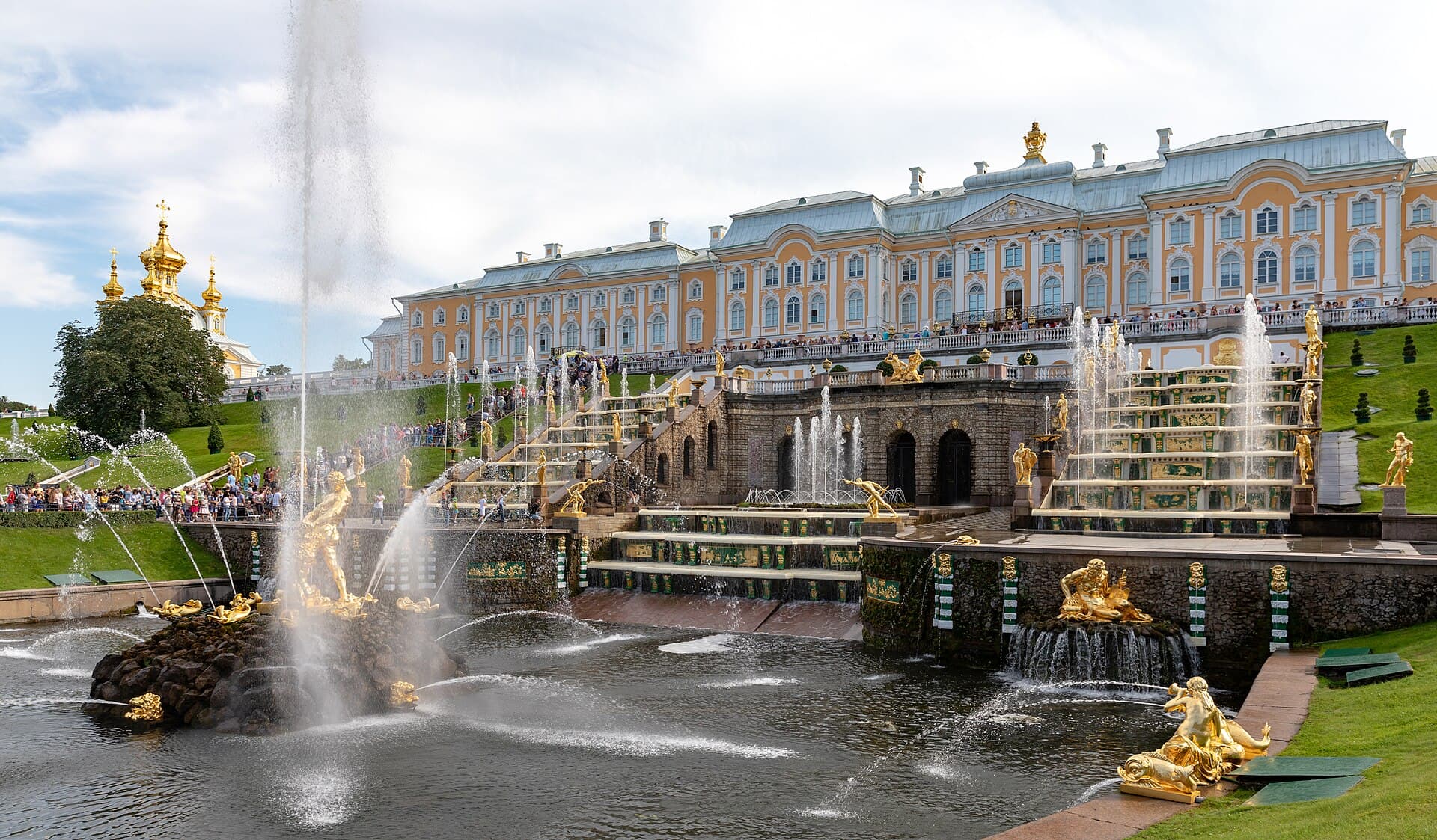
Peterhof, RussiaNinara from Helsinki, Finland / CC BY 2.0, via Wikimedia Commons
RU

Peterhof

Where gilded fountains dance to a tsar's ambition.

The secrets of Peterhof

Peterhof, as no one tells it.

Not the postcards. The stories even locals don't know — whispered in your ear, right where they happened.

3 secrets below. Many more wait inside the tour.
The Grand Cascade

The hundreds of fountains at Peterhof operate without a single pump, an 18th-century engineering marvel. The ingenious system relies on an unseen network to keep the water flowing.

Full story unlocks in the tour
The Grand Palace's Ballroom

Empress Elizabeth, known for her love of lavish displays, issued a specific instruction to the architect designing the Grand Palace's ballroom.

Full story unlocks in the tour
The Grand Cascade's Grottoes

Below the dazzling Grand Cascade, Peter the Great designed grottoes not merely for relief from the summer heat, but for a rather playful purpose.

Full story unlocks in the tour
The full tour

Discover every secret of Peterhof

Every address, every reveal in full — in your ear, right where it happened.

Get the key to Peterhof

You pick your stops. You walk. The voice reveals what the others miss.

Choose your time

How long do you have in Peterhof?

No tours available yet. Check back soon — we're preparing them.

About Peterhof

The story of Peterhof

Peterhof, often referred to as the 'Russian Versailles,' spreads across an imperial estate on the southern coast of the Finnish Gulf, approximately 30 kilometers west of St. Petersburg. Peter the Great commissioned this grand summer residence in the early 18th century, directly responding to Louis XIV's Palace of Versailles. Peterhof was conceived as a symbol of Russia's modernization and its successful quest for access to the Baltic Sea. The complex comprises a series of palaces, formal French gardens, romantic English parks, and the world's largest collection of fountains, securing its place as a UNESCO World Heritage Site.

While the Grand Palace commands attention with its imposing Baroque facade, the true spectacle of Peterhof resides in its elaborate water features. The estate's commanding natural feature is a 16-meter-high bluff, less than 100 meters from the shore, which was ingeniously harnessed to power the numerous fountains without a single pump. This engineering marvel, alongside gilded statues and meticulously designed landscapes, crafts a captivating experience that transports visitors to the opulent world of the Russian tsars.

History

Peter the Great's Vision and Early Construction

The origins of Peterhof reach back to 1705, when Peter the Great established a country estate on the Gulf of Finland. His initial intention was a modest country habitation, but a visit to the French royal court in 1717, where he admired Versailles, inspired him to expand his property into an imperial residence that would rival its French counterpart. Construction of the Peterhof complex commenced in 1714, with architects like Domenico Trezzini and Jean-Baptiste Alexandre Le Blond laying the foundation for the Petrine Baroque style. By 1723, the Lower Park was laid out, the Sea Channel excavated, and several fountains were operational, alongside the construction of Monplaisir and Marly palaces.

Expansion and Imperial Grandeur

After Peter the Great's passing, succeeding monarchs continued to expand and adorn Peterhof. Empress Elizabeth, Peter's daughter, commissioned Francesco Bartolomeo Rastrelli to undertake a significant expansion of the Grand Palace between 1747 and 1756. Rastrelli's additions included two wings and gilded pavilions, transforming the original modest 'Upper Chambers' into the imposing structure seen today. Catherine the Great also contributed to the estate; though she favored Tsarskoye Selo, she invested in Peterhof by building a road connecting it to St. Petersburg. The palace served as a summer residence for Russian monarchs for over 200 years, hosting grand celebrations, receptions, balls, and masquerades for thousands of guests.

World War II and Meticulous Restoration

Peterhof endured immense destruction during World War II. German troops captured the estate in 1941 and occupied it until 1944. Employees managed to save only a portion of the treasures, and attempts to dismantle and bury fountain sculptures were only partially successful. The occupying forces largely destroyed Peterhof, with many fountains ruined, the Grand Palace partially exploded, and its interiors largely burnt out. The English Palace was irreparably damaged and could not be rebuilt. However, restoration work began almost immediately after the war ended, with the Lower Park reopening in 1945. The name 'Peterhof' was temporarily changed to 'Petrodvorets' in 1944 due to anti-German sentiment, but the original name was restored in 1997. The meticulous reconstruction, which continued into the 21st century, has returned Peterhof to its former splendor, earning it recognition as a UNESCO World Heritage Site in 1990 and one of the Seven Wonders of Russia in 2008.

What to see

Peterhof presents a wealth of sights, but its undeniable highlight is the Grand Cascade and Samson Fountain. This monumental ensemble features 64 fountains and 255 bronze sculptures, with the central Samson Fountain depicting the biblical hero tearing open a lion's jaws—a symbol of Russia's victory over Sweden in the Great Northern War. The water from the cascade flows into the Sea Channel, which once served as a grand marine entrance to the complex.

Overlooking the cascade stands the Grand Palace, the largest palace in Peterhof. While its exterior impresses, its interiors, including the elaborate Ballroom, Throne Room, and Chinese Cabinets, offer a glimpse into imperial life. The palace also preserves the Oak Study of Peter I.

Beyond the central attractions, explore the expansive Lower Park, a formal French garden with numerous other fountains, including the 'Chess Mountain' and 'Lion' cascades, and trick fountains designed to surprise visitors. To the east, the Monplaisir Palace was Peter the Great's favorite personal retreat, reflecting his passion for the sea and Dutch architecture. To the west, the Marly Palace was constructed for guests, designed to appear as if floating on water. Do not overlook the Upper Garden, with its symmetrical layout and the Neptune Fountain as its centerpiece.

When to visit

The ideal time to experience Peterhof is during the summer months, from late April to early October, when all the fountains are in full operation. The official opening of the fountains, usually in May, is celebrated with orchestras and dances. While summer offers the complete spectacle, it is also the busiest season. For smaller crowds and milder temperatures, consider visiting in May or September. In winter, the fountains are switched off and entry to the Lower Park is free, offering a different, more contemplative charm, though the hydrofoil service is not available.

Practical

Peterhof is easily reached from St. Petersburg. The fastest and most scenic option is by hydrofoil (Meteor) from the pier near the Hermitage, taking 35-45 minutes and arriving directly at the Lower Gardens. Buses offer a more economical alternative, departing from metro stations like Prospekt Veteranov or Avtovo. A full day is recommended to explore the entire complex. Tickets for the Lower Park (where the fountains are) and the Grand Palace are separate, and it is advisable to purchase them online in advance, particularly during high season, to avoid extended queues. Note that the Grand Palace is typically closed on Mondays and the last Tuesday of the month. If you exit the Lower Park to visit the Upper Garden, re-entry to the Lower Park with the same ticket is not permitted.

Good to know
What is Peterhof Palace known for?
Peterhof Palace is celebrated for its magnificent system of fountains, especially the Grand Cascade and the Samson Fountain, as well as its elaborate palaces and gardens that rival France's Versailles.
How do the fountains at Peterhof work without pumps?
The fountains at Peterhof operate entirely without pumps, utilizing an ingenious gravity-fed system. Water is supplied from natural springs and reservoirs in the Upper Gardens, with the elevation difference creating the pressure needed to power the fountains in the Lower Gardens.
What is the best way to get to Peterhof from St. Petersburg?
The most recommended way to reach Peterhof from St. Petersburg is by hydrofoil (Meteor) from the pier near the Hermitage. This offers a fast (35-45 minutes) and scenic journey directly to the Lower Gardens.
Is Peterhof Palace open year-round?
While the Peterhof gardens are open year-round, the famous fountains only operate from late April/early May to early October. The Grand Palace and other smaller palaces have specific opening hours and closure days, typically Mondays.
Was Peterhof Palace damaged during World War II?
Yes, Peterhof Palace was extensively damaged and largely destroyed during the German occupation in World War II. However, it has undergone meticulous and ongoing restoration since the war, with many parts recreated to their former glory.
Are there other palaces to see at Peterhof besides the Grand Palace?
Yes, Peterhof is a complex of several palaces. Notable examples include Monplaisir Palace, Peter the Great's favorite personal retreat, and Marly Palace, constructed for guests.
Peterhof
From€9.00
No booking · activate anytime · 12h to walk it
Get the key to Peterhof