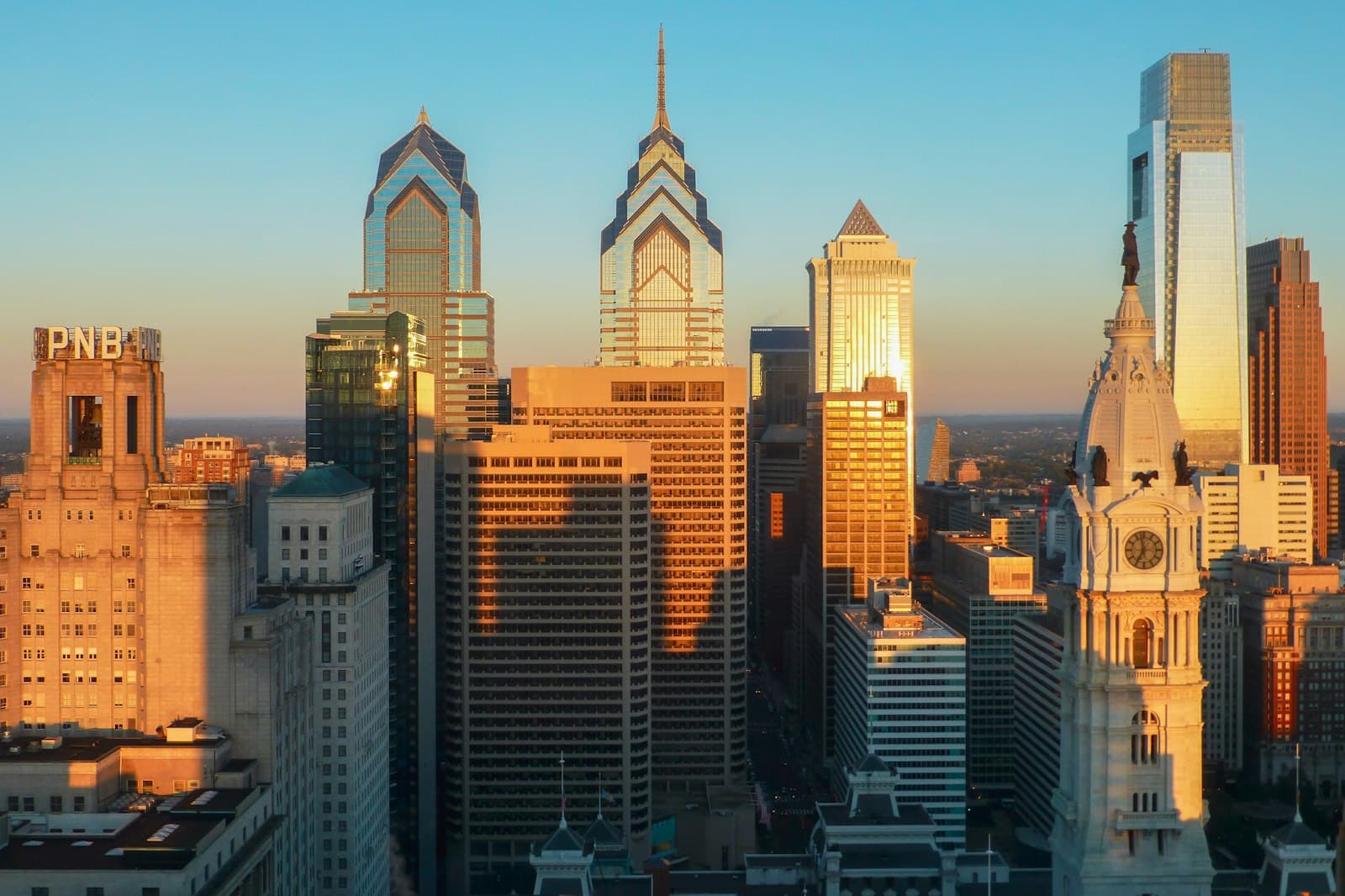
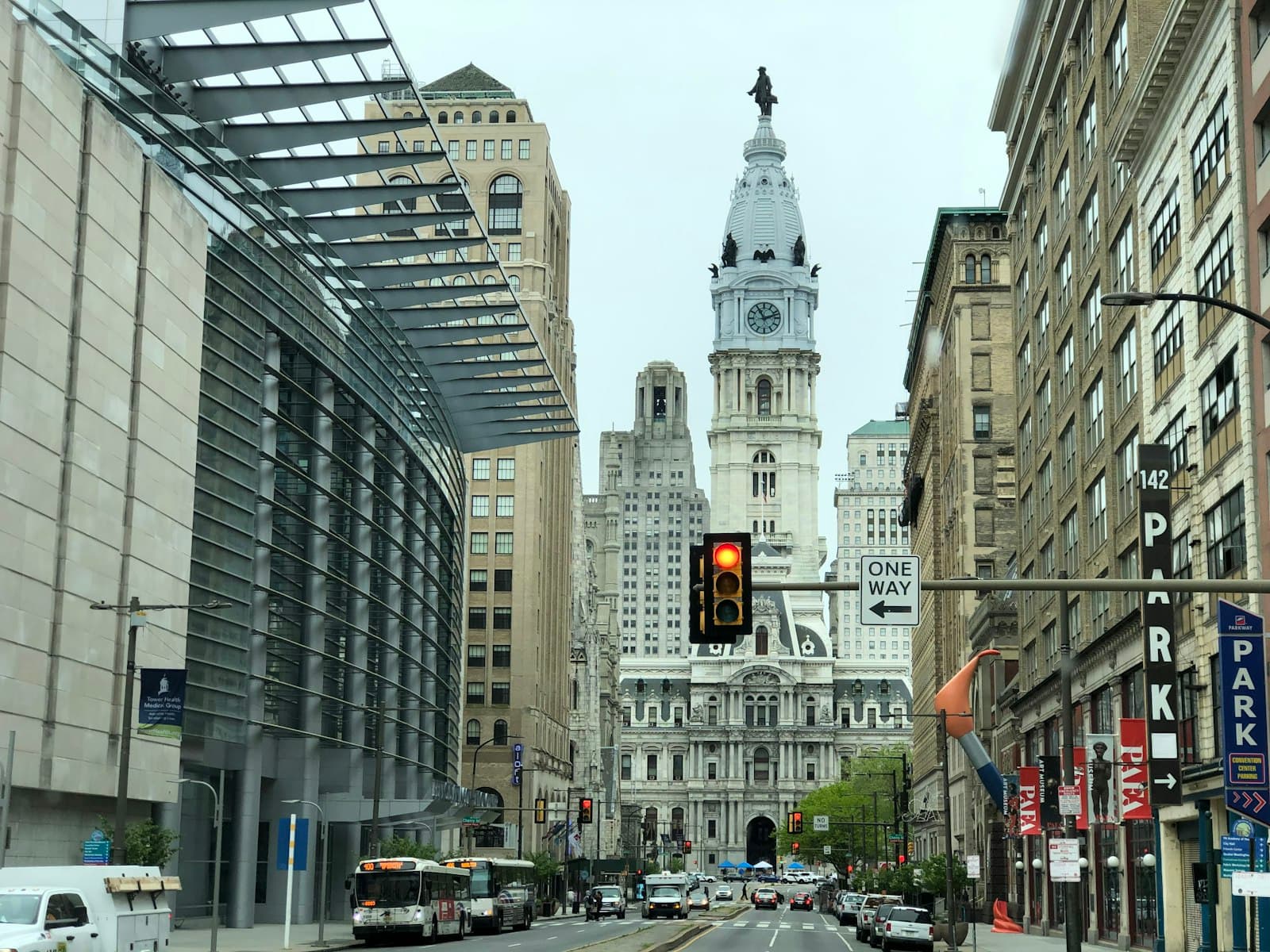
The bronze statue of William Penn atop City Hall holds more than just historical weight.
颐园居 / CC BY-SA 4.0, via Wikimedia CommonsPhiladelphia
“Where centuries of American ambition meet a lively, modern pulse.”
Philadelphia, as no one tells it.
Not the postcards. The stories even locals don't know — whispered in your ear, right where they happened.
This immersive mosaic environment on South Street offers a visual feast, but its origins are rooted in a deeply personal endeavor.
Many visitors seek out the home of Betsy Ross, celebrated for sewing the first American flag, yet the historical evidence for this claim is surprisingly sparse.
Discover every secret of Philadelphia
Every address, every reveal in full — in your ear, right where it happened.
You pick your stops. You walk. The voice reveals what the others miss.
How long do you have in Philadelphia?
No tours available yet. Check back soon — we're preparing them.
The story of Philadelphia
Philadelphia, affectionately known as the "City of Brotherly Love," is a place where the echoes of centuries past resonate alongside a dynamic, contemporary energy. Founded in 1682 by William Penn, an English Quaker who championed religious freedom, Philadelphia played a pivotal role in the American Revolution. It was within this city that the nation's Founding Fathers gathered, established the Continental Army, appointed George Washington as its commander, and adopted the Declaration of Independence on July 4, 1776. Philadelphia also served as the capital of the United States on several occasions between 1776 and 1800.
Beyond its foundational historical significance, Philadelphia has consistently evolved, becoming a significant industrial center in the 19th century and a nexus for innovation. Today, it stands as the fifth-largest city in the United States, a bustling metropolis that proudly holds the distinction of being the first UNESCO World Heritage City in the U.S. From its distinctive accent and devoted sports enthusiasts to its unique culinary traditions, Philadelphia presents a rich array of experiences for every visitor.
## From Quaker Colony to Crucible of Liberty Philadelphia's narrative begins in 1682 with William Penn's aspiration for a "Holy Experiment" – a colony founded upon principles of religious liberty. The city expanded rapidly, drawing diverse settlers and quickly becoming a vital port and the largest city in British America by the mid-18th century, second only to London within the British Empire.
The city's central location and growing influence naturally positioned it as a focal point for the American Revolution. In 1774, it hosted the First Continental Congress, followed by the Second Continental Congress, where the Declaration of Independence was adopted in 1776. Independence Hall, a UNESCO World Heritage site, stands as a monument to these critical moments, where both the Declaration and the U.S. Constitution were drafted and signed. Philadelphia also functioned as the capital of the United States for various intervals between 1776 and 1800, before the federal government relocated to Washington, D.C.
## Industrial Force and Cultural Center After the Revolutionary War, Philadelphia continued to thrive. By 1790, it was the nation's largest city and its financial and cultural heart, though it was eventually surpassed in population by New York City. The 19th century saw Philadelphia emerge as a major industrial city, propelled by extensive construction projects for roads, canals, and railroads. This era also saw the establishment of important institutions, such as the African Methodist Episcopal Church in 1816, the first independent Black denomination in the country.
Philadelphia's dedication to arts and culture deepened over time. It is home to the country's first art museum and art school, the Pennsylvania Academy of the Fine Arts, and exhibits more outdoor sculptures and murals than any other U.S. city. The city's extensive history includes many "firsts," such as the first hospital in the U.S. (Pennsylvania Hospital, founded in 1751 by Benjamin Franklin and Dr. Thomas Bond) and the oldest zoo in America, the Philadelphia Zoo, chartered in 1859. Today, Philadelphia continues to honor its origins while embracing its future, marked by ongoing economic revitalization and a flourishing cultural landscape.
Begin your journey in the Historic District, often called "America's Most Historic Square Mile." Here, you can explore Independence Hall, where the Declaration of Independence and U.S. Constitution were signed, and the Liberty Bell Center, home to the enduring symbol of freedom. Nearby, wander through the charming, continuously inhabited Elfreth's Alley, one of the nation's oldest residential streets.
Those who appreciate art will discover much to admire along the Benjamin Franklin Parkway, where institutions like the Philadelphia Museum of Art reside, known for its "Rocky Steps" and acclaimed collections. Also along the Parkway are the Rodin Museum and the Barnes Foundation, which houses the world's largest collection of Renoir paintings. For a distinct artistic experience, venture to Philadelphia's Magic Gardens on South Street, an immersive mosaic art environment.
For a taste of local life and diverse culinary offerings, make your way to Reading Terminal Market, one of the country's oldest and largest public markets, featuring over 80 vendors. Be sure to ascend the City Hall Tower for sweeping views of the city. Other notable places to explore include the Museum of the American Revolution, the National Constitution Center, and the African American Museum in Philadelphia.
The most agreeable times to visit Philadelphia are spring (March to May) and fall (September to November). During these transitional seasons, the weather is generally pleasant, and the substantial summer crowds begin to diminish, often leading to more favorable accommodation rates.
Spring offers temperatures ranging from the mid-30s to low 70s Fahrenheit (around 2-22°C), with outdoor markets and festivals beginning to appear. Fall brings comfortable temperatures, often in the 70s Fahrenheit (around 21-26°C) in September, along with the added beauty of changing leaves. Summers (June to August) are warm and humid, with average temperatures in the low 70s to mid-80s Fahrenheit (around 21-30°C), and represent the busiest tourist season, meaning larger crowds and higher prices. Winters (December to February) are cold, with average lows around 27-36°F (around -3 to 2°C), but offer fewer tourists and lower prices, alongside festive holiday events.
Philadelphia is a city easily explored on foot, particularly in its historic and central areas. The Southeastern Pennsylvania Transportation Authority (SEPTA) offers an extensive public transportation network, including buses, subways, trolleys, and regional rail, connecting the city and surrounding counties. A SEPTA Key Card can be purchased and reloaded for convenient payment across all modes of transit. The PHLASH bus is a seasonal, straightforward loop service connecting many popular attractions.
From Philadelphia International Airport (PHL), the most efficient way to reach Center City is via the SEPTA Airport Line, a 25-minute train ride that departs every 30 minutes. Taxis and rideshare services like Uber and Lyft are also readily available. For those driving, numerous public parking lots and garages are available in Center City, though street parking requires careful attention to signage.
Philadelphia is dedicated to accessibility, with over 60% of SEPTA stations being wheelchair accessible, and many attractions offering accommodations such as wheelchair loans and assistive listening devices.
- What is the easiest way to get from Philadelphia International Airport (PHL) to Center City?
- The easiest and most efficient way to get from PHL to Center City is by taking the SEPTA Airport Line train. It runs every 30 minutes and takes about 25 minutes.
- What are some essential Philadelphia foods I should try?
- While the cheesesteak is an iconic choice, locals often recommend trying a roast pork sandwich with provolone and broccoli rabe. Be sure to also try a soft pretzel from a street cart and water ice (known as "wooder ice" to Philadelphians).
- Is Philadelphia a walkable city?
- Yes, many of Philadelphia's key attractions, especially in the Historic District and Center City, are easily accessible on foot, making it an excellent city for walking tours.
- What is a "SEPTA Key Card" and do I need one?
- A SEPTA Key Card is a reusable, reloadable contactless chip card used for all SEPTA public transportation (buses, subways, trolleys, regional rail). It is recommended for convenience, though single-ride tickets can also be purchased.
- Are Philadelphia's attractions accessible for visitors with disabilities?
- Yes, Philadelphia is dedicated to accessibility. Many SEPTA stations are wheelchair accessible, and numerous attractions offer accommodations like wheelchair loans, accessible restrooms, and assistive listening devices.
- What is the local etiquette for tipping in Philadelphia?
- Tipping customs in Philadelphia generally follow U.S. standards: 15-20% for good service at restaurants, and a dollar or two per drink at bars.