Proval Lake
At the entry to this distinctive subterranean lake, a bronze figure stands, collecting imaginary fees.
Full story unlocks in the tour
 Николай Максимович / CC BY 3.0, via Wikimedia Commons
“Where peaks meet restorative waters, and literary echoes drift through the air.”
Not the postcards. The stories even locals don't know — whispered in your ear, right where they happened.
At the entry to this distinctive subterranean lake, a bronze figure stands, collecting imaginary fees.
This classical pavilion once produced music powered by the very air.
Local inhabitants engage in a particular custom involving a traveler's statue and loose coins.
Discover every secret of Piatigorsk
Every address, every reveal in full — in your ear, right where it happened.
You pick your stops. You walk. The voice reveals what the others miss.
No tours available yet. Check back soon — we're preparing them.
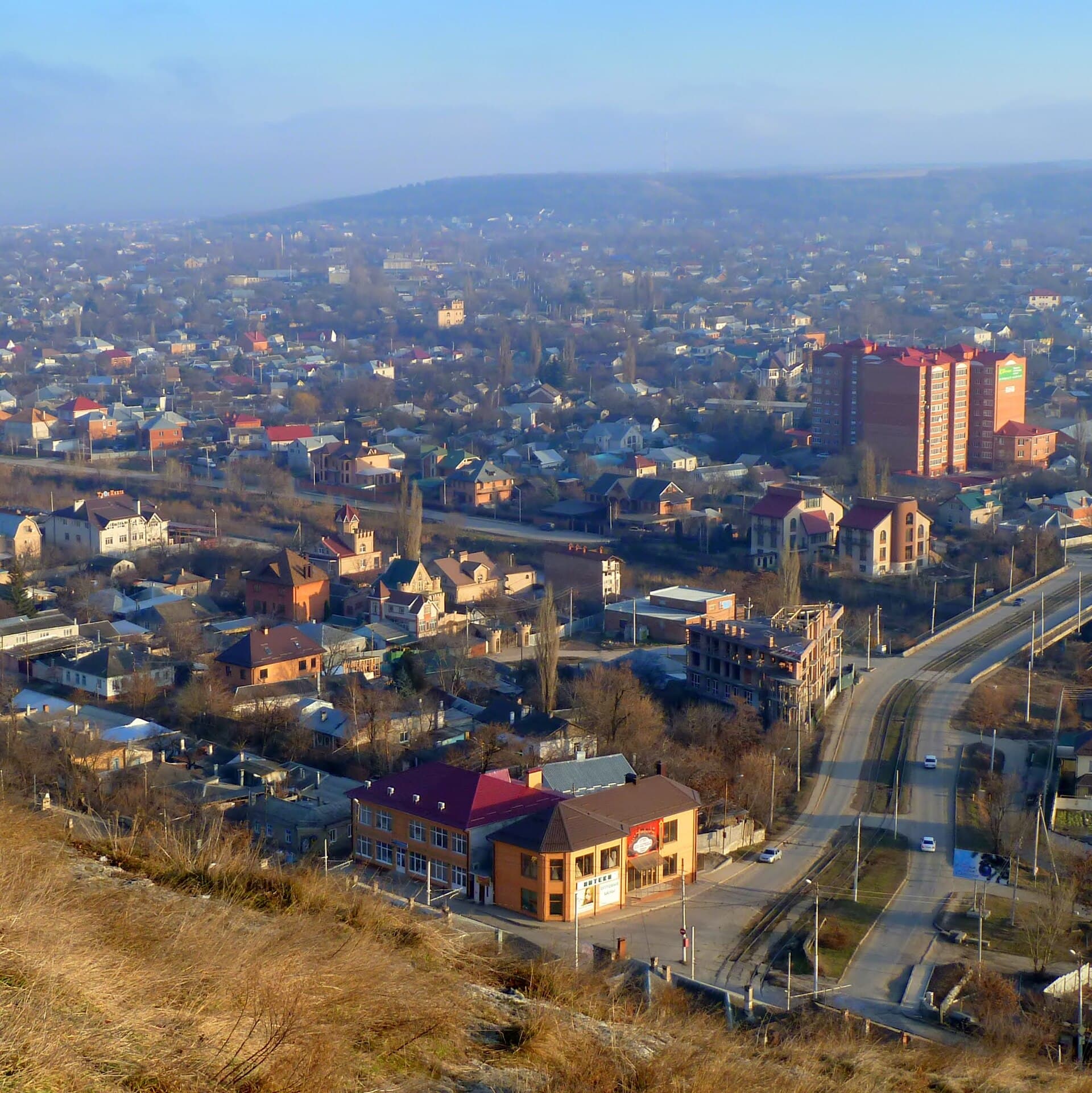
Pyatigorsk, whose name translates to 'five mountains,' is a city in Russia's Stavropol Krai, positioned against the dramatic backdrop of the North Caucasus foothills. Primarily recognized as a historic spa town, it draws visitors with its abundant mineral springs, gentle climate, and therapeutic muds. The city's air carries a faint scent of sulfur from its thermal waters, mingling with the fresh aroma of pine from the surrounding slopes.
Beyond its natural healing properties, Pyatigorsk occupies a significant place in Russian literary history, particularly through its connection with the poet Mikhail Lermontov, who spent his final months here and was fatally wounded in a duel on the slopes of Mount Mashuk. The city's elegant 19th-century promenades, Soviet-era sanatoriums, and compact museums weave a layered cultural narrative. It is a place where spa-goers, hikers, and students converge, creating an atmosphere that feels both provincial and unexpectedly sophisticated.
## From Military Outpost to Refined Resort Pyatigorsk's origins trace back to 1780 with the establishment of the Konstantinogorskaya fortress, a military outpost essential to Imperial Russia's expansion into the Caucasus foothills. The area's mineral springs were noted much earlier, with the first known mention by the Arabian traveler Ibn Battuta in 1334. However, scientific study of these waters commenced in the 18th century, spurred by Peter the Great's interest in European spa resorts.
In 1803, the value of the Caucasian mineral waters received official recognition, leading to the construction of a resort. On May 14, 1830, the settlement, initially known as Goryachevodsk ('town of hot water'), was officially granted city status and renamed Pyatigorsk, a reference to the five-peaked Mount Beshtau. The city's transformation from a disparate settlement to a well-ordered European-style resort was significantly shaped by Italian architects Giuseppe and Giovanni Bernardazzi, who designed many of its early stone buildings, parks, grottos, and bathhouses in the Classical style.
Throughout the 19th century, Pyatigorsk thrived as a desirable destination for Russian nobility, officers, and artists, effectively becoming the region's summer cultural capital. Literary figures such as Alexander Pushkin, Mikhail Lermontov, and Leo Tolstoy visited, with Lermontov's tragic duel and death in 1841 forever marking his name into the city's narrative. The arrival of the railway in 1894 further accelerated the resort's expansion.
In the 20th century, Pyatigorsk continued its development as a leading health resort. The first balneological society in the Russian Empire was founded here in 1863, followed by the opening of the Pyatigorsk Balneological Institute in 1920, which became a scientific center for studying the region's mineral resources. During World War II, the city was temporarily occupied by the German Wehrmacht from August 1942 to January 1943. Post-war, the city was rebuilt, and new springs were discovered, solidifying its status as a significant medical and cultural center in the North Caucasus. In 2010, Pyatigorsk was designated the administrative center of the North Caucasian Federal District.
Begin your exploration with an ascent up Mount Mashuk, either on foot along its paths or via the cable car, for expansive panoramic views of the Caucasus foothills, and on clear days, the snow-capped Mount Elbrus. At its summit, you will find observation platforms and a café.
Descend to Proval Lake, a turquoise subterranean lake within a karst cave on Mount Mashuk, recognized for its faint sulfur aroma and vivid color. Nearby, the 'Shameless Baths' offer a distinctive experience of soaking in natural hot springs carved into the rock, with views of the mountains and city.
Immerse yourself in literary history at the Lermontov House-Museum, where the poet spent his final months. The museum complex also includes the site of his fatal duel on Mount Mashuk.
Walk through the Tsvetnik Park, the city's oldest green space, featuring flower beds, avenues, and attractions like Diana's Grotto, the Lermontov Gallery (now a concert hall), and Gukasov's Coffee House. Be sure to experience the Aeolian Harp gazebo, a classical pavilion with an acoustic system that emulates the sounds of wind-played harps.
For a sampling of the city's therapeutic heritage, visit the public pump rooms to taste the various mineral waters, each possessing distinct mineral compositions.
The ideal period to visit Pyatigorsk for warm-weather activities and comfortable sightseeing extends from late spring through early autumn, specifically from late June to early September. During these months, temperatures are mild, and the mountain weather is generally stable. June is often the warmest month but also receives the most rain. While winter offers a stark beauty, some services may be reduced, and mountain paths can be closed.
Pyatigorsk is well-connected, with the nearest major entry point being Mineralnye Vody airport, approximately 20 km away. Regional trains and buses offer reliable connections, though it is advisable to check seasonal timetables and allow for buffer time during transfers. Public transport within the city, including buses and taxis, is generally dependable for reaching various sights. For those planning to explore the natural springs, remember to bring a reusable water bottle.
When preparing for your trip, consider layers of clothing and comfortable shoes suitable for walking on uneven paths, especially if you intend to hike. Carrying a small amount of local currency is useful for taxis and market stalls. Weekday mornings and early afternoons are typically quieter for sightseeing, while late afternoons bring a more social atmosphere to the promenades. Municipal tourist offices can provide maps and information on cultural events.