The Romans built this aqueduct with astonishing precision, but the secret to its enduring functionality lies in a seemingly simple detail within the water channel itself.
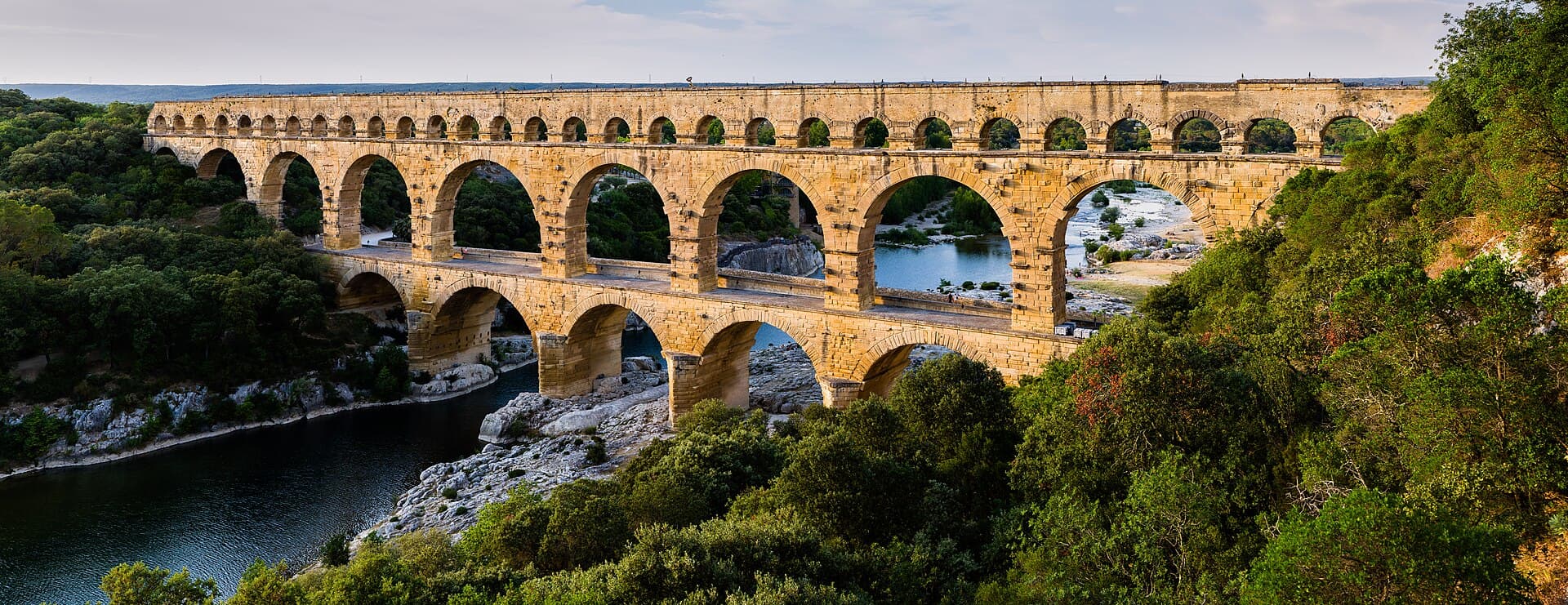
Benh LIEU SONG (Flickr) / CC BY-SA 3.0, via Wikimedia CommonsPont du Gard
Self-guided audio walking tour of Pont du Gard — GPS route, offline playback, story-driven narration in 32 languages.
“Where ancient ambition meets enduring grace.”
Pont du Gard, as no one tells it.
Not the postcards. The stories even locals don't know — whispered in your ear, right where they happened.
Building a structure of this immense scale without modern tools is a marvel, but how did the Roman engineers ensure each massive stone found its exact place?
While the Pont du Gard is the star, the surrounding landscape holds a deeper, prehistoric story that predates the Romans by millennia.
Discover every secret of Pont du Gard
Every address, every reveal in full — in your ear, right where it happened.
You pick your stops. You walk. The voice reveals what the others miss.
How long do you have in Pont du Gard?
Your self-guided audio tour of Pont du Gard is ready — pick your landmarks, choose your language, and start the moment you arrive.
BuyThe story of Pont du Gard
The Pont du Gard is an ancient Roman aqueduct bridge, a monumental testament to Roman engineering and architectural ingenuity, located in southern France. Constructed in the 1st century AD, likely during the reigns of Claudius or Nero, it was designed to carry water over 50 kilometers (31 miles) from the springs of Uzès to the Roman colony of Nemausus, modern-day Nîmes. Rising nearly 49 meters (161 feet) above the Gardon River, it is the tallest Roman aqueduct bridge still standing in the world and the only ancient three-level bridge of its kind to remain largely intact.
This UNESCO World Heritage site, inscribed in 1985, is more than just a bridge; it represents a crucial segment of a larger hydraulic system that supplied Nîmes with an estimated 30,000 to 40,000 cubic meters (around 8 to 11 million US gallons) of water daily for public fountains, baths, and private homes. Its exceptional preservation and imposing presence continue to draw over a million visitors each year, offering a tangible connection to the advanced civilization that shaped much of Europe.
Roman Engineering and Construction
The construction of the Pont du Gard was a colossal undertaking, completed in a remarkably short period—estimated to be around five years, with nearly a thousand men involved. The aqueduct's entire 50-kilometer (31-mile) course from Uzès to Nîmes was designed with an astonishingly subtle average gradient of just 25 centimeters per kilometer (about 1 inch per 182.4 meters), allowing water to flow by gravity alone. The Pont du Gard itself was the most challenging section, requiring a bridge to span the Gardon River valley.
The bridge is composed of three tiers of arches: six on the lowest level, eleven on the middle, and originally 47 on the top, though 35 remain today. The limestone blocks, some weighing up to six tons, were quarried locally, approximately 700 meters downstream from the bridge. These massive stones were precisely cut and fitted together without mortar, relying on friction and gravity for stability. The exterior of the structure was left rough, but the interior channel, where the water flowed, was meticulously smoothed and waterproofed.
From Aqueduct to Road Bridge and Beyond
The aqueduct system functioned for about five centuries, providing Nîmes with a vital water supply until its abandonment in the early 6th century, following the decline of the Roman Empire. Despite falling into disuse as an aqueduct, the Pont du Gard remained largely intact due to its secondary function as a road bridge during the Middle Ages. Locals modified the second level by digging out some of the piers to allow carts to pass through. This adaptation ensured its survival even as other Roman structures were dismantled for building materials.
In the 18th century, a separate road bridge was constructed adjacent to the lower tier of the aqueduct, further solidifying its role in local transport. The monument gained official recognition in 1840 when it was included on France's first list of historic monuments, leading to several restoration campaigns throughout the 19th century. A significant initiative in 2000 removed surrounding traffic and buildings, restoring the site to a more natural setting and enhancing the visitor experience.
A visit to the Pont du Gard offers more than just admiring the aqueduct. Begin by walking across the lower tier of the bridge, which provides views of the Gardon River and an up-close look at the Roman stonework. For a deeper understanding, consider a guided tour that grants access to the third tier, where the water channel once flowed. The site's museum, located on the left bank, offers a comprehensive overview of the aqueduct's history, construction, and its significance in Roman Gaul through models, films, and interactive exhibits. Children aged 5 to 12 can engage with educational activities at the Ludo area.
Beyond the bridge and museum, explore the surrounding natural landscape. The Mémoires de Garrigue trail is a 1.4-kilometer loop that winds through Mediterranean vegetation, olive trees, and vineyards, showcasing archaeological remains of the aqueduct and the region's human history. The Gardon River itself provides opportunities for relaxation and recreation; in summer, visitors can swim in its clear, shallow waters or picnic on its banks. Kayaking under the arches of the Pont du Gard is another popular activity, offering a unique perspective of the monument. Scenic lookouts on both sides of the river, particularly the Belvédère on the left bank, offer iconic photo opportunities, especially during the golden hours of early morning or late afternoon. In the evenings from May to September, the monument is illuminated, with a sound and light show held in July and August.
The best times to visit the Pont du Gard are spring (April–June) and early autumn (September–October). During these periods, the weather is mild, wildflowers are in bloom, and the crowds are generally smaller. Summer (July–August) offers the warmest temperatures, ideal for swimming in the Gardon River and enjoying evening sound and light shows, but also attracts the highest number of visitors. Winter (November–February) sees fewer visitors and shorter operating hours for cultural areas. Allow at least half a day for a complete visit to explore the site's various attractions.
The Pont du Gard site is entirely pedestrian, encouraging exploration on foot or by bicycle. Parking is available on both the left (Vers-Pont-du-Gard) and right (Remoulins) banks, with a daily fee of €9 per vehicle. This fee includes access to the cultural areas, museum, and exhibitions. Access to the first level of the bridge is free. The site is open every day of the year, with hours varying seasonally; cultural areas typically close an hour before the site itself. It's advisable to arrive at least 50 minutes before closing time to maximize your visit.
The Pont du Gard is located approximately 25 km (15.5 miles) from Nîmes and 30 km (18.6 miles) from Avignon. While driving offers the most flexibility, public transport options include trains to Nîmes or Avignon, followed by regional buses or shuttle services. The site is committed to accessibility, offering dedicated parking, easy-access pathways, and free wheelchair provision for visitors with reduced mobility. Restrooms and free Wi-Fi are available on-site. Dining options range from picnic areas to on-site cafés and restaurants.
- What are the opening hours of the Pont du Gard site?
- The Pont du Gard site is open every day of the year. Opening hours vary by season, typically from 9 AM to 6 PM in winter months (January, November, December) and extending to 9 PM or 11 PM in summer (July-August). Cultural areas close one hour before the site.
- Is there an entrance fee for the Pont du Gard?
- There is a €9 parking fee per vehicle, which includes admission to the cultural areas, museum, and exhibitions. Access to the first level of the bridge itself is free for all visitors.
- Can I walk on the Pont du Gard?
- Yes, visitors can freely walk across the lower tier of the aqueduct. Access to the third tier, where the water channel is located, is available through guided tours.
- Are there activities for children at the Pont du Gard?
- Yes, the site is family-friendly and offers the Ludo area, which provides educational activities for children aged 5 to 12, as well as various workshops and exhibitions.
- Can you swim in the Gardon River at the Pont du Gard?
- Yes, in summer, visitors can swim in the clear, shallow waters of the Gardon River at the foot of the monument. Kayaking is also a popular activity.
- How long should I plan for a visit to the Pont du Gard?
- It is recommended to allow at least half a day (3 to 4 hours) for a complete visit to fully experience the bridge, museum, and surrounding trails. For a quicker visit, allow at least 1.5 hours.