The Durga statue in the Shiva temple
Many visitors admire the intricate carvings within Prambanan's main Shiva temple, yet few grasp the true identity of one particular deity.
Full story unlocks in the tour
 Christopher Michel / CC BY-SA 4.0, via Wikimedia Commons
Self-guided audio walking tour of Prambanan — GPS route, offline playback, story-driven narration in 32 languages.
“Where ancient Hindu epics are etched in stone and legends drift through the air.”
Not the postcards. The stories even locals don't know — whispered in your ear, right where they happened.
Many visitors admire the intricate carvings within Prambanan's main Shiva temple, yet few grasp the true identity of one particular deity.
You might observe a captivating performance of the Ramayana Ballet with the illuminated temples as a backdrop, unaware of a subtle connection to the temple's carvings.
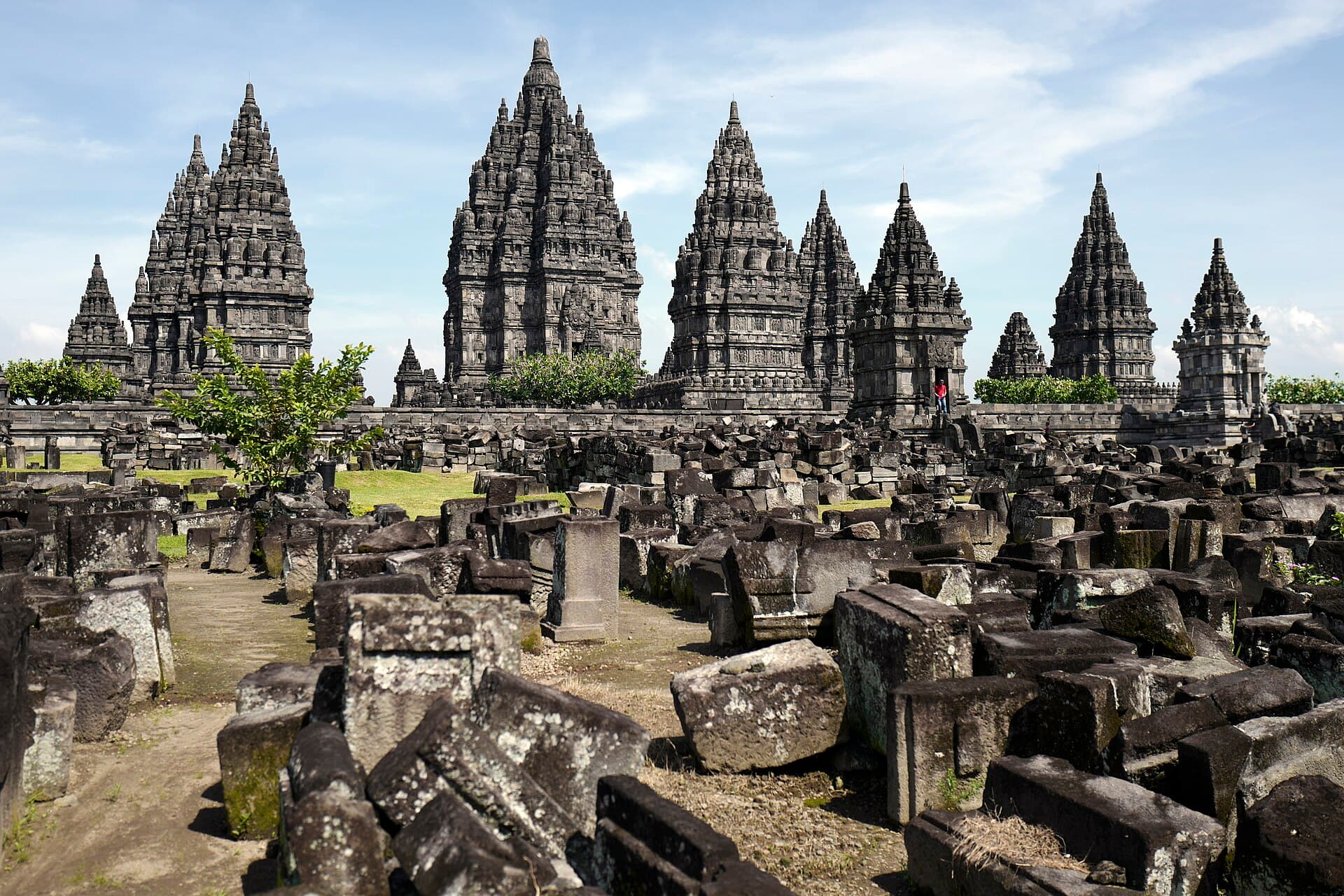
As you traverse the expansive complex, you will notice many smaller temple ruins surrounding the main structures, often appearing as piles of scattered stones.
Discover every secret of Prambanan
Every address, every reveal in full — in your ear, right where it happened.
You pick your stops. You walk. The voice reveals what the others miss.


Lume has a built-in augmented-reality guide. Hold your phone up and its camera shows the street ahead of you, with a glowing arrow laid over the real view that always points to your next stop — no map to puzzle over, no wrong turns. Like everything in Lume, it works fully offline.
Prambanan, a UNESCO World Heritage Site, stands as Indonesia's largest Hindu temple complex and a testament to 9th-century Javanese artistry and devotion. Approximately 17 kilometers east of Yogyakarta, this sprawling archaeological park invites exploration into a past where Hindu and Buddhist kingdoms shaped the cultural landscape of Java.
The complex is defined by its towering and pointed architecture, with the central Shiva temple rising dramatically to 47 meters, symbolizing Mount Meru, the sacred mountain in Hindu belief. Surrounded by hundreds of individual temples, Prambanan offers a profound glimpse into ancient religious practices and epic storytelling carved in stone.
Prambanan emerged in the 9th century during the Mataram Kingdom, a period of intense political and religious dynamism in Central Java. While the nearby Borobudur monument celebrated Buddhism, Prambanan was a monumental assertion of Hindu devotion. It is believed that the complex was constructed under the Hindu Sanjaya dynasty, possibly during the reign of Rakai Pikatan, to honor Shiva and to rival the grand Buddhist structures of the Sailendra dynasty.
Local folklore imbues Prambanan with the romantic and tragic legend of Princess Roro Jonggrang. The tale recounts how Prince Bandung Bondowoso, having killed Roro Jonggrang's father, sought her hand in marriage. To avoid the union, the princess challenged him to construct a thousand temples in a single night. With the help of supernatural beings, Bandung Bondowoso nearly succeeded, completing 999 temples. However, Roro Jonggrang tricked him by prematurely signaling dawn. Enraged, the prince cursed her, transforming her into the thousandth statue, considered by many to be the Durga figure within the Shiva temple. This enduring myth adds a layer of magic and emotion to the site.
After its period of prominence, Prambanan was deserted within a few years of its completion, possibly due to a shift in political power or natural disasters, and eventually collapsed. The temple ruins lay largely forgotten until 1733 when they were rediscovered by a Dutch East India Company employee, Cornelis Antonie Lons. Formal restoration efforts began in 1918, with significant work commencing in 1937 and the central temple's completion in 1953. The complex has faced further challenges, including a 5.9-magnitude earthquake in 2006 that damaged 30-40% of the structures. Restoration is an ongoing process, ensuring the preservation of this remarkable heritage site.
Prambanan's expansive grounds invite a thorough exploration, ideally allowing two to three hours for an unhurried visit. The central and most prominent structures are the three main temples dedicated to the Hindu Trimurti: Shiva (the Destroyer), Vishnu (the Preserver), and Brahma (the Creator). The Shiva temple, the tallest at 47 meters, is particularly impressive, housing statues of Shiva, his consort Durga, his son Ganesha, and the sage Agastya.
Walk along the inner balustrades of the Shiva and Brahma temples to observe the intricate bas-reliefs that narrate the epic tale of the Ramayana. These detailed carvings offer a visual journey through ancient Hindu mythology.
Beyond the main compound, an entry ticket also grants access to the nearby 8th-century Buddhist Sewu Temple, located 800 meters north. This complex, along with the smaller Bubrah and Lumbung temples, provides a fascinating contrast to the Hindu architecture of Prambanan and highlights the religious coexistence of the era.
Consider hiring a local guide at the main entrance to enrich your understanding of the history, symbolism, and stories embedded in the temple's architecture. An hour-long guided tour of the main complex typically costs IDR 150,000 to 250,000.
The dry season, from April to October, is the most favorable time to visit Prambanan, offering clear skies and manageable temperatures. June, July, and August see the highest number of international visitors, so for a balance of good weather and fewer crowds, consider April to May or September to October.
Arriving early in the morning, between 7:00 AM and 9:00 AM, provides softer light for photography, cooler temperatures, and quieter pathways before tour groups arrive. Alternatively, a late afternoon visit (around 4:00 PM to 5:00 PM) offers a special experience as the volcanic stone glows amber in the golden hour light, creating dramatic silhouettes against the darkening sky. The inner courtyard of the Trimurti temples is closed every Monday for maintenance, though outer paths and the Sewu complex remain accessible.
Prambanan is open daily from 6:30 AM to 5:00 PM, with the last entry at 4:30 PM. Foreign adult visitor tickets cost IDR 400,000, with discounts for children (IDR 250,000) and students with valid ID. Tickets can be purchased online or at the main entrance, where separate booths are available for foreign visitors.
From central Yogyakarta, Prambanan is about 17 kilometers east. Ride-hailing apps like Grab or Gojek offer a convenient 30-45 minute journey for approximately IDR 50,000 to 80,000. Public bus 1A from Malioboro Street, with a transfer to Bus 2B, also runs to Prambanan, taking 45-60 minutes and costing IDR 3,500.
Wear comfortable shoes for walking the extensive grounds. While a sarong is provided for entry, dressing respectfully with covered shoulders and longer trousers is advisable as it is a cultural heritage site. Facilities include toilets, a visitor center with maps and bottled water, and a café. ATMs are available in the parking area, and cash (IDR) is useful for small purchases.
Prambanan in Korean, in Chinese or in Hebrew — and 29 more languages, every stop narrated by a native voice. The widest language range of any self-guided audio tour.
Available in: