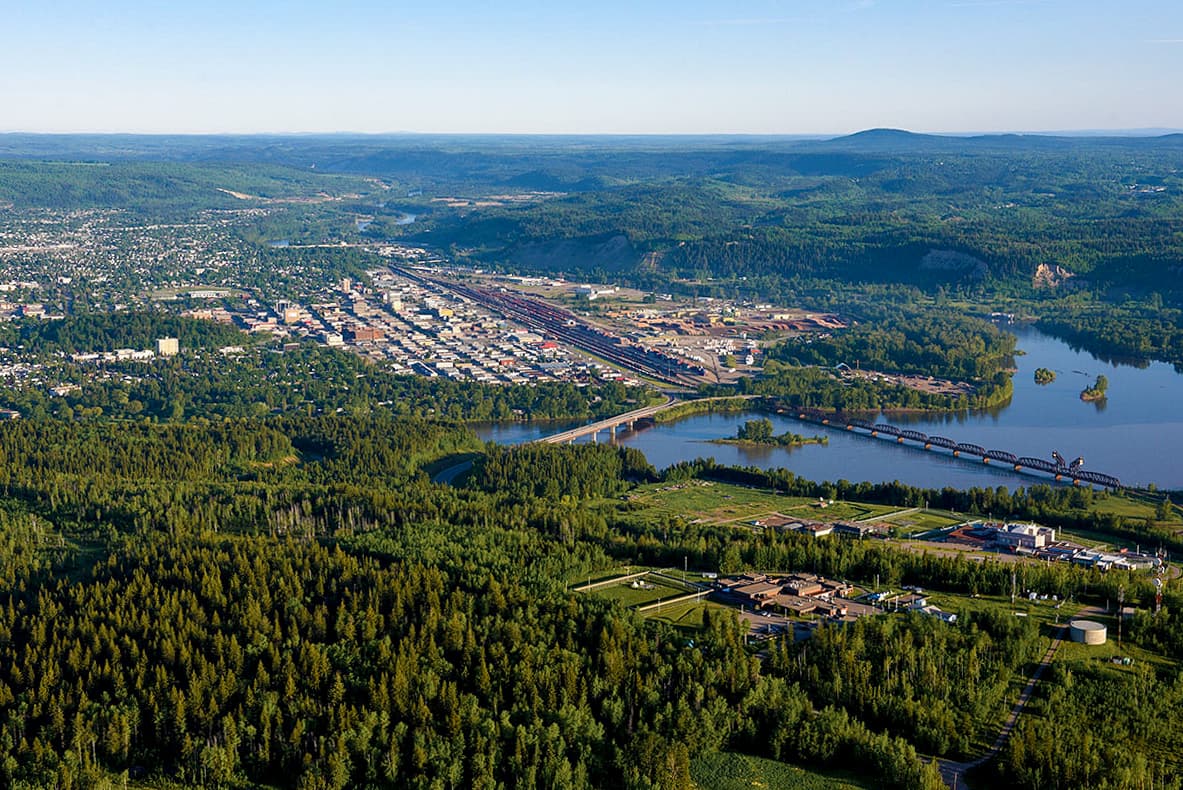
Prince George, CanadaEurydemus / CC BY-SA 4.0, via Wikimedia Commons
CA

Prince George

Where the northern spirit meets urban comfort at the confluence of two powerful rivers.

The secrets of Prince George

Prince George, as no one tells it.

Not the postcards. The stories even locals don't know — whispered in your ear, right where they happened.

3 secrets below. Many more wait inside the tour.
The Crescents neighborhood

Before Prince George's official incorporation, a deliberate design choice shaped a distinctive neighborhood layout.

Full story unlocks in the tour
Caribou Brewing Company

A Prince George entrepreneur may have played a significant role in a common beverage packaging innovation.

Full story unlocks in the tour
Mr. PG statue

Prince George's iconic lumberjack mascot once possessed a voice and a fondness for travel.

Full story unlocks in the tour
The full tour

Discover every secret of Prince George

Every address, every reveal in full — in your ear, right where it happened.

Get the key to Prince George

You pick your stops. You walk. The voice reveals what the others miss.

Choose your time

How long do you have in Prince George?

No tours available yet. Check back soon — we're preparing them.

About Prince George

The story of Prince George

Prince George, often referred to as British Columbia's "northern capital," is a city where the conveniences of urban life seamlessly merge with immediate access to a boundless wilderness. Situated at the meeting point of the Fraser and Nechako Rivers, the city functions as a central hub for higher education, healthcare, government services, arts, entertainment, sports, and major industries like forestry and mining. With a population exceeding 76,000, it maintains a welcoming community atmosphere while providing the services typically found in larger cities.

Known to locals as "PG," the city serves as a portal to outdoor adventures, encircled by over 1,600 lakes and numerous provincial and regional parks. From its recognizable Mr. PG statue, a symbol of the city's forestry heritage, to the serene riverbanks and forested paths, Prince George offers a varied range of experiences. It is a place where one can effortlessly transition from exploring downtown shops and eateries to immersing oneself in the natural splendor of Northern British Columbia.

History

From Trading Post to Northern Capital

The story of Prince George is profoundly rooted in the land of the Lheidli T'enneh First Nation, who have inhabited the area for at least 9,000 years. Their traditional territory lies at the confluence of the Nechako and Fraser Rivers, a significant meeting point reflected in their name, which means “people of the confluence of the two rivers.” European contact commenced in 1793 with Alexander Mackenzie, but it was Simon Fraser who established a fur trading post called Fort George in 1807 for the North West Company, naming it in honor of King George III.

For many years, Fort George remained a relatively modest trading post, overshadowed by other centers like Fort St. James. Agricultural settlement began around the post in the early 1900s, coinciding with the arrival of the Grand Trunk Pacific Railway (later CN Rail) in 1914. The railway's presence was a transformative event, leading to the development of a new townsite and an influx of people. The city was officially incorporated on March 6, 1915, and after some discussion, adopted the name Prince George. While some theories suggest the name honored King George V or Prince George, Duke of Kent, internal railway documents aimed to distinguish it from existing “Fort George” communities.

The early 20th century saw growth, though it was interrupted by World War I and the Spanish Flu. Significant development resumed in the 1930s and during World War II with the establishment of Army Camp Prince George, housing 6,000 soldiers. The forestry industry became a cornerstone of the city's economy, with the first pulp mill opening in 1966. By 1981, Prince George was the second-largest city in British Columbia and, at one point, held the distinction of having the most millionaires per capita in the country due to its independently-operated mills. Today, Prince George continues to evolve as a vital economic and cultural center, while acknowledging its deep Indigenous roots and industrial past.

What to see

Begin your exploration at the Lheidli T'enneh Memorial Park, a significant green space where the Fraser and Nechako Rivers meet, honoring the ancestral lands of the Lheidli T'enneh First Nation. For expansive city views, drive or walk up to Connaught Hill Park, offering a 360-degree perspective of Prince George. The Central BC Railway and Forestry Museum provides an immersive experience into the industries that shaped the city, with a collection of trains and artifacts.

Those who appreciate nature should journey to the Ancient Forest (Chun T'oh Whudujut Park), an hour's drive east, home to a rare inland temperate rainforest with ancient cedar trees accessible via a boardwalk trail. Cottonwood Island Nature Park offers walking trails and distinctive tree bark carvings by Elmer Gunderson. Take a moment for a photograph with Mr. PG, the city's 8.2-meter (27-foot) tall lumberjack mascot, located at the junction of Highways 16 and 97. For arts and culture, visit the Two Rivers Gallery, explore local museums, or attend a performance by the Prince George Symphony Orchestra.

When to visit

Prince George is a destination for all seasons, with each offering distinct experiences. For warm-weather activities like hiking, fishing, and exploring parks, the most agreeable time to visit is from mid-July to mid-August, when average daily high temperatures are above 65°F (18°C) and skies are clearest. July is the warmest month, with an average high of 74°F (23°C). Winters bring cold and snow, ideal for activities like cross-country skiing, with January being the coldest month, averaging 13°F (-11°C).

Practical

Prince George is accessible by car via the scenic Highway 16 and Highway 97, by plane into Prince George Airport (YXS), or by VIA Rail's Jasper-Prince Rupert route. The Prince George Airport is approximately 15 minutes from the city center, with taxi and shuttle services readily available. While downtown Prince George is generally calm, it can become quiet after 5 PM, as many shops close early. Having a car is recommended for exploring the city and surrounding provincial parks. The city provides diverse dining and accommodation options, including choices that welcome pets. For assistance and local insights, visit the Tourism Prince George Visitor Information Centre.

Good to know
What is Prince George recognized for?
Prince George is recognized as British Columbia's "northern capital," serving as a center for industry (especially forestry), education, healthcare, and as a portal to extensive outdoor recreation and wilderness.
Are there guided tours available in Prince George?
Yes, guided tours are available for adventure activities, cultural experiences, and scenic walks. You can consult the Tourism Prince George website for options.
Can I go fishing in Prince George?
Absolutely. Prince George is acknowledged for its excellent fishing opportunities in various spots, including the Fraser River, Nadsilnich Lake, and Purden Lake.
What are some of the best hiking trails in Prince George?
Popular hiking trails include Teapot Mountain, the Ancient Forest (Chun T'oh Whudujut Park), and Forests for the World.
Where can I observe wildlife in Prince George?
Parks like Forests for the World and the Ancient Forest are good places to observe birds, deer, and other local wildlife. Always remember to maintain a safe distance.
Is Prince George welcoming to pets?
Yes, many hotels, cabins, and campgrounds in Prince George are welcoming to pets. Many parks and trails also allow pets, provided they are on a leash and you clean up after them.
Prince George
From€9.00
No booking · activate anytime · 12h to walk it
Get the key to Prince George