Marina di Corricella
The pastel houses of Corricella are Procida's most iconic image, yet their striking colors serve a practical purpose beyond their beauty.
Full story unlocks in the tour
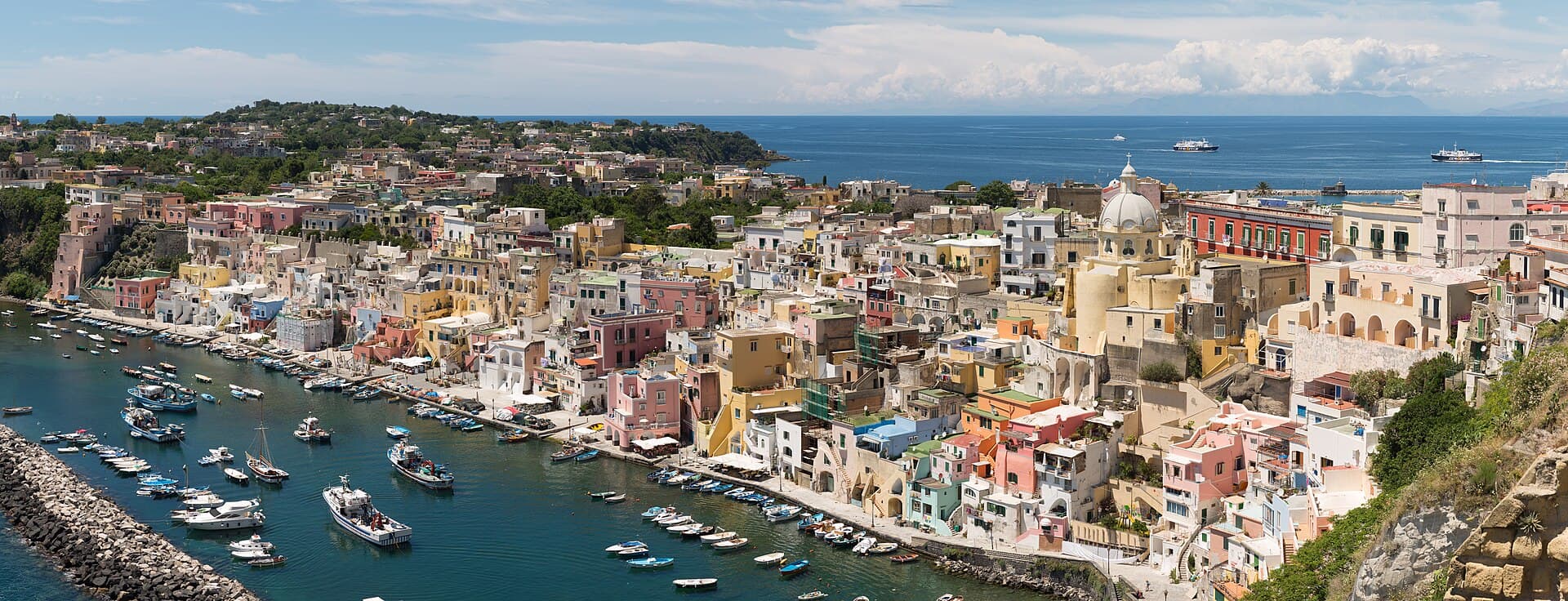 Ekrem Canli / CC BY-SA 4.0, via Wikimedia Commons
Self-guided audio walking tour of Procida — GPS route, offline playback, story-driven narration in 32 languages.
“An island painted in whispers, where every color tells a story.”
Not the postcards. The stories even locals don't know — whispered in your ear, right where they happened.
The pastel houses of Corricella are Procida's most iconic image, yet their striking colors serve a practical purpose beyond their beauty.
This imposing 16th-century palace, overlooking the fortified village of Terra Murata, holds a surprising past that belies its grand appearance.
A short walk from Procida, this small, crescent-shaped islet is a protected nature reserve, often overlooked by visitors despite its singular allure.
Discover every secret of Procida
Every address, every reveal in full — in your ear, right where it happened.
You pick your stops. You walk. The voice reveals what the others miss.

Your self-guided audio tour of Procida is ready — pick your landmarks, choose your language, and start the moment you arrive.
BuyLume has a built-in augmented-reality guide. Hold your phone up and its camera shows the street ahead of you, with a glowing arrow laid over the real view that always points to your next stop — no map to puzzle over, no wrong turns. Like everything in Lume, it works fully offline.
Procida, the smallest of the three volcanic islands gracing the Bay of Naples, offers an authentic Italian island experience, distinct from its more celebrated neighbors, Capri and Ischia. Spanning just 4 square kilometers, the island is renowned for its extraordinary pastel-colored fishing village, Marina di Corricella, and its designation as the Italian Capital of Culture in 2022. With a population of approximately 10,000, Procida retains a lived-in, genuine atmosphere, where daily rhythms are shaped by the sea and time-honored customs.
Travelers are drawn to Procida for its tranquil beaches, dramatic volcanic contours, and a slower cadence of life. The island's appeal resides in its unpretentious loveliness, where fishing boats still tie up at dawn and freshly laundered clothes wave between brightly colored balconies. It is a place where the aroma of simmering ragù drifts from kitchen windows and evening diversions center around extended dinners and unhurried drinks, rather than a bustling nightlife.
Procida has also captivated artists and filmmakers, serving as the backdrop for Elsa Morante's novel 'Arturo's Island' and the film 'Il Postino' (The Postman). Its singular character and scenic beauty make it an appealing destination for those seeking an authentic Mediterranean escape, free from the crowds and elevated prices often found on other islands in the region.
## Ancient Origins and Fortified Settlements Procida's story reaches back to antiquity, with archaeological discoveries indicating the presence of Mycenaean Greeks as early as the 16th–15th centuries BC. The island itself is of volcanic origin, shaped by the eruptions of four now-dormant, submerged volcanoes. Early Greek settlers arrived from the Aegean in the 8th century BC, followed by others from nearby Cumae. During Roman dominion, Procida became a favored retreat for the patrician class, though the satirist Juvenal once described it as a barren place.
After the collapse of the Western Roman Empire and subsequent incursions by Vandals, Goths, and Saracens, the populace sought refuge in a fortified village on the island's highest point, known as Terra Murata, or 'walled land'. This strategic elevation, 91 meters above sea level, provided natural defenses that were later strengthened. The island became a feudal dominion under the Da Procida family, with Giovanni da Procida emerging as a significant figure in the Sicilian Vespers revolt.
## From Royal Hunting Ground to Cultural Capital In 1339, control of the fiefdom passed to the Cossa family. The 16th century saw the construction of the Palazzo d'Avalos, which later served as a royal palace and then a significant prison until the late 20th century. After 1735, the Bourbon dynasty abolished feudal holdings, and Procida became a royal hunting preserve, fostering the growth of the local economy. Shipbuilding and maritime industries flourished for centuries, shaping the island's distinctive way of life.
The 20th century brought its own challenges, including a decline in shipbuilding due to industrial competition, and in 1907, Procida lost its mainland territory, which became Monte di Procida. A notable infrastructure achievement was the construction of Europe's first underwater aqueduct in 1957, bringing drinking water to the island. In a testament to its enduring cultural heritage, Procida was designated the Italian Capital of Culture in 2022, the first small island to receive this honor. This recognition brought international attention while underscoring the island's commitment to cultural preservation and sustainable tourism.
Begin your exploration at Marina Grande, Procida's main port, also known as Sent'Co. Wander its narrow streets, admiring the pastel-colored houses, and perhaps enjoy a coffee accompanied by a traditional lingua di bue pastry. From here, make your way to Terra Murata, the island's fortified hilltop village and its highest point. Explore its medieval lanes, the crumbling Palazzo d'Avalos (a former prison), and the 11th-century Abbey of San Michele Arcangelo, which offers expansive views of the Bay of Naples.
Descend from Terra Murata to the iconic Marina di Corricella, an ancient fishing harbor celebrated for its amphitheater-like arrangement of brightly colored houses. This car-free village is ideal for unhurried walks, enjoying a granita di limone, and savoring fresh seafood at a waterfront restaurant. For those seeking the shore, Procida offers several options with characteristic volcanic black sand. Spiaggia della Chiaia is reached via a staircase and provides views of Corricella, while Pozzo Vecchio Beach (also known as Il Postino beach) is recognized for its natural loveliness and cinematic connections. Chiaiolella Beach is the largest and most accommodating.
Consider a visit to Isola di Vivara, a small, uninhabited nature reserve linked to Procida by a footbridge. It is a sanctuary for migratory birds and offers extraordinary views back towards Procida. Remember to arrange your visit in advance. Do not miss the opportunity to take a boat tour around the island to appreciate its coastline and colorful architecture from a different vantage point.
The most pleasant times to visit Procida are during the shoulder seasons: May to June and September to October. In these months, the weather is warm and agreeable, perfect for exploration, and the island is verdant. Crowds are manageable, and accommodation prices are more reasonable than during the peak summer. May is particularly appealing, with flowering lemon trees and the Lemon Festival. Early autumn provides warm days and beautiful evening light for photography. While July and August are peak season with high temperatures and numerous events, anticipate larger crowds and higher prices, especially around Ferragosto (August 15). A visit during Holy Week (March or April) allows you to experience the atmospheric Misteri Procession.
Procida is accessible only by sea, with frequent ferry and hydrofoil services departing from Naples (Molo Beverello and Calata Porta di Massa), Pozzuoli, and the nearby islands of Ischia and Capri. Hydrofoils from Naples take approximately 40 minutes, while slower ferries take about an hour. Tickets can be purchased at port ticket offices or in advance online.
Once on the island, walking is the most authentic way to explore, as the island is small enough to traverse in about 40 minutes. Public buses operate four lines connecting key points of interest, with tickets available at tabacchi shops, bars, or from drivers. Renting a scooter or an electric bicycle at Marina Grande is also a popular and enjoyable option for navigating the narrow, sometimes steep, streets. Private cars are generally not recommended or permitted for tourists. Pack lightly, as cobblestone paths and stairs can make rolling luggage challenging. While many tourist-facing businesses have English-speaking staff, learning basic Italian phrases is always appreciated.
Procida in Korean, in Chinese or in Hebrew — and 29 more languages, every stop narrated by a native voice. The widest language range of any self-guided audio tour.
Available in: