Iglesia del Sagrado Corazón de Jesús
Cette église en bois, un phare à Puerto Varas, partage une lignée architecturale étonnante avec une structure située à l'autre bout de l'océan.
L'histoire complète se débloque dans le tour
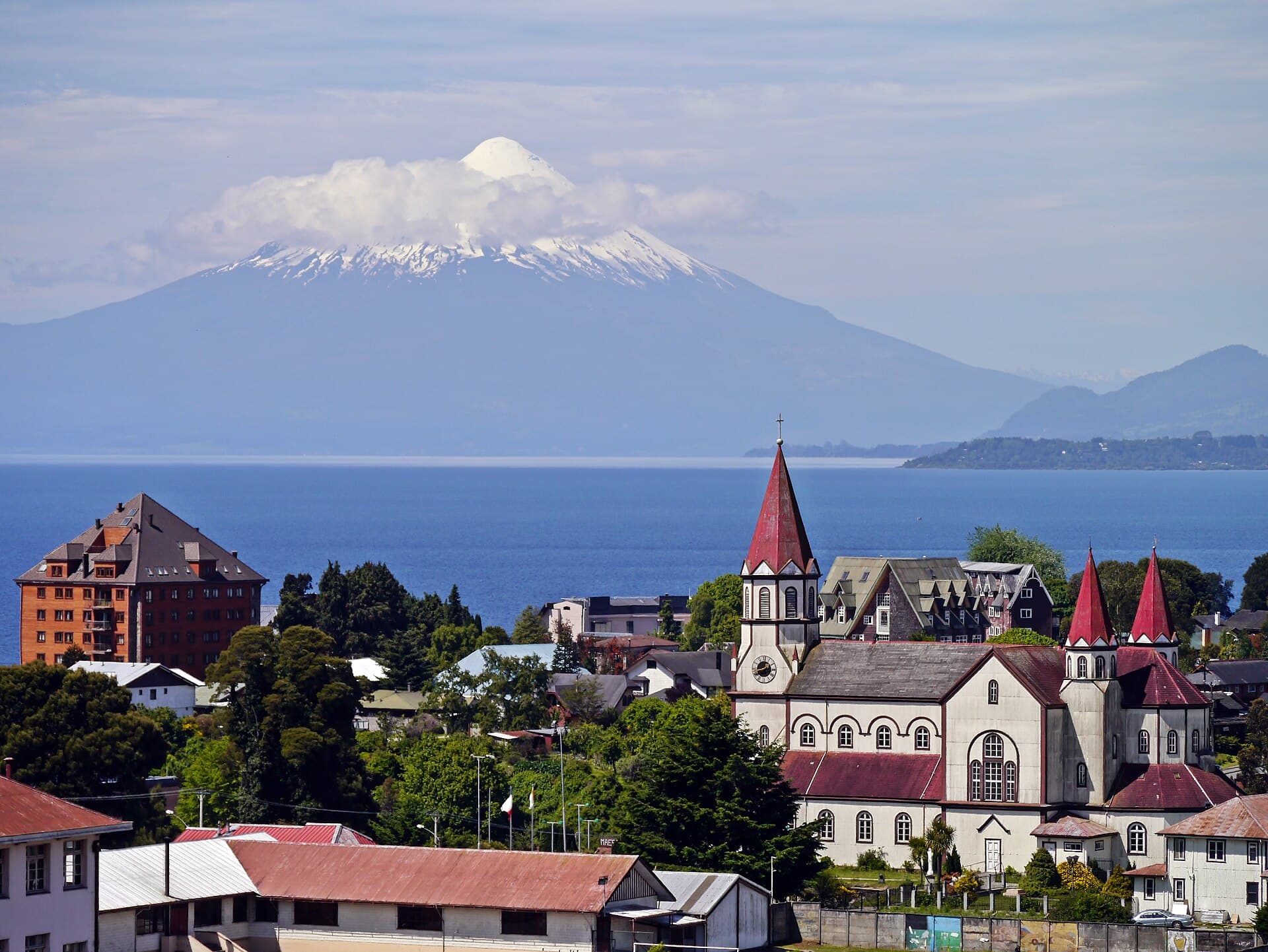 M M from Switzerland / CC BY-SA 2.0, via Wikimedia Commons
Visite audio autoguidée de Puerto Varas — parcours GPS à pied, lecture hors ligne, narration en 32 langues.
“Là où l'héritage allemand rencontre la nature sauvage de la Patagonie, sous le regard des volcans.”
Pas les cartes postales. Les histoires que même les habitants ignorent — soufflées à l'oreille, là où elles se sont passées.
Cette église en bois, un phare à Puerto Varas, partage une lignée architecturale étonnante avec une structure située à l'autre bout de l'océan.
Au-delà de l'étendue du lac et de la grandeur des volcans, une caractéristique géologique distinctive façonne le terrain local.
L'influence allemande à Puerto Varas s'étend au-delà de ses structures et dans une tradition culinaire chérie, célébrée chaque année.
Découvrez tous les secrets de Puerto Varas
Chaque adresse, chaque révélation en entier — dans ton oreille, là où elle s'est passée.
Tu choisis tes lieux. Tu marches. La voix te révèle ce que les autres ignorent.


Votre visite audioguidée de Puerto Varas vous attend — choisissez vos lieux, votre langue, et lancez-vous dès votre arrivée.
AcheterLume intègre un guide en réalité augmentée. Levez votre téléphone : sa caméra montre la rue devant vous, avec une flèche lumineuse posée sur l'image réelle qui pointe toujours vers votre prochain arrêt — aucune carte à déchiffrer, aucun mauvais virage. Comme tout dans Lume, ça fonctionne entièrement hors-ligne.
Puerto Varas, souvent surnommée « La Ville des Roses », est une ville lacustre située dans la région des Lacs, au sud du Chili. Elle s'étend le long des rives du lac Llanquihue, le deuxième plus grand lac du Chili, offrant des vues imprenables sur les volcans enneigés Osorno, Calbuco et Tronador. Le caractère unique de la ville découle de son héritage allemand persistant, visible dans son architecture et ses pratiques culturelles. Au-delà de l'atmosphère accueillante de la ville, Puerto Varas sert de porte d'entrée vers le sud sauvage de la Patagonie, avec des montagnes, des forêts, des lacs et des parcs nationaux tous à portée de main.
Cette convergence d'influence européenne et de paysages naturels spectaculaires fait de Puerto Varas une destination prisée pour les escapades tranquilles comme pour l'exploration en plein air. D'une douce promenade le long de la promenade du lac à l'aventure dans des forêts anciennes et l'ascension de pentes volcaniques, la ville présente un éventail varié d'expériences. Son attrait réside dans la façon dont ces éléments s'entremêlent, forgeant un paysage culturel distinct sur fond de splendeur naturelle inégalée.
## Colonisation allemande et développement précoce L'histoire de Puerto Varas commence au milieu du XIXe siècle, plus précisément en 1853, lorsque le gouvernement chilien a lancé un projet de colonisation des terres inhabitées autour du lac Llanquihue. Les immigrants allemands ont été encouragés à s'établir dans la région, les 212 premières familles allemandes arrivant à la fin de 1853. La ville a reçu son nom d'Antonio Varas, alors ministre de l'Intérieur, qui a joué un rôle central dans l'orchestration de la colonisation du sud du Chili.
Les colons ont apporté leurs coutumes de construction, ce qui a conduit à l'architecture allemande caractéristique observée à Puerto Varas aujourd'hui. Les maisons étaient fabriquées à partir de bois d'alerce local, présentant fréquemment des toits en pente raide et des éléments néo-gothiques. Le peuplement initial a commencé dans une zone connue sous le nom de « La Fábrica », où la route de Puerto Montt rencontrait le lac Llanquihue. En 1897, Puerto Varas a obtenu le statut administratif de « Villa », et en 1925, elle est officiellement devenue une municipalité.
## Croissance et identité culturelle L'inauguration d'une ligne de chemin de fer en 1912 a relié Puerto Varas au centre du Chili, accélérant le commerce et le développement. L'identité culturelle distincte de la ville, un mélange de traditions chiliennes et allemandes, est devenue plus prononcée au fil du temps. Cela est apparent non seulement dans l'architecture, mais aussi dans la cuisine locale, avec des gâteaux allemands comme le « kuchen » devenant un aliment de base. Dans les années 1950, le maire Teobaldo Kuschel Kneer a lancé une vaste campagne de plantation de rosiers dans toute la ville, ce qui a valu à Puerto Varas son titre affectueux, « La Ville des Roses ».
## Époque moderne et tourisme Puerto Varas a longtemps maintenu un profil touristique, même au début du XXe siècle, servant de point de transit vers Bariloche en Argentine. Le quartier historique de la ville, s'étendant sur 13 hectares dans son secteur ouest, a été désigné « Zona Típica » (Zone Patrimoniale) en 1992 pour sauvegarder son héritage architectural unique. Parmi les structures protégées notables figurent l'Iglesia del Sagrado Corazón de Jesús, la Casa Kuschel et la Casa Yunge. Aujourd'hui, Puerto Varas reste une destination touristique importante, offrant un large éventail d'activités de plein air et une scène locale animée, tout en continuant à honorer ses traditions fondatrices.
Commencez votre exploration par une promenade le long du front de lac Llanquihue, un sentier de 2,4 km offrant des vues sur le volcan Osorno et le paysage environnant. Depuis l'embarcadère principal, vous pouvez atteindre le Mirador La Puntilla pour des vues panoramiques et pour observer la sculpture de la princesse Licarayen, une figure de la légende mapuche. L'Iglesia del Sagrado Corazón de Jesús (Église du Sacré-Cœur de Jésus), une église en bois de style néo-roman et baroque construite entre 1915 et 1918, est un monument emblématique visible de nombreux points de la ville.
Pour une perspective alternative, montez le Cerro Philippi, une colline avec un sentier bien entretenu menant à une Croix Monumentale et des vues sur le lac et les volcans. Plongez dans l'héritage allemand de la ville en visitant le Museo Antonio Felmer à Nueva Braunau, qui expose des artefacts de l'époque des immigrants allemands. L'intrigant Museo Pablo Fierro présente également une collection unique d'art et d'objets, l'artiste étant souvent présent. Au-delà de la ville, une excursion d'une journée au Parc National Vicente Pérez Rosales est fortement recommandée pour découvrir les Chutes de Petrohué, où l'eau déferlante cascade sur des roches volcaniques sombres, et les eaux émeraude du Lago Todos los Santos. Vous pouvez également visiter les villes voisines d'influence allemande comme Frutillar et Puerto Octay le long du lac Llanquihue.
La période la plus favorable pour visiter Puerto Varas pour les activités par temps chaud s'étend de fin décembre à fin février, correspondant à l'été chilien. Pendant ces mois, les températures diurnes moyennes oscillent autour de 19-20°C (66-68°F), avec des minima proches de 10-11°C (50-51°F). Février offre généralement le ciel le plus clair et moins de précipitations. Bien que l'été soit une période populaire, Puerto Varas peut être appréciée tout au long de l'année, chaque saison présentant un attrait distinct. L'hiver (juin à août) apporte des températures plus fraîches, autour de 7°C (45°F) en moyenne, et plus de pluie, mais aussi des opportunités de ski sur le volcan Osorno.
Puerto Varas est facilement accessible, l'aéroport commercial le plus proche étant celui de Puerto Montt (Aéroport El Tepual), à environ 25 kilomètres. Des vols réguliers relient Puerto Montt à Santiago, un voyage d'environ 2,5 heures. Depuis l'aéroport, des minibus et des taxis sont disponibles pour Puerto Varas. Des bus longue distance desservent également la ville, la reliant à Santiago et à d'autres villes.
À Puerto Varas, le centre-ville est compact et agréable pour la marche, en particulier le long du lac. Pour de plus longues distances ou pour visiter les attractions à proximité, les taxis partagés (« colectivos ») sont une option, et des locations de voitures sont disponibles à l'aéroport de Puerto Montt. Il est conseillé de réserver les hébergements et les visites populaires à l'avance, surtout pendant la haute saison estivale, car Puerto Varas est une destination prisée. Des bureaux de change, des banques et des distributeurs automatiques de billets sont disponibles dans la ville, mais il est judicieux d'avoir quelques pesos chiliens pour les petits achats dans les zones plus rurales.
Puerto Varas en coréen, en chinois ou en hébreu — et dans 29 autres langues, chaque étape narrée par une voix native. La plus large gamme de langues de tous les audioguides autoguidés.
Disponible en :