The fabled King Nestor, celebrated for his sagacity in Homer's epics, once held court in Pylos. Yet, the discovery of his palace unveiled a surprising detail about the daily rhythms of this Mycenaean kingdom.
Flyax / CC BY-SA 3.0, via Wikimedia CommonsPylos
“Where ancient echoes meet azure waters.”
Pylos, as no one tells it.
Not the postcards. The stories even locals don't know — whispered in your ear, right where they happened.
This serene bay once hosted a pivotal naval confrontation that shaped modern Greek history. Beneath its placid surface, a silent testament to the conflict's ferocity endures.
Pylos' imposing Ottoman fortress, Niokastro, has served many rulers throughout the ages. Within its walls, one building underwent a remarkable transformation, mirroring the town's shifting allegiances.
Discover every secret of Pylos
Every address, every reveal in full — in your ear, right where it happened.
You pick your stops. You walk. The voice reveals what the others miss.
How long do you have in Pylos?
No tours available yet. Check back soon — we're preparing them.
The story of Pylos
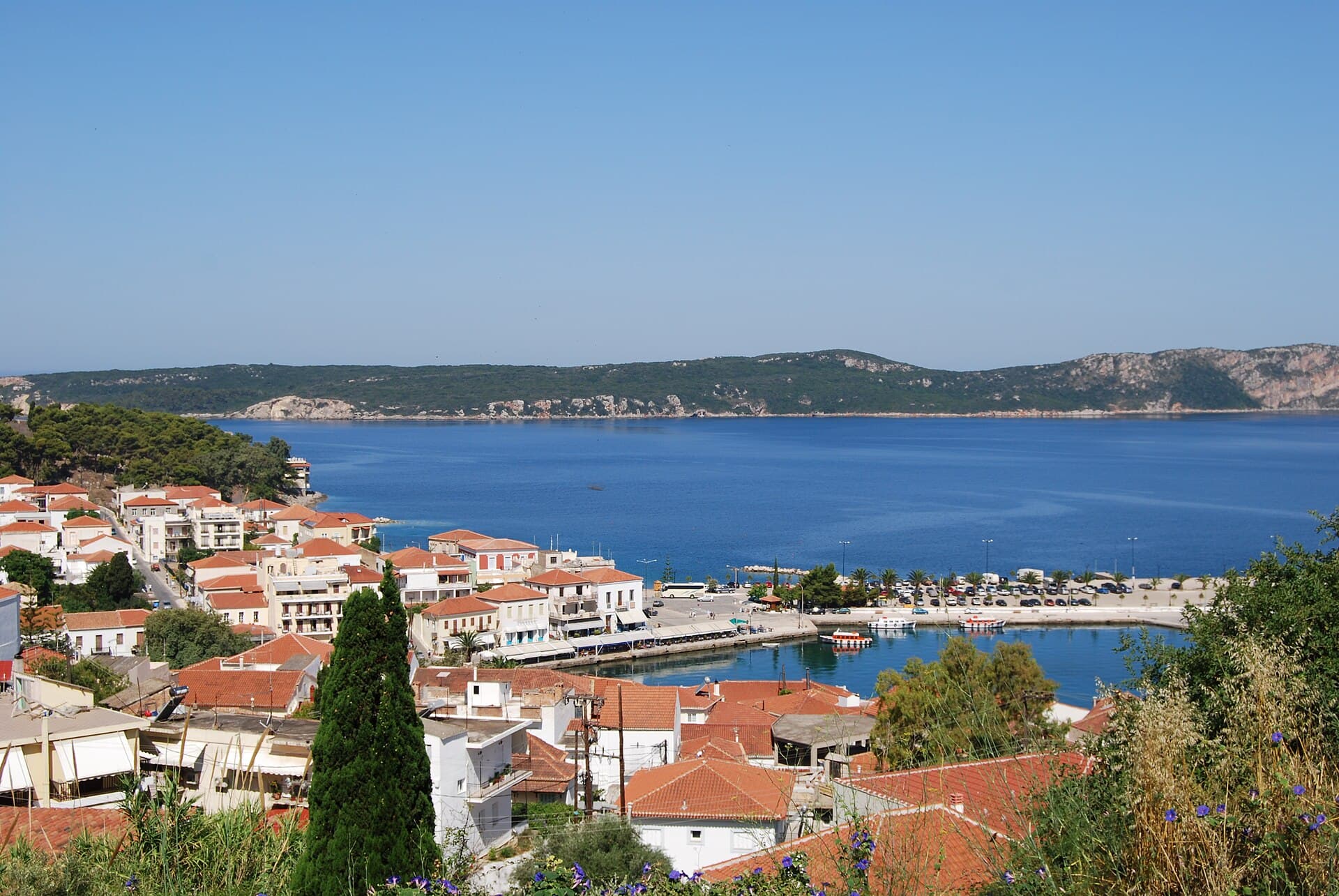
Pylos, historically known as Navarino, is a captivating coastal town in Messenia, Peloponnese, Greece. It unfolds amphitheatrically around one of the Mediterranean's most exquisite natural harbors, Navarino Bay, which finds shelter behind the elongated island of Sfaktiria. This strategic position has rendered Pylos a significant location across epochs, from its Mycenaean origins to its crucial role in the Greek War of Independence.
The town itself presents a distinctive architectural character, a fusion of neoclassical design from its French rebuilding after the 1827 Battle of Navarino, and the enduring presence of Ottoman fortifications. Exploring Pylos reveals a delightful harborfront, a central square shaded by venerable plane trees, and winding side streets that beckon discovery. Beyond its immediate allure, Pylos serves as a portal to a region rich in archaeological sites, immaculate beaches, and authentic Greek culture.
From Mythical Kingdom to Modern Port
Pylos' story reaches back to Neolithic times, first emerging as a prominent kingdom in Mycenaean Greece. It is traditionally identified as the 'sandy Pylos' ruled by King Nestor, a revered figure in Homer's Iliad and Odyssey, recognized for his wisdom. The remains of the Palace of Nestor, situated on the hill of Ano Englianos, approximately 17 kilometers north of contemporary Pylos, stand as the best-preserved Mycenaean palace in Greece. Excavations commenced in 1939 by American archaeologist Carl Blegen, uncovering a complex featuring a throne room, storerooms, and unique baths, all adorned with frescoes. Crucially, thousands of Linear B clay tablets were also found here, offering invaluable insights into the Mycenaean language and the administrative and economic systems of the era.
In Classical times, the area around modern Pylos was largely uninhabited. However, it gained prominence during the Peloponnesian War when Athens fortified a promontory, leading to the Battle of Pylos in 425 BC, a notable Athenian triumph over Sparta. After centuries of relative quiet, Pylos, then known as Navarino, became part of the Frankish Principality of Achaea in the 13th century, and later came under Venetian and Ottoman control. The Ottomans constructed the New Navarino fortress, or Niokastro, in 1573, utilizing the bay as a naval base.
The most defining moment in Pylos' modern history arrived on October 20, 1827, with the Battle of Navarino. In this decisive naval engagement, the combined fleets of Britain, France, and Russia overwhelmingly defeated the Ottoman and Egyptian forces, a victory that significantly hastened Greece's independence from Ottoman rule. Following this battle, the modern town of Pylos was designed in 1829 by French military engineers, resulting in its distinctive neoclassical architecture.
Begin your exploration at the Palace of Nestor, approximately 17 kilometers from Pylos. This exceptionally preserved Mycenaean palace offers a tangible connection to Homeric legend, with visible architectural elements like the throne room and ancient baths. Complement your visit with the Archaeological Museum of Chora, located nearby, which houses the Linear B tablets and other artifacts from the palace, offering deeper context.
Within Pylos town, the Niokastro Fortress (New Navarino) commands the southern skyline. Constructed by the Ottomans in 1573, this well-preserved fortress offers expansive views of Navarino Bay. Inside, explore the restored barracks, which now house the Archaeological Museum of Pylos, featuring finds from Mycenaean tombs and an exhibition on regional shipwrecks and underwater archaeology. The Church of the Transfiguration, also within Niokastro, presents a fascinating history of architectural and religious transformations.
The Plateia Trion Navarchon (Square of the Three Admirals) serves as the town's core, shaded by immense plane trees and featuring a monument to the allied admirals of the Battle of Navarino. From the harbor, consider a boat trip to the islands of Navarino Bay, where memorials to the British, French, and Russian sailors of the 1827 battle can be found.
A short drive north leads to the iconic Voidokilia Beach, recognized for its perfect omega shape and clear waters, often considered among Europe's most beautiful. Adjacent to it is the Gialova Lagoon, a significant wetland and a sanctuary for birdwatching, home to over 260 bird species. For a glimpse into medieval history, the magnificent Methoni Castle, a Venetian fortress extending into the sea, is a worthwhile excursion about 30 minutes south of Pylos.
Pylos experiences a Mediterranean climate, characterized by long, warm summers and mild, short winters. For those seeking abundant sunshine and warm temperatures for beach activities, the summer months of June, July, and August are ideal, though this is also the peak tourist season with larger crowds. The shoulder seasons of spring (April to May) and fall (September to October) offer milder temperatures, fewer visitors, and comfortable conditions for exploring archaeological sites and enjoying the blooming wildflowers or warm sea. Sea temperatures are best for swimming from June to October. Winter (November to March) brings cooler, wetter weather, and Pylos transforms into a quieter, authentic fishing town, with some tourist services operating on reduced hours.
Pylos is located approximately 280 kilometers from Athens, a drive of about 3 to 3.5 hours via the Athens-Corinth highway. A rental car is highly recommended for exploring Pylos and the surrounding region, as public transport options from Athens are limited, and many attractions are best accessed by independent transport. Kalamata International Airport is the nearest major airport.
Within Pylos town, most attractions are within walking distance, making it easy to explore the historic center, castle, and waterfront on foot. Bicycles are available for rent, offering another way to navigate the town and its immediate surroundings. Pylos has banks and ATMs around the main square and port, and credit cards are widely accepted in hotels, most restaurants, and shops. However, carrying some cash is advisable for smaller establishments or rural stops. Tipping is appreciated but not mandatory; rounding up the bill or leaving 5-10% for good service is customary.
- What is Pylos most famous for?
- Pylos is most recognized for its connection to the mythical King Nestor from Homer's epics, the well-preserved Palace of Nestor, and the pivotal Battle of Navarino in 1827, which was crucial for Greek independence.
- Is Pylos a good base for exploring the Peloponnese?
- Yes, Pylos is considered an excellent base for exploring the Peloponnese due to its central location, offering easy access to significant historical sites, beautiful beaches like Voidokilia, and other appealing towns.
- What are the main historical sites to visit in Pylos?
- Key historical sites include the Palace of Nestor, the Niokastro Fortress (New Navarino Castle), Paleokastro (Old Navarino Castle), and the archaeological museums in Chora and Pylos.
- Are there good beaches near Pylos?
- Yes, Pylos is near some of the finest beaches in the Peloponnese, including the famous omega-shaped Voidokilia Beach, Gialova Beach, and Chrysi Ammos Beach.
- How far is Pylos from Athens?
- Pylos is approximately 280 kilometers southwest of Athens, a journey that typically takes 3 to 3.5 hours by car.
- What is the Battle of Navarino?
- The Battle of Navarino, fought in Navarino Bay in 1827, was a decisive naval battle during the Greek War of Independence where allied forces (Britain, France, Russia) defeated the Ottoman-Egyptian fleet, significantly aiding Greece's path to independence.