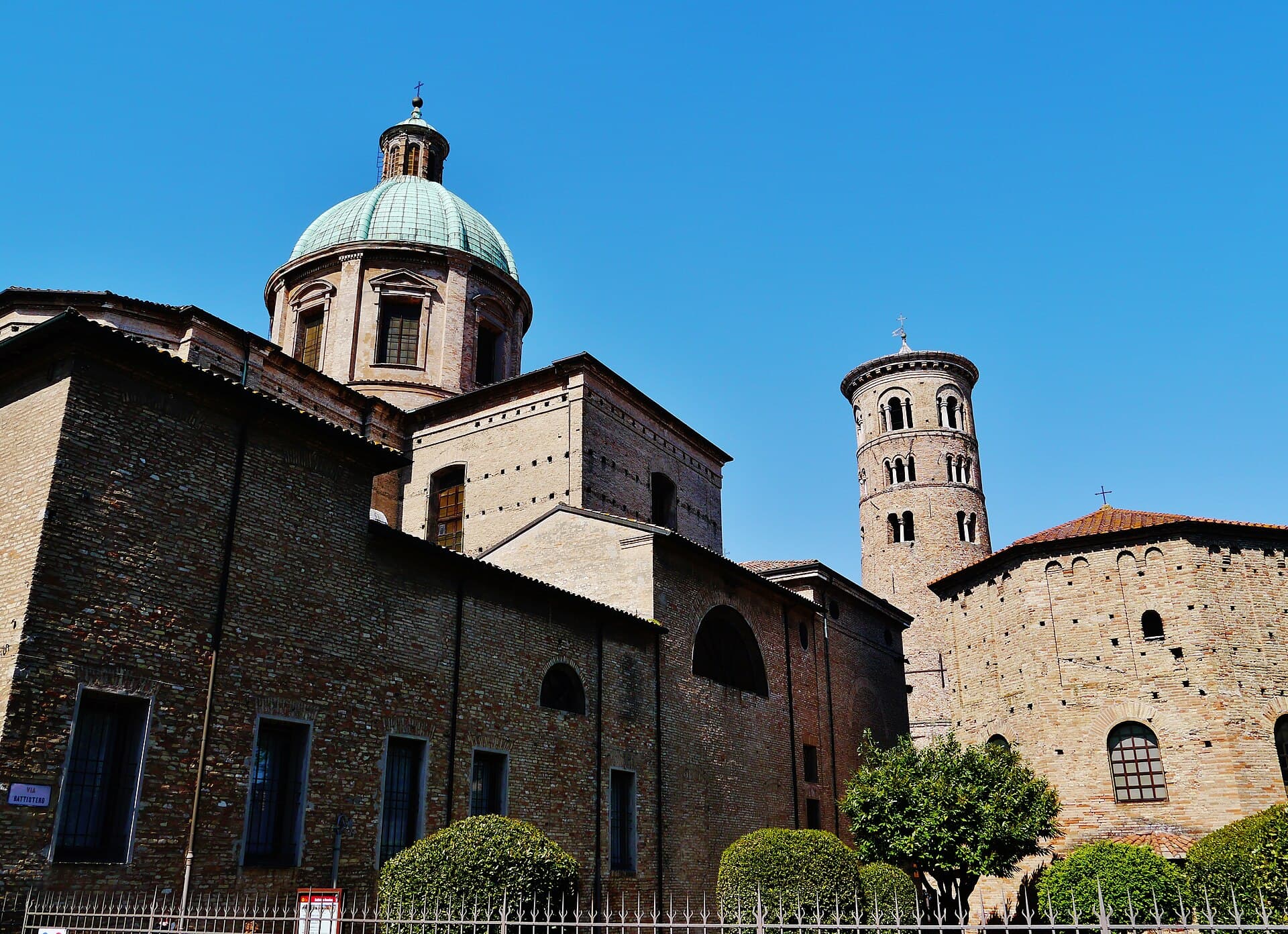
Ravenna, ItalyZairon / CC BY-SA 4.0, via Wikimedia Commons
IT

Ravenna

Where ancient empires left their glittering mark in gold and glass.

The secrets of Ravenna

Ravenna, as no one tells it.

Not the postcards. The stories even locals don't know — whispered in your ear, right where they happened.

3 secrets below. Many more wait inside the tour.
Mausoleum of Galla Placidia

The brilliant blue mosaics of Galla Placidia are celebrated, yet the empress herself might not actually be interred there.

Full story unlocks in the tour
Dante Alighieri's Tomb

Ravenna carefully guards the remains of Italy's most celebrated poet, Dante Alighieri, but his bones have experienced quite a journey.

Full story unlocks in the tour
Basilica di San Vitale

The mosaics in the Basilica di San Vitale portray Emperor Justinian and Empress Theodora with remarkable detail, but Theodora's ascent to power was far from ordinary.

Full story unlocks in the tour
The full tour

Discover every secret of Ravenna

Every address, every reveal in full — in your ear, right where it happened.

Get the key to Ravenna

You pick your stops. You walk. The voice reveals what the others miss.

Choose your time

How long do you have in Ravenna?

No tours available yet. Check back soon — we're preparing them.

About Ravenna

The story of Ravenna

Ravenna, a city in Italy's Emilia-Romagna region, carries an extraordinary legacy as a triple capital, having served as the seat of the Western Roman Empire, the Ostrogothic Kingdom, and Byzantine Italy. This singular history has bequeathed a collection of eight UNESCO World Heritage sites, celebrated for their remarkably preserved early Christian and Byzantine mosaics. The city's compact and easily traversable center makes it an ideal destination for those seeking a deeper exploration into art and history, away from the crowds of larger Italian cities.

Beyond its gleaming mosaics, Ravenna offers a tranquil atmosphere with authentic local cuisine, including piadina flatbreads and squacquerone cheese. The city is connected to the Adriatic Sea by the Candiano Canal, an 18th-century man-made waterway that historically served as a crucial trade and naval link. Whether you are drawn to ancient artistry, historical intrigue, or simply a quieter Italian experience, Ravenna presents a compelling fusion of cultural richness and local allure.

History

From Roman Authority to Byzantine Grandeur

Ravenna's historical importance began to blossom in ancient times when the Adriatic Sea was nearer to the city, which sat on coastal lagoons that later silted up. It came under Roman command in 191 BCE and swiftly became a significant port for Rome's naval fleet in the Adriatic. The Roman emperor Augustus constructed the port of Classis, approximately 3 miles from the city.

The city's pivotal role in European history commenced in 402 CE when the Western Roman Emperor Honorius relocated his court from Milan to Ravenna due to the threat of barbarian invasions. Ravenna then served as the capital of the Western Roman Empire until its dissolution in 476 CE. During this era, the city was adorned with magnificent monuments and elevated to an archbishopric in 438 CE.

After the fall of the Western Roman Empire, Ravenna became the capital of Odoacer, the first barbarian ruler of Italy. In 493 CE, Odoacer surrendered to the Ostrogothic king Theodoric, who then made Ravenna the capital of his kingdom. The city's standing as a cultural and political center continued to expand, drawing scholars, lawyers, doctors, and artisans.

In 540 CE, the Byzantine Empire, under Emperor Justinian, conquered Ravenna, and it became the capital of Byzantine Italy. This period marked a zenith for Ravenna's artistic development, with the creation of many of its celebrated Byzantine mosaics. The city served as the administrative heart of Byzantine governance in Italy, with its influence extending across a diagonal strip of territory from north of Ravenna to south of Rome. However, the Exarchate of Ravenna eventually fractured due to revolts and invasions, with the city falling to the Lombards around 751 CE. After a brief period of Lombard dominion, Ravenna was given to the pope by the Franks in 757 CE, though local archbishops retained considerable authority. The city's turbulent political narrative persisted through the centuries, with periods of conflict between the Holy Roman Empire and the Papacy, before its eventual incorporation into the unified Kingdom of Italy in the mid-19th century.

What to see

Ravenna's primary appeal is its collection of eight UNESCO World Heritage sites, celebrated for their early Christian and Byzantine mosaics. A combined ticket is available for entry to many of these locations, which are largely concentrated in the city center.

Begin with the Basilica di San Vitale, an octagonal church displaying intricate 6th-century mosaics, including notable depictions of Emperor Justinian I and Empress Theodora. Adjacent to it is the Mausoleum of Galla Placidia, a smaller, unassuming structure from the exterior that reveals an astonishing interior of deep blue and gold mosaics.

The Basilica of Sant'Apollinare Nuovo features extensive mosaic friezes portraying processions of martyrs and virgins. The Neonian Baptistery and the Arian Baptistery are both octagonal structures with remarkable dome mosaics illustrating the baptism of Christ. Do not overlook the Archiepiscopal Chapel (St. Andrew Chapel), a private chapel with distinctive mosaics, situated within the Archiepiscopal Museum. A short drive beyond the city center, the Mausoleum of Theodoric stands as a distinctive circular monument with a massive single-stone dome. Farther afield, the Basilica of Sant'Apollinare in Classe offers another impressive display of Byzantine mosaics, particularly in its apse.

Beyond the mosaics, visit Dante Alighieri's Tomb and the nearby Basilica of San Francesco, which features a unique flooded crypt where ancient mosaics are visible beneath the water, often with goldfish swimming among them. For a hands-on experience, consider a mosaic-making workshop.

When to visit

The best times to visit Ravenna are during the late spring (May, June) and early autumn (September, early October) months. During these periods, the weather is mild with warm, sunny days and less rain, making exploration of the city's outdoor sites enjoyable. Crowds are also fewer than in the peak summer months.

Summer (June-August) is warm to hot, with average daily temperatures reaching up to 33°C (91°F), and the city is lively with festivals like the Ravenna Festival in June and July. However, it also experiences the most tourists. Winter (November-March) can be cold, damp, and foggy, but offers a quieter and more affordable experience for cultural travelers.

Practical

Ravenna's historic city center is largely pedestrian-friendly and flat, making it easy to explore on foot. Bicycles are also a popular way to move around, with rental options available near the train station. While most major attractions are walkable, two sites, Classis Ravenna and the Basilica of Sant'Apollinare in Classe, are a short drive (about 5 minutes) southeast of the city center.

For visiting the UNESCO World Heritage mosaic sites, a combo ticket is recommended and can be purchased for entry to multiple locations. Some smaller sites, like the Mausoleum of Galla Placidia and the Neonian Baptistery, may have timed entry or visit limits during busy periods. Tipping is customary but not required. Ravenna is well-connected by train, making it a feasible day trip from cities like Bologna or Florence.

Good to know
How many UNESCO World Heritage sites are in Ravenna?
Ravenna is home to eight UNESCO World Heritage sites, all recognized for their exceptional early Christian and Byzantine mosaics.
Is Ravenna a walkable city?
Yes, Ravenna is an extremely walkable city. Its historic center is compact and largely pedestrian-only, making it easy to navigate on foot.
What is Ravenna most famous for?
Ravenna is most famous for its extraordinary and well-preserved early Christian and Byzantine mosaics, which adorn its numerous UNESCO World Heritage sites.
Can you visit Ravenna as a day trip?
Yes, Ravenna can be visited as a day trip, especially if focusing on the main mosaic sites in the city center. However, spending two days allows for a more relaxed and comprehensive exploration.
What is the best time of year to visit Ravenna?
The best time to visit Ravenna is during late spring (May, June) and early autumn (September, early October) for pleasant weather and fewer crowds.
Where is Dante Alighieri buried?
Dante Alighieri, the celebrated Italian poet, is buried in Ravenna, not his native Florence. His tomb is a significant site in the city.
Ravenna
From€9.00
No booking · activate anytime · 12h to walk it
Get the key to Ravenna