Casa Navàs
This modernist marvel in Plaça del Mercadal holds a unique distinction among its architectural peers.
Full story unlocks in the tour
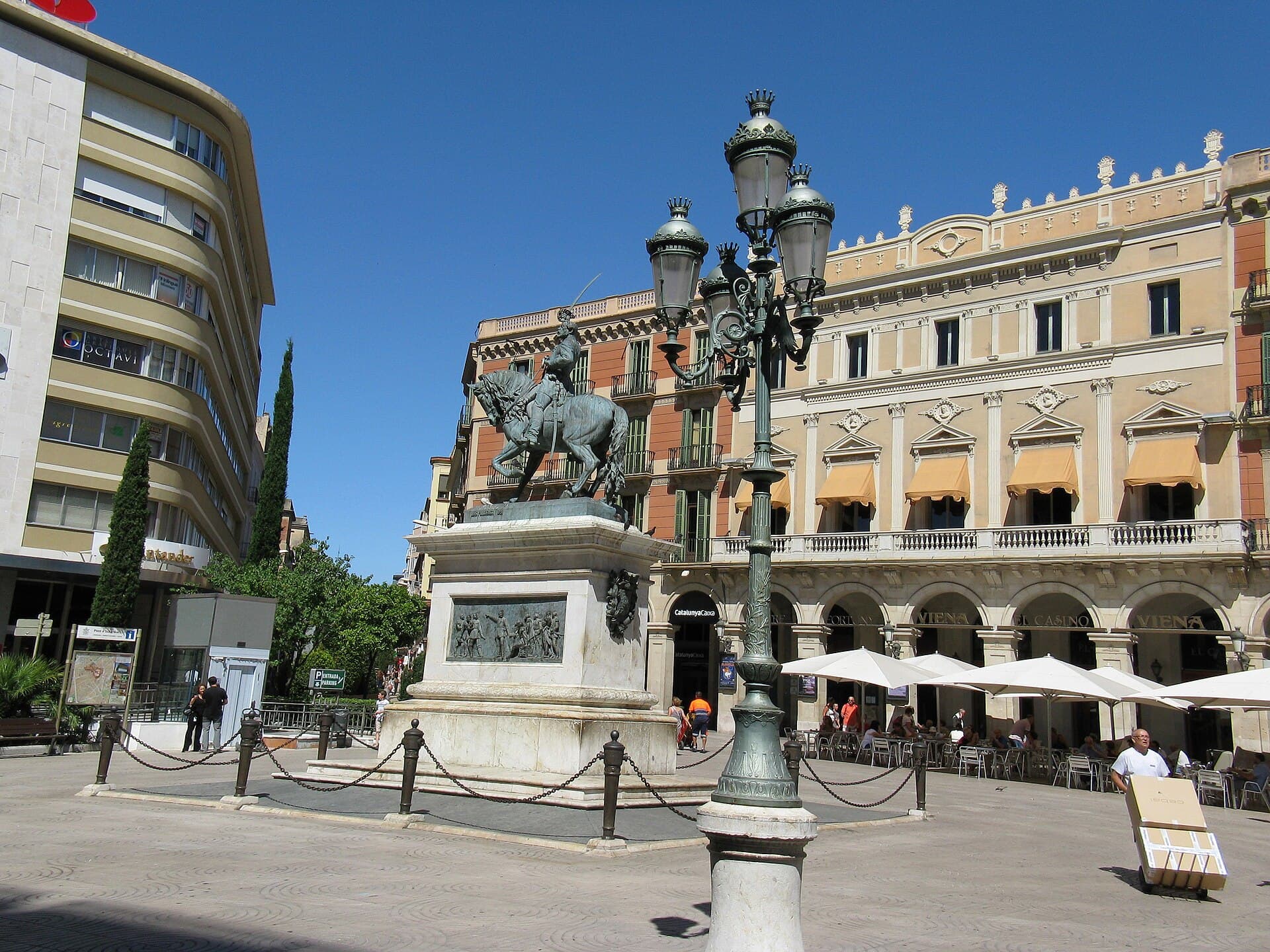 Misburg3014 / CC BY-SA 3.0, via Wikimedia Commons
Self-guided audio walking tour of Reus — GPS route, offline playback, story-driven narration in 32 languages.
“Reus: Where Modernisme's elegance meets the spirited culture of vermouth.”
Not the postcards. The stories even locals don't know — whispered in your ear, right where they happened.
This modernist marvel in Plaça del Mercadal holds a unique distinction among its architectural peers.
The soaring bell tower of Reus's primary church offers more than just sweeping vistas.
Reus is recognized as the birthplace of Spanish vermouth, yet its rise in this industry was sparked by an unforeseen agricultural calamity.
Discover every secret of Reus
Every address, every reveal in full — in your ear, right where it happened.
You pick your stops. You walk. The voice reveals what the others miss.


Your self-guided audio tour of Reus is ready — pick your landmarks, choose your language, and start the moment you arrive.
BuyLume has a built-in augmented-reality guide. Hold your phone up and its camera shows the street ahead of you, with a glowing arrow laid over the real view that always points to your next stop — no map to puzzle over, no wrong turns. Like everything in Lume, it works fully offline.
Reus, a city in Catalonia, Spain, presents an engaging blend of Modernisme architecture, a compelling historical narrative, and a distinctive culinary identity. While frequently linked to its most celebrated native, Antoni Gaudí, born here in 1852, Reus itself proudly displays the creations of other prominent Catalan Modernisme architects, such as Lluís Domènech i Montaner. The city's pedestrian-friendly historic core invites leisurely exploration, revealing elegant squares, bustling shops, and welcoming cafes.
Beyond its architectural allure, Reus occupies a significant position in Spain's gastronomic landscape as the undisputed capital of vermouth. The local custom of "fer el vermut"—savoring a glass of this fortified wine with olives and potato chips before lunch—is a cherished cultural experience. With its authentic atmosphere and proximity to the Costa Daurada beaches and the Roman ruins of Tarragona, Reus offers a rewarding and less-traveled alternative to more crowded destinations.
The story of Reus extends back to Roman antiquity, though its documented presence as a notable settlement begins in the 12th century. The name "Reus" is thought to derive from the Latin word "reddis," indicating its early function as a market town. Its strategic position on trade routes fueled its expansion, and by the Middle Ages, Reus had established itself as a significant commercial center in the Camp de Tarragona region, a status solidified when King James II granted it the privilege of hosting weekly markets in 1309.
The 18th century marked a "golden age" for Reus, as it became a primary hub for the production and trade of spirits, particularly brandy. During this period, Reus, alongside Glasgow and Paris, was considered one of Europe's three main spirits markets, bringing substantial prosperity to the city and driving urban development. The 19th century ushered in industrialization, with Reus becoming an important center for textiles, metalworking, and food processing. The inauguration of one of Spain's first railway lines, connecting Reus with Tarragona in 1856, further enhanced its logistical and export capabilities.
The late 19th and early 20th centuries witnessed an architectural boom, transforming Reus into a showcase of Catalan Modernisme. Affluent industrialists and merchants commissioned elaborate residences from leading architects like Lluís Domènech i Montaner and Pere Caselles, leaving a legacy of nearly 80 modernist buildings that grace the city today. While Antoni Gaudí, the world-renowned architect, was born in Reus in 1852, none of his structures stand in his hometown. However, his influence is celebrated at the interactive Gaudí Centre. Reus also holds the distinction of being the "cradle of vermouth in Spain," a tradition that blossomed after the phylloxera plague impacted wine production in the region in the late 19th century.
Begin your journey in Plaça del Mercadal, the city's central square, home to the striking Casa Navàs, a Modernisme marvel by Lluís Domènech i Montaner. Also in this square stands the Gaudí Centre, an interactive museum dedicated to the life and creations of Antoni Gaudí, Reus's most celebrated son. A short stroll leads to the Prioral de Sant Pere, a 16th-century Gothic church crowned with an octagonal bell tower offering views towards the Costa Daurada.
Explore the Ruta del Modernisme, a walking tour highlighting approximately 80 modernist buildings throughout the city, including Casa Rull and Institut Pere Mata. For a taste of local culture, follow the Ruta del Vermut, sampling the city's acclaimed vermouth at various establishments and producers. The Salvador Vilaseca Museum offers archaeological and historical insights into the region. Do not overlook the Monument al General Prim in Plaça de Prim, dedicated to the influential 19th-century military and political figure.
The most agreeable times to experience Reus are during spring (April–June) and autumn (September–October). In these months, the weather is comfortable, with average temperatures ranging from 20°C to 27°C, making it ideal for exploring the city on foot. Summer (July–August) is also lively, with warm temperatures (average high of 29°C in August) and abundant sunshine, particularly appealing for those wishing to combine city exploration with visits to the nearby Costa Daurada beaches. Winters are generally mild.
Reus is a city easy to navigate on foot, especially its compact center, making walking the optimal way to experience it. For longer distances, the local yellow buses operated by Reus Transport provide a reliable and economical option, serving the main areas of the city. Taxis are readily available at designated stands or can be requested via phone or ride-sharing applications. The Reus train station connects the city to Tarragona, Barcelona, and other key destinations in Catalonia. Reus Airport (REU) is situated just 3 kilometers from the city center, with bus line L50 offering a direct and convenient connection.
The local currency is the Euro (€). Credit and debit cards are widely accepted, but carrying some cash is advisable for smaller establishments or street markets. ATMs are readily available throughout the city. While tipping is not obligatory, rounding up the bill for good service is a polite gesture. Spanish is the official language, but Catalan is also widely spoken. Reus is considered a safe city for visitors, though standard precautions against petty theft are always recommended.
Reus in Korean, in Chinese or in Hebrew — and 29 more languages, every stop narrated by a native voice. The widest language range of any self-guided audio tour.
Available in: