The Black Madonna of Rocamadour is renowned for performing miracles, particularly for sailors in distress. But how would anyone know a miracle had happened far out at sea?
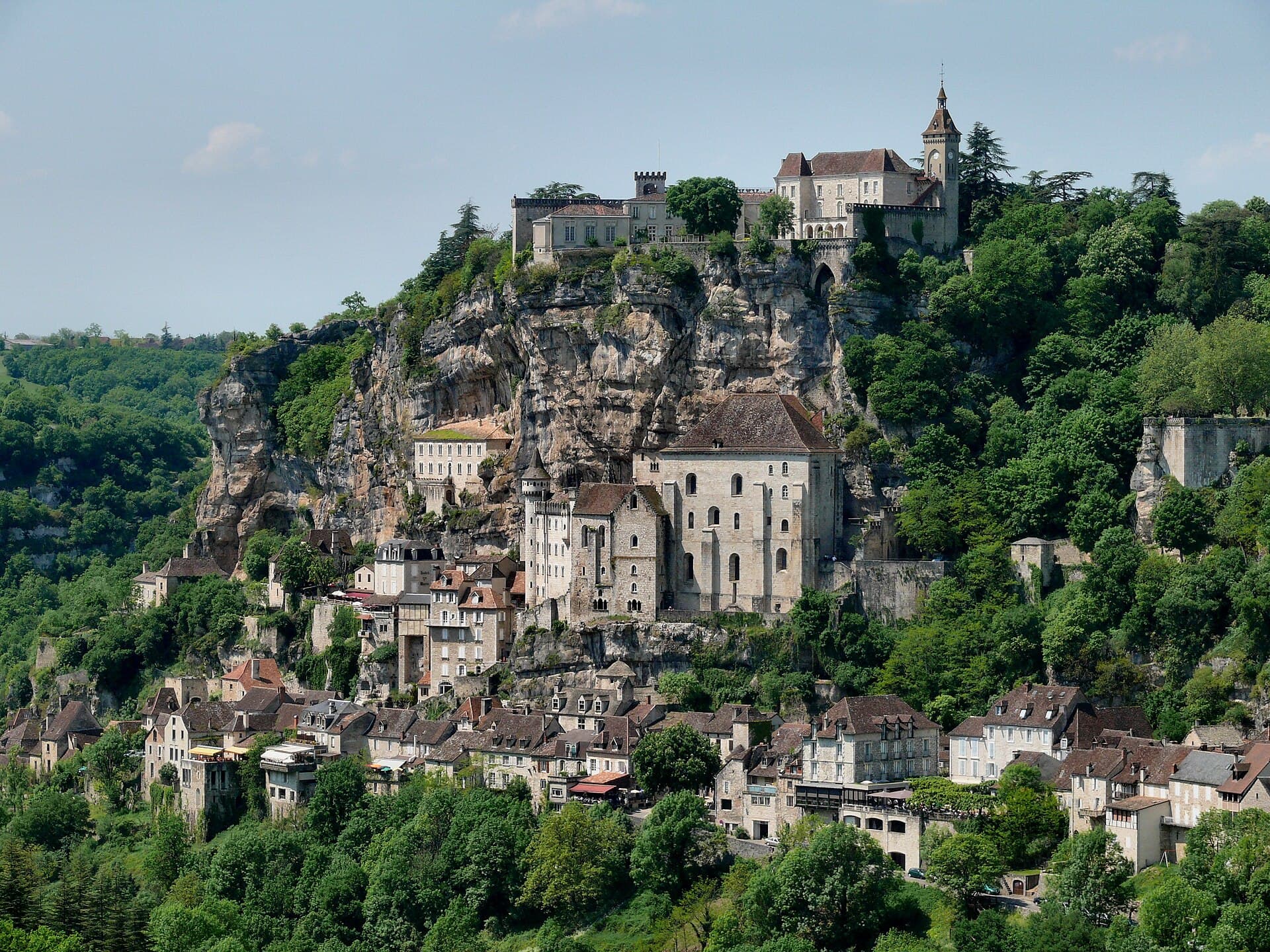
Dynamosquito from France / CC BY-SA 2.0, via Wikimedia CommonsRocamadour
“A sacred village suspended between heaven and earth.”
Rocamadour, as no one tells it.
Not the postcards. The stories even locals don't know — whispered in your ear, right where they happened.
High above the chapel, a legendary sword is embedded in the rock, said to belong to a famous knight. But how did it get there, and what became of it?
The clergy who serve Rocamadour's sanctuary have a secret shortcut, allowing them to arrive at services with surprising speed.
Discover every secret of Rocamadour
Every address, every reveal in full — in your ear, right where it happened.
You pick your stops. You walk. The voice reveals what the others miss.
How long do you have in Rocamadour?
No tours available yet. Check back soon — we're preparing them.
The story of Rocamadour
Rocamadour, a village in southwestern France, appears to defy gravity, its buildings clinging to a sheer limestone cliff 120 meters above the Alzou Valley. This dramatic setting, coupled with centuries of religious significance, has made it a UNESCO World Heritage site and a major pilgrimage destination. The village is structured on three distinct levels, reflecting medieval society: the castle for nobility at the top, the religious sanctuaries in the middle, and the lower town for lay workers and merchants along the river.
Travelers are drawn to Rocamadour not only by its unique architecture but also by the spiritual atmosphere that permeates its ancient stones. The site has attracted pilgrims, including kings and queens, for nearly a millennium, seeking solace and miracles. Today, it remains a significant stop on the Way of Saint James pilgrimage route. Rocamadour offers a blend of history, legend, and natural beauty, inviting exploration of its sanctuaries, medieval streets, and expansive viewpoints.
From Prehistory to Pilgrimage
The area around Rocamadour has been inhabited for thousands of years, with prehistoric drawings found in the Grotte des Merveilles. The site's religious significance began to emerge in the 9th century with the worship of the Blessed Virgin Mary. However, Rocamadour's standing as a pilgrimage site truly soared in 1166 with the discovery of an incorrupt body, believed by some to be that of Saint Amadour, a hermit who lived in the caves, or possibly the disciple Zaccheus.
This discovery propelled Rocamadour to become one of medieval Christendom's four most important pilgrimage sites, alongside Jerusalem, Compostela, and Rome. The 12th-century Livre des Miracles, written by a monk from the sanctuary, documented 126 miracles attributed to the Black Madonna, further solidifying Rocamadour's reputation. Kings and queens, including Henry II of England and Saint Louis IX of France, were among the thousands of pilgrims who made the arduous journey.
Construction of the religious buildings, financed by pilgrim donations, began in 1152 under Abbot Géraud d'Escorailles and was largely completed by the end of the 12th century. The Sanctuary, comprising eight chapels, was built around a central courtyard, with the Chapelle Notre-Dame and its Black Madonna statue becoming a central focus. The Black Madonna, carved from walnut wood in the 12th century, acquired its dark color over time due to age and exposure to candle smoke.
Decline and Revival
The 15th century saw a decline in pilgrimages due to events like the Black Plague and famine. In 1562, during the Wars of Religion, Protestants pillaged and burned parts of the Sanctuary, destroying the body of Saint Amadour, though the Black Madonna statue remained unharmed. The site was again looted during the French Revolution. Reconstruction efforts began in the 19th century, led by Abbot Chevalt, an architect and pupil of Eugène Viollet-le-Duc. Today, Rocamadour continues to attract over a million visitors annually, maintaining its status as a significant spiritual and tourist destination.
Rocamadour's unique vertical layout means exploration often involves ascending or descending its levels. The lower town features Rue Roland le Preux, a pedestrian-only main street with shops selling local specialties like Rocamadour goat cheese and walnut cakes. From here, the Grand Escalier, a monumental staircase of 216 steps, leads to the sanctuary complex. Traditionally, pilgrims climbed these steps on their knees.
The sanctuary level houses seven chapels, the Saint-Sauveur Basilica, and the crypt of Saint-Amadour. The Chapelle Notre-Dame is central, containing the revered 12th-century Black Madonna statue. Above the Chapel of Notre-Dame, a sword, believed to be Durandal, Roland's legendary blade, was once embedded in the cliff face. The twelfth-century frescos in St. Michael's Chapel are also notable. At the very top, the Château de Rocamadour, built to defend the sanctuary, offers sweeping views of the Alzou Valley from its ramparts.
Beyond the main village, nearby attractions include the Gouffre de Padirac, a spectacular underground cave with a river, and animal parks such as La Forêt des Singes (Monkey Forest) and Rocher des Aigles (bird of prey park).
The best times to visit Rocamadour are late spring (May-June) or early autumn (September-October). During these months, the weather is mild, crowds are smaller, and parking is less challenging. Spring offers blooming wildflowers, while autumn brings clear skies and warm colors to the surrounding landscapes. Summer sees the largest crowds, especially during festivals, so visiting early in the morning or late in the afternoon is recommended to avoid peak times and for better photography lighting.
Rocamadour is accessible by car, with several paid parking lots available. P1 (L'Hospitalet), P3 (Les Garennes), and P4 (Le Garroustié) are located on the plateau, while P2 (Le Château) is just above the sanctuary, and P5 (La Vallée) is at the bottom of the Alzou canyon. Access to the village is restricted for motorized vehicles from 11 am to 7 pm in summer. A car is generally essential for exploring the wider Lot region.
To navigate the village's three levels, visitors can climb the Grand Escalier, use one of two lifts, or take a small train that runs between the Vallée car park and the village from early April to late September. The site is partially accessible for wheelchairs and pushchairs, with lifts available to bypass the stairs to the sanctuary, though some medieval structures remain challenging.
Plan for approximately three to four hours to explore the historic heart of Rocamadour, including the medieval city and sanctuaries. If including nearby sites like the Gouffre de Padirac or animal parks, a full day or even two days are recommended.
- What is Rocamadour famous for?
- Rocamadour is celebrated for its dramatic cliffside setting, its centuries-old pilgrimage site dedicated to the Black Madonna, and its unique medieval architecture.
- How do you get to the sanctuaries in Rocamadour?
- Travelers can reach the sanctuaries by ascending the 216 steps of the Grand Escalier, or by utilizing one of the two available lifts that connect the different levels of the village.
- Is Rocamadour suitable for people with reduced mobility?
- Rocamadour offers partial accessibility. Lifts connect the three main levels (commercial street, religious site, and château), and the religious sanctuary has wide, smooth paths. However, some medieval structures and the path to the castle are not wheelchair-friendly.
- How much time is needed to visit Rocamadour?
- To visit the historic heart of Rocamadour, including the medieval city and sanctuaries, allow about three to four hours. A full day or two is ideal if you plan to include nearby attractions.
- Can you stay overnight in Rocamadour?
- Yes, there are hotels, restaurants, and shops on the lower level's main street. Options within the medieval cluster are limited, so nearby towns can offer quieter lodging.
- What local specialties should I try in Rocamadour?
- Be sure to try Rocamadour cheese, a goat's milk cheese with AOC status, and walnut cake, a specialty of the Quercy region. Regional red Amadour wine is also available.